41,95 €
41,95 €
inkl. MwSt.
Erscheint vor. 22.01.26

21 °P sammeln
41,95 €
Als Download kaufen
41,95 €
inkl. MwSt.
Erscheint vor. 22.01.26
21 °P sammeln
Jetzt verschenken
Alle Infos zum eBook verschenken
41,95 €
inkl. MwSt.
Erscheint vor. 22.01.26
Alle Infos zum eBook verschenken
21 °P sammeln

Andere Kunden interessierten sich auch für
") Urban Phantasmagorias (eBook, PDF)38,95 €
Urban Phantasmagorias (eBook, PDF)38,95 €") Modern Architecture in the Balkans (eBook, ePUB)41,95 €
Modern Architecture in the Balkans (eBook, ePUB)41,95 €") New Narratives of Russian and East European Art (eBook, PDF)32,95 €
New Narratives of Russian and East European Art (eBook, PDF)32,95 €") Political Postmodernisms (eBook, PDF)35,95 €
Political Postmodernisms (eBook, PDF)35,95 €") The Socialist Life of Modern Architecture (eBook, PDF)43,95 €
The Socialist Life of Modern Architecture (eBook, PDF)43,95 €") Urban Phantasmagorias (eBook, ePUB)38,95 €
Urban Phantasmagorias (eBook, ePUB)38,95 €") Architecture or Revolution (eBook, PDF)37,95 €
Architecture or Revolution (eBook, PDF)37,95 €







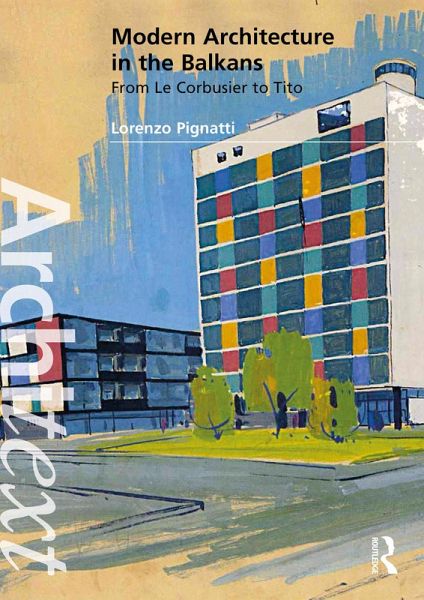
This book is an attempt to comprehend the reasons for modernity in the Balkans, beginning with the famous Journey to the East undertaken by Charles-Édouard Jeanneret in 1911; a journey during which the future Le Corbusier was the first to appreciate the originality of the region's architecture. However, the modernity that developed after the Second World War would not have existed without the figure of Josip Broz Tito. With political and cultural acumen, this partisan and charismatic leader of Yugoslavia promoted a process of "socialist modernisation" that looked both east and west, while holding fast to a faith in a political ideology interpreted with freedom and originality. Le Corbusier and Tito are therefore the two central figures of this book. While there is no direct relationship between them, this book presents a series of intersecting relations, beginning with the interpretation of Yugoslavia's cities and architecture, to trace a path that gives this region an unquestionably central position in the international architectural panorama of the twentieth century.
Dieser Download kann aus rechtlichen Gründen nur mit Rechnungsadresse in A, B, BG, CY, CZ, D, DK, EW, E, FIN, F, GR, HR, H, IRL, I, LT, L, LR, M, NL, PL, P, R, S, SLO, SK ausgeliefert werden.