Sie sind bereits eingeloggt. Klicken Sie auf 2. tolino select Abo, um fortzufahren.
Bitte loggen Sie sich zunächst in Ihr Kundenkonto ein oder registrieren Sie sich bei bücher.de, um das eBook-Abo tolino select nutzen zu können.
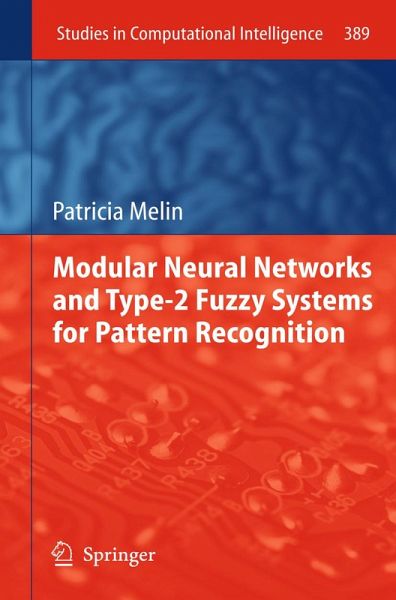
This book describes hybrid intelligent systems using type-2 fuzzy logic and modular neural networks for pattern recognition applications. Hybrid intelligent systems combine several intelligent computing paradigms, including fuzzy logic, neural networks, and bio-inspired optimization algorithms, which can be used to produce powerful pattern recognition systems. Type-2 fuzzy logic is an extension of traditional type-1 fuzzy logic that enables managing higher levels of uncertainty in complex real world problems, which are of particular importance in the area of pattern recognition. The book is…mehr
This book describes hybrid intelligent systems using type-2 fuzzy logic and modular neural networks for pattern recognition applications. Hybrid intelligent systems combine several intelligent computing paradigms, including fuzzy logic, neural networks, and bio-inspired optimization algorithms, which can be used to produce powerful pattern recognition systems. Type-2 fuzzy logic is an extension of traditional type-1 fuzzy logic that enables managing higher levels of uncertainty in complex real world problems, which are of particular importance in the area of pattern recognition. The book is organized in three main parts, each containing a group of chapters built around a similar subject. The first part consists of chapters with the main theme of theory and design algorithms, which are basically chapters that propose new models and concepts, which are the basis for achieving intelligent pattern recognition. The second part contains chapters with the main theme of using type-2 fuzzy models and modular neural networks with the aim of designing intelligent systems for complex pattern recognition problems, including iris, ear, face and voice recognition. The third part contains chapters with the theme of evolutionary optimization of type-2 fuzzy systems and modular neural networks in the area of intelligent pattern recognition, which includes the application of genetic algorithms for obtaining optimal type-2 fuzzy integration systems and ideal neural network architectures for solving problems in this area.
Dieser Download kann aus rechtlichen Gründen nur mit Rechnungsadresse in A, B, BG, CY, CZ, D, DK, EW, E, FIN, F, GR, HR, H, IRL, I, LT, L, LR, M, NL, PL, P, R, S, SLO, SK ausgeliefert werden.
Die Herstellerinformationen sind derzeit nicht verfügbar.
Autorenporträt
Patricia Melin holds the Doctor in Science degree (Doctor Habilitatus D.Sc.) in Computer Science from the Polish Academy of Sciences. She is a Professor of Computer Science in the Graduate Division, Tijuana Institute of Technology, Tijuana, Mexico, since 1998. In addition, she is serving as Director of Graduate Studies in Computer Science and head of the research group on Hybrid Neural Intelligent Systems (2000-present). She is past President of NAFIPS (North American Fuzzy Information Processing Society) 2019-2020. Prof. Melin is the founding Chair of the Mexican Chapter of the IEEE Computational Intelligence Society. She is member of the IEEE Neural Network Technical Committee (2007 to present), the IEEE Fuzzy System Technical Committee (2014 to present) and is Chair of the Task Force on Hybrid Intelligent Systems (2007 to present) and she is currently Associate Editor of the Journal of Information Sciences and IEEE Transactions on Fuzzy Systems. She is member of NAFIPS, IFSA, and IEEE. She belongs to the Mexican Research System with level III. Her research interests are in Modular Neural Networks, Type-2 Fuzzy Logic, Pattern Recognition, Fuzzy Control, Neuro-Fuzzy and Genetic-Fuzzy hybrid approaches. She has published over 300 journal papers, 20 authored books, 50 edited books, and more than 300 papers in conference proceedings, for a total of more than 800 publications with h-index of 86 in Google Scholar. She is Editor-in-Chief of the Advances in Fuzzy Systems journal (Wiley). She has served as Guest Editor of several Special Issues in the past, in journals like: Applied Soft Computing, Intelligent Systems, Information Sciences, Non-Linear Studies, JAMRIS, Fuzzy Sets and Systems. She has been recognized as Highly Cited Researcher in 2017 and 2018 by Clarivate Analytics because of having multiple highly cited papers in Web of Science. Martha Ram¿rez holds the B.S. in Computer Science, M.S. in Computer Science, and the Ph.D. in Computer Science from Tijuana Institute of Technology. Currently she works at Tecnologico Nacional de Mexico in Mexico City. Her current research interests include hybrid intelligent systems, neural networks and fuzzy systems. She has published more 10 papers in time series prediction, classification and clustering using supervised and unsupervised neural network models, in addition to type-1 and type-2 fuzzy logic for aggregation of responses in ensembles and modular neural networks. Oscar Castillo holds the Doctor in Science degree (Doctor Habilitatus) in Computer Science from the Polish Academy of Sciences (with the Dissertation "Soft Computing and Fractal Theory for Intelligent and Manufacturing"). He is a Professor of Computer Science in the Graduate Division, Tijuana Institute of Technology, Tijuana, Mexico. In addition, he is serving as Research Director of Computer Science and head of the research group on Hybrid Fuzzy Intelligent Systems. Currently, he is President of HAFSA (Hispanic American Fuzzy Systems Association) and Past President of IFSA (International Fuzzy Systems Association). Prof. Castillo is also Chair of the Mexican Chapter of the Computational Intelligence Society (IEEE). He is also a member of NAFIPS, IFSA and IEEE. He belongs to the Mexican Research System (SNI Level 3). His research interests are in Type-2 Fuzzy Logic, Fuzzy Control, Neuro-Fuzzy and Genetic-Fuzzy hybrid approaches. He has published over 300 journal papers, 20 authored books, 100 edited books, 300 papers in conference proceedings, and more than 300 chapters in edited books, in total more than 1180 publications (according to Scopus) with h index of 97 and more than 31000 citations according to Google Scholar. He has been Guest Editor of several successful Special Issues in the past, like in the following journals: Applied Soft Computing, Intelligent Systems, Information Sciences, Soft Computing, Non-Linear Studies, Fuzzy Sets and Systems, JAMRIS and Engineering Letters. He is currently Associate
Inhaltsangabe
Part I: Basic Concepts and Theory
Part II Modular Neural Networks in Pattern Recognition
Part III Optimization of Modular Neural Networks for Pattern Recognition
Part I: Basic Concepts and Theory.- Part II Modular Neural Networks in Pattern Recognition.- Part III Optimization of Modular Neural Networks for Pattern Recognition.
Part II Modular Neural Networks in Pattern Recognition
Part III Optimization of Modular Neural Networks for Pattern Recognition
Part I: Basic Concepts and Theory.- Part II Modular Neural Networks in Pattern Recognition.- Part III Optimization of Modular Neural Networks for Pattern Recognition.
Es gelten unsere Allgemeinen Geschäftsbedingungen: www.buecher.de/agb
Impressum
www.buecher.de ist ein Internetauftritt der buecher.de internetstores GmbH
Geschäftsführung: Monica Sawhney | Roland Kölbl | Günter Hilger
Sitz der Gesellschaft: Batheyer Straße 115 - 117, 58099 Hagen
Postanschrift: Bürgermeister-Wegele-Str. 12, 86167 Augsburg
Amtsgericht Hagen HRB 13257
Steuernummer: 321/5800/1497
USt-IdNr: DE450055826