Sie sind bereits eingeloggt. Klicken Sie auf 2. tolino select Abo, um fortzufahren.
Bitte loggen Sie sich zunächst in Ihr Kundenkonto ein oder registrieren Sie sich bei bücher.de, um das eBook-Abo tolino select nutzen zu können.
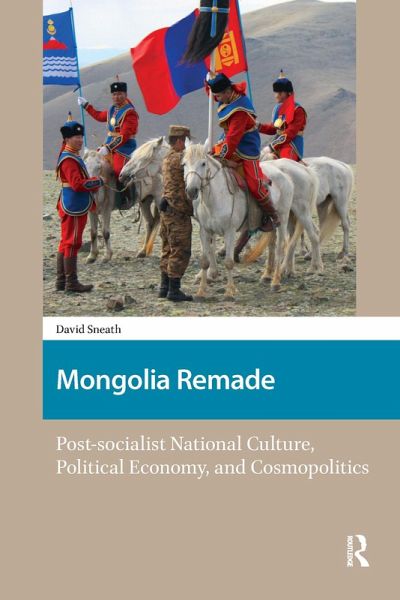
This book explores the historical and contemporary processes that have made and remade Mongolia as it is today: the construction of ethnic and national cultures, the transformations of political economy and a 'nomadic' pastoralism, and the revitalization of a religious and cosmological heritage that has led to new forms of post-socialist politics. Widely published as an expert in the field, David Sneath offers a fresh perspective into a region often seen as mysterious to the West.
This book explores the historical and contemporary processes that have made and remade Mongolia as it is today: the construction of ethnic and national cultures, the transformations of political economy and a 'nomadic' pastoralism, and the revitalization of a religious and cosmological heritage that has led to new forms of post-socialist politics. Widely published as an expert in the field, David Sneath offers a fresh perspective into a region often seen as mysterious to the West.
Dieser Download kann aus rechtlichen Gründen nur mit Rechnungsadresse in A, B, BG, CY, CZ, D, DK, EW, E, FIN, F, GR, HR, H, IRL, I, LT, L, LR, M, NL, PL, P, R, S, SLO, SK ausgeliefert werden.
Die Herstellerinformationen sind derzeit nicht verfügbar.
Autorenporträt
David Sneath is the Director of the Mongolia and Inner Asia Studies Unit and Reader at the Department of Social Anthropology, University of Cambridge. He has over 50 publications including three monographs and three multi-volume edited works. Professor Caroline Humphrey is an anthropologist who has worked across Asia and countries of the former Soviet Union. She is currently based at the Mongolia and Inner Asia Studies Unit at Cambridge, which she co-founded, and she is a Director of Research at the Department of Social Anthropology. She has been a Fellow of King's since 1978. Franck Billé is a cultural anthropologist based at the University of California, Berkeley, where he is program director for the Tang Center for Silk Road Studies. He is the author of Sinophobia (Hawaii, 2015), coauthor of On the Edge (Harvard, 2021), editor of Voluminous States (Duke, 2020), and coeditor of Yellow Perils (Hawaii, 2019) and Frontier Encounters (Open Book, 2012). He is currently finalizing his latest book, Somatic States: On Cartography, Geobodies, Bodily Integrity (Duke University Press). More information about his current research is available on his website: www.franckbille.com.
Inhaltsangabe
Chapter 1. Introduction Part I: The Making and Remaking of Mongolia Part II: Masters of the Steppe: Peoples of Mongolia (First published in Fitzhugh, Rossabi & Honeychurch (eds.) 2009. Genghis Khan and the Mongol Empire, Washington: Smithsonian Arctic Studies Center). Part III: The Ending of the Old Order Part IV: Making Mongolia Modern Chapter 2. Mapping and the Headless State: Rethinking national populist concepts of Mongolia (first published in Sabloff, P. (ed.) 2011. Mapping Mongolia: Situating Mongolia in the World from Geologic Time to the Present, Philadelphia: University of Pennsylvania Press). Chapter 3. The Rural and the Urban in Pastoral Mongolia (first published in in Bruun, O. and Narangoa, L., (eds.) 2005. Mongolians from Country to City: Floating Boundaries, Pastoralism and City Life in the Mongol Lands, Copenhagen: NIAS Press). Chapter 4. Proprietary Regimes and Sociotechnical Systems: Rights over Land in Mongolia's 'age of the market' (first published in Verdery, K., and Humphrey C., (eds.) 2004. Property in Question: Value Transformation in the Global Economy, Oxford: Berg). Chapter 5 Political Mobilization and the Construction of Collective Identity in Mongolia (first published in Central Asia Survey 29(3), 2010). Chapter 6 The Age of the Market and the Regime of Debt: The role of credit in the transformation of pastoral Mongolia (first published in Social Anthropology/ Anthropologie Sociale 20(4), 2012). Chapter 7 Reading the Signs by Lenin's Light: Development, divination and metonymic fields in Mongolia (first published in Ethnos 74(1), 2009). Chapter 8 Ritual Idioms and Spatial Orders: Comparing the rites for Mongolian and Tibetan 'local deities' (first published in in Bulag, U., and Diemberger, H., (eds.) 2007. The Mongol-Tibet Interface: Opening new research terrains in Inner Asia, Leiden: Brill). Chapter 9 Nationalizing Civilizational Resources: Sacred mountains and cosmopolitical ritual in Mongolia (first published in Asian Ethnicity 15(4), 2014). Chapter 10 Mongolian Capitalism.
Chapter 1. Introduction Part I: The Making and Remaking of Mongolia Part II: Masters of the Steppe: Peoples of Mongolia (First published in Fitzhugh, Rossabi & Honeychurch (eds.) 2009. Genghis Khan and the Mongol Empire, Washington: Smithsonian Arctic Studies Center). Part III: The Ending of the Old Order Part IV: Making Mongolia Modern Chapter 2. Mapping and the Headless State: Rethinking national populist concepts of Mongolia (first published in Sabloff, P. (ed.) 2011. Mapping Mongolia: Situating Mongolia in the World from Geologic Time to the Present, Philadelphia: University of Pennsylvania Press). Chapter 3. The Rural and the Urban in Pastoral Mongolia (first published in in Bruun, O. and Narangoa, L., (eds.) 2005. Mongolians from Country to City: Floating Boundaries, Pastoralism and City Life in the Mongol Lands, Copenhagen: NIAS Press). Chapter 4. Proprietary Regimes and Sociotechnical Systems: Rights over Land in Mongolia's 'age of the market' (first published in Verdery, K., and Humphrey C., (eds.) 2004. Property in Question: Value Transformation in the Global Economy, Oxford: Berg). Chapter 5 Political Mobilization and the Construction of Collective Identity in Mongolia (first published in Central Asia Survey 29(3), 2010). Chapter 6 The Age of the Market and the Regime of Debt: The role of credit in the transformation of pastoral Mongolia (first published in Social Anthropology/ Anthropologie Sociale 20(4), 2012). Chapter 7 Reading the Signs by Lenin's Light: Development, divination and metonymic fields in Mongolia (first published in Ethnos 74(1), 2009). Chapter 8 Ritual Idioms and Spatial Orders: Comparing the rites for Mongolian and Tibetan 'local deities' (first published in in Bulag, U., and Diemberger, H., (eds.) 2007. The Mongol-Tibet Interface: Opening new research terrains in Inner Asia, Leiden: Brill). Chapter 9 Nationalizing Civilizational Resources: Sacred mountains and cosmopolitical ritual in Mongolia (first published in Asian Ethnicity 15(4), 2014). Chapter 10 Mongolian Capitalism.
Es gelten unsere Allgemeinen Geschäftsbedingungen: www.buecher.de/agb
Impressum
www.buecher.de ist ein Internetauftritt der buecher.de internetstores GmbH
Geschäftsführung: Monica Sawhney | Roland Kölbl | Günter Hilger
Sitz der Gesellschaft: Batheyer Straße 115 - 117, 58099 Hagen
Postanschrift: Bürgermeister-Wegele-Str. 12, 86167 Augsburg
Amtsgericht Hagen HRB 13257
Steuernummer: 321/5800/1497
USt-IdNr: DE450055826