46,95 €
inkl. MwSt.
Sofort per Download lieferbar
23 °P sammeln

Andere Kunden interessierten sich auch für
") Moral Obligations (eBook, ePUB)46,95 €
Moral Obligations (eBook, ePUB)46,95 €") Moral Reality and the Empirical Sciences (eBook, PDF)42,95 €
Moral Reality and the Empirical Sciences (eBook, PDF)42,95 €") The Concept of Morality (eBook, PDF)32,95 €
The Concept of Morality (eBook, PDF)32,95 €") Love, Reason and Morality (eBook, PDF)42,95 €
Love, Reason and Morality (eBook, PDF)42,95 €") The Nature and Practice of Trust (eBook, PDF)39,95 €
The Nature and Practice of Trust (eBook, PDF)39,95 €") Moral Teleology (eBook, PDF)0,00 €
Moral Teleology (eBook, PDF)0,00 €") What is this thing called Metaethics? (eBook, PDF)38,95 €
What is this thing called Metaethics? (eBook, PDF)38,95 €






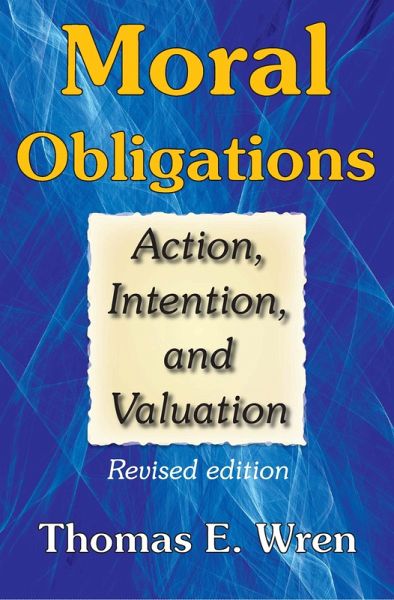
There are many ways of writing about the moral life; Moral Obligations follows the way of what philosophers call ""meta-ethics"": the analysis, not of particular moral problems, but of how the concepts used in formulating and solving them, concepts like ""right"" and ""obligatory,"" have significance and power over us. The meta-ethical part of this book is preceded by a discussion of action, in which Wren lays the foundations for the argument that moral obligation is a part of the formal structure of human agency.
Wren's argument is practical and social-psychological: it is to help all, starting with those who are already committed to some version of the ethic of individual dignity, to promote interagency fellowship and peace as a result of seeing a certain truth, namely, the truth that the urgency of their feelings of moral obligation derives from a unspoken intention to belong to a community of agents.
Moral Obligations begins with the philosophy of action, and then it reviews the historical debate about the nature of obligation and its social context. This is followed by a section about action in general: it establishes the standpoint of the agent and makes an inventory of several species of action. Later chapters summarize the foregoing themes, with emphasis on the unspoken side of intention, and develop them in conjunction with an analysis of the hypothetical imperative. The work closes with a discussion of the dilemma of membership in competing moral communities.
Wren's argument is practical and social-psychological: it is to help all, starting with those who are already committed to some version of the ethic of individual dignity, to promote interagency fellowship and peace as a result of seeing a certain truth, namely, the truth that the urgency of their feelings of moral obligation derives from a unspoken intention to belong to a community of agents.
Moral Obligations begins with the philosophy of action, and then it reviews the historical debate about the nature of obligation and its social context. This is followed by a section about action in general: it establishes the standpoint of the agent and makes an inventory of several species of action. Later chapters summarize the foregoing themes, with emphasis on the unspoken side of intention, and develop them in conjunction with an analysis of the hypothetical imperative. The work closes with a discussion of the dilemma of membership in competing moral communities.
Dieser Download kann aus rechtlichen Gründen nur mit Rechnungsadresse in A, B, BG, CY, CZ, D, DK, EW, E, FIN, F, GR, HR, H, IRL, I, LT, L, LR, M, NL, PL, P, R, S, SLO, SK ausgeliefert werden.