72,95 €
72,95 €
inkl. MwSt.
Sofort per Download lieferbar

36 °P sammeln
72,95 €
Als Download kaufen
72,95 €
inkl. MwSt.
Sofort per Download lieferbar
36 °P sammeln
Jetzt verschenken
Alle Infos zum eBook verschenken
72,95 €
inkl. MwSt.
Sofort per Download lieferbar
Alle Infos zum eBook verschenken
36 °P sammeln

Andere Kunden interessierten sich auch für
") Moscow and Havana 1917 to the Present (eBook, PDF)72,95 €
Moscow and Havana 1917 to the Present (eBook, PDF)72,95 €") Culture and the Cuban State (eBook, ePUB)87,95 €
Culture and the Cuban State (eBook, ePUB)87,95 €") Dark Beyond Darkness (eBook, ePUB)29,95 €
Dark Beyond Darkness (eBook, ePUB)29,95 €") North of Havana (eBook, ePUB)14,95 €
North of Havana (eBook, ePUB)14,95 €") Cuba's Caribbean Marxism: Essays on Ideology, Government, Society, and Economy in the Post Fidel Castro Era (eBook, ePUB)9,99 €
Cuba's Caribbean Marxism: Essays on Ideology, Government, Society, and Economy in the Post Fidel Castro Era (eBook, ePUB)9,99 €") The Declarations of Havana (eBook, ePUB)9,95 €
The Declarations of Havana (eBook, ePUB)9,95 €") Fidel Castro and Africa's Liberation Struggle (eBook, ePUB)72,95 €
Fidel Castro and Africa's Liberation Struggle (eBook, ePUB)72,95 €





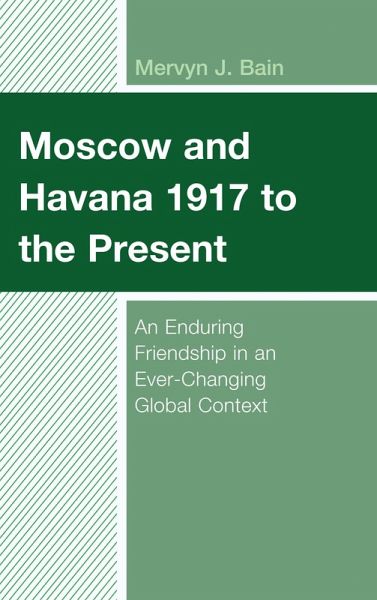
This book addresses the relationship between Moscow and Havana in the period from the Russian Revolution through the present, i.e. from November 1917 onwards. Its release is particularly timely, due to both November 2017 being the 100th anniversary of the Russian Revolution, as well as the historic election in Cuba in April 2018, when Miguel Díaz-Canel replaced Raúl Castro as the President of Cuba. Traditionally, Moscow's interest in Cuba has been thought to have been ignited by the Cuban Revolution in January 1959 and ended by the implosion of the Soviet Union in December 1991. This book examines why a bilateral relationship has existed throughout the last century, specifically in three distinct periods: (1) from the time of the Russian Revolution until the Cuban Revolution, (2) from January 1959 until December 1991 and (3) the post-Soviet period from 1992 until the present. It also analyzes the questions of what within the relationship drew the two countries together in these three disparate periods when in only one, January 1959 to December 1991, did the relationship exist between two socialist governments. It offers a number of different conclusions, including that although each period of the relationship has its own peculiarities and nuances, a number of commonalities exist between the three eras. Consequently, it is posited that due to these commonalities, the contemporary bilateral relationship remains important for both countries, and is likely to continue in its present form for the short to medium term, despite the historic change which occurred in Cuba in April 2018.