115,99 €
115,99 €
inkl. MwSt.
Sofort per Download lieferbar

0 °P sammeln
115,99 €
Als Download kaufen
115,99 €
inkl. MwSt.
Sofort per Download lieferbar
0 °P sammeln
Jetzt verschenken
Alle Infos zum eBook verschenken
115,99 €
inkl. MwSt.
Sofort per Download lieferbar
Alle Infos zum eBook verschenken
0 °P sammeln

Andere Kunden interessierten sich auch für
") Multi-field Modeling of Soft Active Materials (eBook, ePUB)115,99 €
Multi-field Modeling of Soft Active Materials (eBook, ePUB)115,99 €") Polymer Nanocomposite Materials (eBook, PDF)133,99 €
Polymer Nanocomposite Materials (eBook, PDF)133,99 €") Thermal Analysis of Polymeric Materials (eBook, PDF)178,99 €
Thermal Analysis of Polymeric Materials (eBook, PDF)178,99 €") Biological Soft Matter (eBook, PDF)133,99 €
Biological Soft Matter (eBook, PDF)133,99 €") Hydrogen Bonding in Polymeric Materials (eBook, PDF)144,99 €
Hydrogen Bonding in Polymeric Materials (eBook, PDF)144,99 €") Spectroscopic Techniques for Polymer Characterization (eBook, PDF)153,99 €
Spectroscopic Techniques for Polymer Characterization (eBook, PDF)153,99 €") Polymer Electrolytes (eBook, PDF)144,99 €
Polymer Electrolytes (eBook, PDF)144,99 €



An expert and up-to-date discussion of the properties and design of soft active material modeling
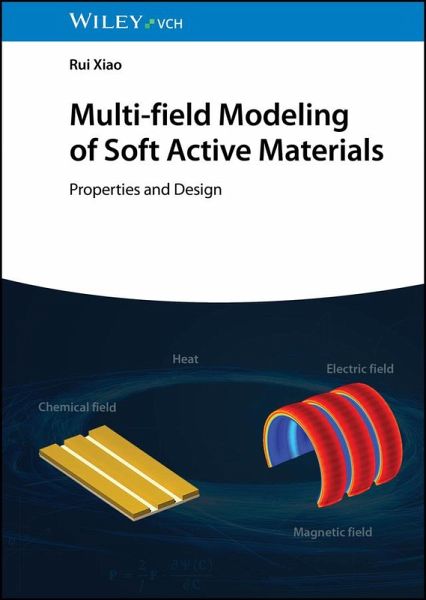
In Multi-Field Modeling of Soft Active Materials: Properties and Design, Professor Rui Xiao delivers an up-to-date exploration of the multi-field modeling of soft active materials, including shape-memory polymers, liquid crystal elastomers, dielectric elastomers, magnetic elastomers, and hydrogels. The book provides a deep understanding of the underlying mechanisms of stimulus-response behaviors in polymers.
The author provides guidance on future development of the theoretical approaches for active materials, as well as efficient tools to design functional soft machines composed of active materials.
Readers will also find:
Primarily aimed at graduate students and researchers in solid mechanics, materials science, and polymer physics, Multi-Field Modeling of Soft Active Materials is particularly relevant for those specializing in the soft materials and responsive polymers.
In Multi-Field Modeling of Soft Active Materials: Properties and Design, Professor Rui Xiao delivers an up-to-date exploration of the multi-field modeling of soft active materials, including shape-memory polymers, liquid crystal elastomers, dielectric elastomers, magnetic elastomers, and hydrogels. The book provides a deep understanding of the underlying mechanisms of stimulus-response behaviors in polymers.
The author provides guidance on future development of the theoretical approaches for active materials, as well as efficient tools to design functional soft machines composed of active materials.
Readers will also find:
- A thorough introduction to the basics of continuum mechanics
- Comprehensive explorations of hyperelastic and viscoelastic models
- Thermodynamically consistent frameworks for multi-field coupling models
- Complete implementation procedures for finite element analysis
Primarily aimed at graduate students and researchers in solid mechanics, materials science, and polymer physics, Multi-Field Modeling of Soft Active Materials is particularly relevant for those specializing in the soft materials and responsive polymers.
Dieser Download kann aus rechtlichen Gründen nur mit Rechnungsadresse in D ausgeliefert werden.