Abdelkhalak El Hami, Mohamed Eid
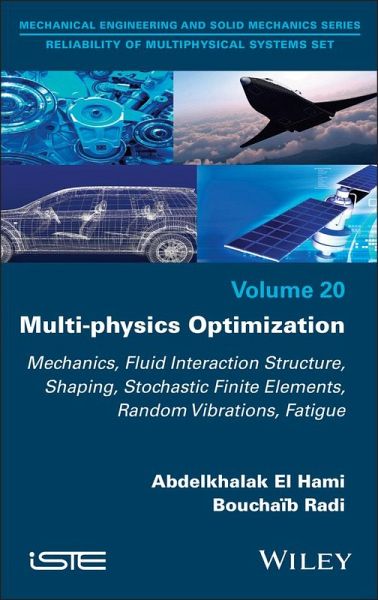
Multi-physics Optimization (eBook, ePUB)
Mechanics, Fluid Interaction Structure, Shaping, Stochastic Finite Elements, Random Vibrations, Fatigue
126,99 €
126,99 €
inkl. MwSt.
Sofort per Download lieferbar
0 °P sammeln
126,99 €
Als Download kaufen
126,99 €
inkl. MwSt.
Sofort per Download lieferbar
0 °P sammeln
Jetzt verschenken
Alle Infos zum eBook verschenken
126,99 €
inkl. MwSt.
Sofort per Download lieferbar
Alle Infos zum eBook verschenken
0 °P sammeln
Abdelkhalak El Hami, Mohamed Eid
Multi-physics Optimization (eBook, ePUB)
Mechanics, Fluid Interaction Structure, Shaping, Stochastic Finite Elements, Random Vibrations, Fatigue
- Format: ePub
- Merkliste
- Auf die Merkliste
- Bewerten Bewerten
- Teilen
- Produkt teilen
- Produkterinnerung
- Produkterinnerung

Bitte loggen Sie sich zunächst in Ihr Kundenkonto ein oder registrieren Sie sich bei
bücher.de, um das eBook-Abo tolino select nutzen zu können.
Hier können Sie sich einloggen
Sie sind bereits eingeloggt. Klicken Sie auf 2. tolino select Abo, um fortzufahren.

Bitte loggen Sie sich zunächst in Ihr Kundenkonto ein oder registrieren Sie sich bei bücher.de, um das eBook-Abo tolino select nutzen zu können.
This book illustrates, in detail, the state of the art in the multidisciplinary science of multi-physics optimization. In a context of the perpetual search for improved industrial competitiveness, the evolution of product design and optimization methods and tools appears to be a strategic necessity in view of the imperative to reduce costs. In the aeronautics sector, resources are mainly focused on forecasting and controlling the costs incurred by failures that occur at commissioning, during the warranty period, and during aircraft operation. However, in the future, new contracts for the sale…mehr
- Geräte: eReader
- mit Kopierschutz
- eBook Hilfe
- Größe: 22.77MB
Andere Kunden interessierten sich auch für
Abdelkhalak El HamiMulti-physics Optimization (eBook, PDF)126,99 €
Abdelkhalak El HamiReliability-based Modeling of System Performance (eBook, ePUB)142,99 €
Maurice LeroyRheology, Physical and Mechanical Behavior of Materials 1 (eBook, ePUB)114,99 €
Daniel RoyerElastic Waves in Solids, Volume 1 (eBook, ePUB)139,99 €
Yuri S. MuzychkaThermal Spreading and Contact Resistance (eBook, ePUB)107,99 €
Cooperative Control of Multi-Agent Systems (eBook, ePUB)105,99 €
Dominique Paul ChevallierMulti-Body Kinematics and Dynamics with Lie Groups (eBook, ePUB)99,95 €-
-
-
This book illustrates, in detail, the state of the art in the multidisciplinary science of multi-physics optimization. In a context of the perpetual search for improved industrial competitiveness, the evolution of product design and optimization methods and tools appears to be a strategic necessity in view of the imperative to reduce costs. In the aeronautics sector, resources are mainly focused on forecasting and controlling the costs incurred by failures that occur at commissioning, during the warranty period, and during aircraft operation. However, in the future, new contracts for the sale of aeronautical equipment will become increasingly oriented toward sales by the hour of operation.
The aim of this book is to propose new methods for reliability-based optimization, enabling an analysis of a system's life cycle. The V-cycle allows development phases to be viewed in terms of development time and levels of integration complexity.
Multi-physics Optimization is dedicated to optimization methods for multi-physics problems. Each chapter clearly sets out the techniques used and developed and accompanies them with illustrative examples. The book is aimed at students but is also a valuable resource for practicing engineers and research lecturers.
The aim of this book is to propose new methods for reliability-based optimization, enabling an analysis of a system's life cycle. The V-cycle allows development phases to be viewed in terms of development time and levels of integration complexity.
Multi-physics Optimization is dedicated to optimization methods for multi-physics problems. Each chapter clearly sets out the techniques used and developed and accompanies them with illustrative examples. The book is aimed at students but is also a valuable resource for practicing engineers and research lecturers.
Dieser Download kann aus rechtlichen Gründen nur mit Rechnungsadresse in D ausgeliefert werden.
Produktdetails
- Produktdetails
- Verlag: John Wiley & Sons
- Seitenzahl: 364
- Erscheinungstermin: 19. August 2025
- Englisch
- ISBN-13: 9781394401710
- Artikelnr.: 75261447
- Verlag: John Wiley & Sons
- Seitenzahl: 364
- Erscheinungstermin: 19. August 2025
- Englisch
- ISBN-13: 9781394401710
- Artikelnr.: 75261447
- Herstellerkennzeichnung Die Herstellerinformationen sind derzeit nicht verfügbar.
Abdelkhalak El Hami is University Professor at INSA Rouen Normandie, France, and is the author (or co-author) of over sixty books. He is responsible for several European educational and/or research projects as a specialist in the fields of optimization, reliability and AI of multiphysics systems.
Mohamed Eid is University Professor at the Settat Faculty of Science and Technology, Hassan Premier University, Morocco. He is the author of several books, specializing in numerical optimization methods and system reliability.
Preface ix
Chapter 1 Introduction to Optimization in Mechanics 1
1.1 Introduction 1
1.2 Problems of general dynamics 2
1.2.1 Finite element methods 4
1.2.2 Modal assumption method 5
1.2.3 Direct integration 7
1.3 Structural optimization 9
1.3.1 Design optimization 9
1.3.2 Shape optimization 10
1.3.3 Topological optimization 10
1.3.4 Definitions and formulation of an optimization problem 13
1.4 Structures with uncertain parameters 15
1.4.1 Monte Carlo simulation 16
1.4.2 Analytical method 16
1.4.3 Stochastic finite element method 16
1.4.4 Fuzzy logic method 17
1.4.5 Bibliography study of reliability methods 18
1.4.6 Bibliography study of reliability optimization methods 24
1.5 Conclusion 26
Chapter 2 Modal Synthesis and Reliability Optimization Methods 27
2.1 Introduction 27
2.2 State of the art of modal synthesis methods 27
2.2.1 Introduction 27
2.2.2 Model reduction method for elastodynamic systems 28
2.2.3 Fixed-interface method (Craig Bampton) 29
2.2.4 Reduction of junction degrees of freedom 31
2.3 Coupling of modal synthesis and RBDO methods 33
2.4 Numerical application 34
2.4.1 L-Plate embedded at the ends 34
2.4.2 Analysis of results 37
2.4.3 A vibrating connecting rod 38
2.4.4 Application: transient model reduction 42
2.5 Conclusion 44
Chapter 3 Modal Synthesis Methods and Stochastic Finite Element Methods 45
3.1 Introduction 45
3.2 Linear dynamical problems 46
3.2.1 Equations of motion 46
3.2.2 Solution in transient state 47
3.2.3 Solution in the harmonic domain 48
3.2.4 Direct integration 49
3.3 Modal synthesis methods 52
3.3.1 Introduction 52
3.3.2 Substructure assembly technique 54
3.3.3 Fixed-interface method 55
3.3.4 MacNeal's open-interface method 59
3.3.5 Open interface method 61
3.3.6 Hybrid method 64
3.3.7 Reduction of junction d.o.f 64
3.4 Stochastic finite element methods 67
3.4.1 Introduction 67
3.4.2 Discretization of random fields 67
3.4.3 Methods for calculating moments 69
3.5 Conclusion 78
Chapter 4 Fatigue and Reliability Optimization for Structures Subjected to
Random Vibrations 79
4.1 Introduction 79
4.2 Fatigue damage analysis 80
4.2.1 Formulations and developments 80
4.2.2 Strategy for the fatigue damage analysis 83
4.3 Reliability optimization of structures subjected to random vibrations
84
4.3.1 Deterministic optimization 84
4.3.2 Reliability-based design optimization (RBDO) 85
4.3.3 Reliability optimization of structures subjected to random vibrations
92
4.4 Applications 94
4.4.1 Problem description 94
4.4.2 Results and discussion 97
4.5. Conclusion 101
Chapter 5 Optimization and Shaping 103
5.1 Introduction 103
5.2 Different approaches to process optimization 103
5.3 Characterization of forming processes by objective functions 107
5.4 Deterministic and probabilistic optimization of a T-shaped tube 107
5.4.1 Selection of objective function and definition of constraints 109
5.4.2 Deterministic formulation of the optimization problem 113
5.4.3 Probabilistic formulation of the optimization problem 116
5.4.4 Sensitivity of optimums to uncertainties 123
5.5 Deterministic and reliable optimization of a tube with two expansion
areas 125
5.5.1 Deterministic formulation of the optimization problem 129
5.5.2 Reliability formulation of the optimization problem 130
5.5.3 Numerical results 130
Chapter 6 Reliability and FSI Optimization 133
6.1 Introduction 133
6.2 Reliability optimization in mechanics 134
6.2.1 Deterministic optimization 134
6.2.2 Different approaches to RBDO 135
6.2.3 Traditional approach 137
6.2.4 Hybrid approach 138
6.2.5 Hybrid frequency approach 140
6.3 Safest point (SP) method 142
6.4 Numerical simulation 146
6.4.1 Reliability calculation for an aircraft wing 146
6.4.2 RBDO application to the aircraft wing 148
Chapter 7 Reliability-based Optimization for Dental Implants 163
7.1 Introduction 163
7.2 Stochastic approach 164
7.2.1 Monte Carlo (MC) method 164
7.2.2 Generalized polynomial chaos (GPC) method 165
7.3 Deterministic design optimization 166
7.4 Reliability-based design optimization (RBDO) 166
7.4.1 Traditional method 167
7.4.2 Optimal safety factor (OSF) using GPC 168
7.5 Numerical result 170
7.5.1 2D dental implant 171
7.6 Conclusion 176
Appendices 177
Appendix 1 Binomial Distribution 179
Appendix 2 Geometric Distribution 181
Appendix 3 Poisson Distribution 183
Appendix 4 Exponential Distribution 185
Appendix 5 Normal Distribution 187
Appendix 6 Log-Normal Distribution 191
Appendix 7 Weibull Distribution 195
Appendix 8 Pareto Distribution 199
Appendix 9 Extreme Value Distribution 201
Appendix 10 Asymptotic Distributions 203
Appendix 11 Introduction to Optimization 209
Appendix 12 Notion of Statistics 221
References 235
Index 249
Chapter 1 Introduction to Optimization in Mechanics 1
1.1 Introduction 1
1.2 Problems of general dynamics 2
1.2.1 Finite element methods 4
1.2.2 Modal assumption method 5
1.2.3 Direct integration 7
1.3 Structural optimization 9
1.3.1 Design optimization 9
1.3.2 Shape optimization 10
1.3.3 Topological optimization 10
1.3.4 Definitions and formulation of an optimization problem 13
1.4 Structures with uncertain parameters 15
1.4.1 Monte Carlo simulation 16
1.4.2 Analytical method 16
1.4.3 Stochastic finite element method 16
1.4.4 Fuzzy logic method 17
1.4.5 Bibliography study of reliability methods 18
1.4.6 Bibliography study of reliability optimization methods 24
1.5 Conclusion 26
Chapter 2 Modal Synthesis and Reliability Optimization Methods 27
2.1 Introduction 27
2.2 State of the art of modal synthesis methods 27
2.2.1 Introduction 27
2.2.2 Model reduction method for elastodynamic systems 28
2.2.3 Fixed-interface method (Craig Bampton) 29
2.2.4 Reduction of junction degrees of freedom 31
2.3 Coupling of modal synthesis and RBDO methods 33
2.4 Numerical application 34
2.4.1 L-Plate embedded at the ends 34
2.4.2 Analysis of results 37
2.4.3 A vibrating connecting rod 38
2.4.4 Application: transient model reduction 42
2.5 Conclusion 44
Chapter 3 Modal Synthesis Methods and Stochastic Finite Element Methods 45
3.1 Introduction 45
3.2 Linear dynamical problems 46
3.2.1 Equations of motion 46
3.2.2 Solution in transient state 47
3.2.3 Solution in the harmonic domain 48
3.2.4 Direct integration 49
3.3 Modal synthesis methods 52
3.3.1 Introduction 52
3.3.2 Substructure assembly technique 54
3.3.3 Fixed-interface method 55
3.3.4 MacNeal's open-interface method 59
3.3.5 Open interface method 61
3.3.6 Hybrid method 64
3.3.7 Reduction of junction d.o.f 64
3.4 Stochastic finite element methods 67
3.4.1 Introduction 67
3.4.2 Discretization of random fields 67
3.4.3 Methods for calculating moments 69
3.5 Conclusion 78
Chapter 4 Fatigue and Reliability Optimization for Structures Subjected to
Random Vibrations 79
4.1 Introduction 79
4.2 Fatigue damage analysis 80
4.2.1 Formulations and developments 80
4.2.2 Strategy for the fatigue damage analysis 83
4.3 Reliability optimization of structures subjected to random vibrations
84
4.3.1 Deterministic optimization 84
4.3.2 Reliability-based design optimization (RBDO) 85
4.3.3 Reliability optimization of structures subjected to random vibrations
92
4.4 Applications 94
4.4.1 Problem description 94
4.4.2 Results and discussion 97
4.5. Conclusion 101
Chapter 5 Optimization and Shaping 103
5.1 Introduction 103
5.2 Different approaches to process optimization 103
5.3 Characterization of forming processes by objective functions 107
5.4 Deterministic and probabilistic optimization of a T-shaped tube 107
5.4.1 Selection of objective function and definition of constraints 109
5.4.2 Deterministic formulation of the optimization problem 113
5.4.3 Probabilistic formulation of the optimization problem 116
5.4.4 Sensitivity of optimums to uncertainties 123
5.5 Deterministic and reliable optimization of a tube with two expansion
areas 125
5.5.1 Deterministic formulation of the optimization problem 129
5.5.2 Reliability formulation of the optimization problem 130
5.5.3 Numerical results 130
Chapter 6 Reliability and FSI Optimization 133
6.1 Introduction 133
6.2 Reliability optimization in mechanics 134
6.2.1 Deterministic optimization 134
6.2.2 Different approaches to RBDO 135
6.2.3 Traditional approach 137
6.2.4 Hybrid approach 138
6.2.5 Hybrid frequency approach 140
6.3 Safest point (SP) method 142
6.4 Numerical simulation 146
6.4.1 Reliability calculation for an aircraft wing 146
6.4.2 RBDO application to the aircraft wing 148
Chapter 7 Reliability-based Optimization for Dental Implants 163
7.1 Introduction 163
7.2 Stochastic approach 164
7.2.1 Monte Carlo (MC) method 164
7.2.2 Generalized polynomial chaos (GPC) method 165
7.3 Deterministic design optimization 166
7.4 Reliability-based design optimization (RBDO) 166
7.4.1 Traditional method 167
7.4.2 Optimal safety factor (OSF) using GPC 168
7.5 Numerical result 170
7.5.1 2D dental implant 171
7.6 Conclusion 176
Appendices 177
Appendix 1 Binomial Distribution 179
Appendix 2 Geometric Distribution 181
Appendix 3 Poisson Distribution 183
Appendix 4 Exponential Distribution 185
Appendix 5 Normal Distribution 187
Appendix 6 Log-Normal Distribution 191
Appendix 7 Weibull Distribution 195
Appendix 8 Pareto Distribution 199
Appendix 9 Extreme Value Distribution 201
Appendix 10 Asymptotic Distributions 203
Appendix 11 Introduction to Optimization 209
Appendix 12 Notion of Statistics 221
References 235
Index 249

Preface ix
Chapter 1 Introduction to Optimization in Mechanics 1
1.1 Introduction 1
1.2 Problems of general dynamics 2
1.2.1 Finite element methods 4
1.2.2 Modal assumption method 5
1.2.3 Direct integration 7
1.3 Structural optimization 9
1.3.1 Design optimization 9
1.3.2 Shape optimization 10
1.3.3 Topological optimization 10
1.3.4 Definitions and formulation of an optimization problem 13
1.4 Structures with uncertain parameters 15
1.4.1 Monte Carlo simulation 16
1.4.2 Analytical method 16
1.4.3 Stochastic finite element method 16
1.4.4 Fuzzy logic method 17
1.4.5 Bibliography study of reliability methods 18
1.4.6 Bibliography study of reliability optimization methods 24
1.5 Conclusion 26
Chapter 2 Modal Synthesis and Reliability Optimization Methods 27
2.1 Introduction 27
2.2 State of the art of modal synthesis methods 27
2.2.1 Introduction 27
2.2.2 Model reduction method for elastodynamic systems 28
2.2.3 Fixed-interface method (Craig Bampton) 29
2.2.4 Reduction of junction degrees of freedom 31
2.3 Coupling of modal synthesis and RBDO methods 33
2.4 Numerical application 34
2.4.1 L-Plate embedded at the ends 34
2.4.2 Analysis of results 37
2.4.3 A vibrating connecting rod 38
2.4.4 Application: transient model reduction 42
2.5 Conclusion 44
Chapter 3 Modal Synthesis Methods and Stochastic Finite Element Methods 45
3.1 Introduction 45
3.2 Linear dynamical problems 46
3.2.1 Equations of motion 46
3.2.2 Solution in transient state 47
3.2.3 Solution in the harmonic domain 48
3.2.4 Direct integration 49
3.3 Modal synthesis methods 52
3.3.1 Introduction 52
3.3.2 Substructure assembly technique 54
3.3.3 Fixed-interface method 55
3.3.4 MacNeal's open-interface method 59
3.3.5 Open interface method 61
3.3.6 Hybrid method 64
3.3.7 Reduction of junction d.o.f 64
3.4 Stochastic finite element methods 67
3.4.1 Introduction 67
3.4.2 Discretization of random fields 67
3.4.3 Methods for calculating moments 69
3.5 Conclusion 78
Chapter 4 Fatigue and Reliability Optimization for Structures Subjected to
Random Vibrations 79
4.1 Introduction 79
4.2 Fatigue damage analysis 80
4.2.1 Formulations and developments 80
4.2.2 Strategy for the fatigue damage analysis 83
4.3 Reliability optimization of structures subjected to random vibrations
84
4.3.1 Deterministic optimization 84
4.3.2 Reliability-based design optimization (RBDO) 85
4.3.3 Reliability optimization of structures subjected to random vibrations
92
4.4 Applications 94
4.4.1 Problem description 94
4.4.2 Results and discussion 97
4.5. Conclusion 101
Chapter 5 Optimization and Shaping 103
5.1 Introduction 103
5.2 Different approaches to process optimization 103
5.3 Characterization of forming processes by objective functions 107
5.4 Deterministic and probabilistic optimization of a T-shaped tube 107
5.4.1 Selection of objective function and definition of constraints 109
5.4.2 Deterministic formulation of the optimization problem 113
5.4.3 Probabilistic formulation of the optimization problem 116
5.4.4 Sensitivity of optimums to uncertainties 123
5.5 Deterministic and reliable optimization of a tube with two expansion
areas 125
5.5.1 Deterministic formulation of the optimization problem 129
5.5.2 Reliability formulation of the optimization problem 130
5.5.3 Numerical results 130
Chapter 6 Reliability and FSI Optimization 133
6.1 Introduction 133
6.2 Reliability optimization in mechanics 134
6.2.1 Deterministic optimization 134
6.2.2 Different approaches to RBDO 135
6.2.3 Traditional approach 137
6.2.4 Hybrid approach 138
6.2.5 Hybrid frequency approach 140
6.3 Safest point (SP) method 142
6.4 Numerical simulation 146
6.4.1 Reliability calculation for an aircraft wing 146
6.4.2 RBDO application to the aircraft wing 148
Chapter 7 Reliability-based Optimization for Dental Implants 163
7.1 Introduction 163
7.2 Stochastic approach 164
7.2.1 Monte Carlo (MC) method 164
7.2.2 Generalized polynomial chaos (GPC) method 165
7.3 Deterministic design optimization 166
7.4 Reliability-based design optimization (RBDO) 166
7.4.1 Traditional method 167
7.4.2 Optimal safety factor (OSF) using GPC 168
7.5 Numerical result 170
7.5.1 2D dental implant 171
7.6 Conclusion 176
Appendices 177
Appendix 1 Binomial Distribution 179
Appendix 2 Geometric Distribution 181
Appendix 3 Poisson Distribution 183
Appendix 4 Exponential Distribution 185
Appendix 5 Normal Distribution 187
Appendix 6 Log-Normal Distribution 191
Appendix 7 Weibull Distribution 195
Appendix 8 Pareto Distribution 199
Appendix 9 Extreme Value Distribution 201
Appendix 10 Asymptotic Distributions 203
Appendix 11 Introduction to Optimization 209
Appendix 12 Notion of Statistics 221
References 235
Index 249

Chapter 1 Introduction to Optimization in Mechanics 1
1.1 Introduction 1
1.2 Problems of general dynamics 2
1.2.1 Finite element methods 4
1.2.2 Modal assumption method 5
1.2.3 Direct integration 7
1.3 Structural optimization 9
1.3.1 Design optimization 9
1.3.2 Shape optimization 10
1.3.3 Topological optimization 10
1.3.4 Definitions and formulation of an optimization problem 13
1.4 Structures with uncertain parameters 15
1.4.1 Monte Carlo simulation 16
1.4.2 Analytical method 16
1.4.3 Stochastic finite element method 16
1.4.4 Fuzzy logic method 17
1.4.5 Bibliography study of reliability methods 18
1.4.6 Bibliography study of reliability optimization methods 24
1.5 Conclusion 26
Chapter 2 Modal Synthesis and Reliability Optimization Methods 27
2.1 Introduction 27
2.2 State of the art of modal synthesis methods 27
2.2.1 Introduction 27
2.2.2 Model reduction method for elastodynamic systems 28
2.2.3 Fixed-interface method (Craig Bampton) 29
2.2.4 Reduction of junction degrees of freedom 31
2.3 Coupling of modal synthesis and RBDO methods 33
2.4 Numerical application 34
2.4.1 L-Plate embedded at the ends 34
2.4.2 Analysis of results 37
2.4.3 A vibrating connecting rod 38
2.4.4 Application: transient model reduction 42
2.5 Conclusion 44
Chapter 3 Modal Synthesis Methods and Stochastic Finite Element Methods 45
3.1 Introduction 45
3.2 Linear dynamical problems 46
3.2.1 Equations of motion 46
3.2.2 Solution in transient state 47
3.2.3 Solution in the harmonic domain 48
3.2.4 Direct integration 49
3.3 Modal synthesis methods 52
3.3.1 Introduction 52
3.3.2 Substructure assembly technique 54
3.3.3 Fixed-interface method 55
3.3.4 MacNeal's open-interface method 59
3.3.5 Open interface method 61
3.3.6 Hybrid method 64
3.3.7 Reduction of junction d.o.f 64
3.4 Stochastic finite element methods 67
3.4.1 Introduction 67
3.4.2 Discretization of random fields 67
3.4.3 Methods for calculating moments 69
3.5 Conclusion 78
Chapter 4 Fatigue and Reliability Optimization for Structures Subjected to
Random Vibrations 79
4.1 Introduction 79
4.2 Fatigue damage analysis 80
4.2.1 Formulations and developments 80
4.2.2 Strategy for the fatigue damage analysis 83
4.3 Reliability optimization of structures subjected to random vibrations
84
4.3.1 Deterministic optimization 84
4.3.2 Reliability-based design optimization (RBDO) 85
4.3.3 Reliability optimization of structures subjected to random vibrations
92
4.4 Applications 94
4.4.1 Problem description 94
4.4.2 Results and discussion 97
4.5. Conclusion 101
Chapter 5 Optimization and Shaping 103
5.1 Introduction 103
5.2 Different approaches to process optimization 103
5.3 Characterization of forming processes by objective functions 107
5.4 Deterministic and probabilistic optimization of a T-shaped tube 107
5.4.1 Selection of objective function and definition of constraints 109
5.4.2 Deterministic formulation of the optimization problem 113
5.4.3 Probabilistic formulation of the optimization problem 116
5.4.4 Sensitivity of optimums to uncertainties 123
5.5 Deterministic and reliable optimization of a tube with two expansion
areas 125
5.5.1 Deterministic formulation of the optimization problem 129
5.5.2 Reliability formulation of the optimization problem 130
5.5.3 Numerical results 130
Chapter 6 Reliability and FSI Optimization 133
6.1 Introduction 133
6.2 Reliability optimization in mechanics 134
6.2.1 Deterministic optimization 134
6.2.2 Different approaches to RBDO 135
6.2.3 Traditional approach 137
6.2.4 Hybrid approach 138
6.2.5 Hybrid frequency approach 140
6.3 Safest point (SP) method 142
6.4 Numerical simulation 146
6.4.1 Reliability calculation for an aircraft wing 146
6.4.2 RBDO application to the aircraft wing 148
Chapter 7 Reliability-based Optimization for Dental Implants 163
7.1 Introduction 163
7.2 Stochastic approach 164
7.2.1 Monte Carlo (MC) method 164
7.2.2 Generalized polynomial chaos (GPC) method 165
7.3 Deterministic design optimization 166
7.4 Reliability-based design optimization (RBDO) 166
7.4.1 Traditional method 167
7.4.2 Optimal safety factor (OSF) using GPC 168
7.5 Numerical result 170
7.5.1 2D dental implant 171
7.6 Conclusion 176
Appendices 177
Appendix 1 Binomial Distribution 179
Appendix 2 Geometric Distribution 181
Appendix 3 Poisson Distribution 183
Appendix 4 Exponential Distribution 185
Appendix 5 Normal Distribution 187
Appendix 6 Log-Normal Distribution 191
Appendix 7 Weibull Distribution 195
Appendix 8 Pareto Distribution 199
Appendix 9 Extreme Value Distribution 201
Appendix 10 Asymptotic Distributions 203
Appendix 11 Introduction to Optimization 209
Appendix 12 Notion of Statistics 221
References 235
Index 249