37,95 €
inkl. MwSt.
Sofort per Download lieferbar
19 °P sammeln

Andere Kunden interessierten sich auch für
") Murder at the Sleepy Lagoon (eBook, ePUB)15,95 €
Murder at the Sleepy Lagoon (eBook, ePUB)15,95 €") Death Row Welcomes You (eBook, ePUB)9,95 €
Death Row Welcomes You (eBook, ePUB)9,95 €") Bone Valley (eBook, ePUB)12,95 €
Bone Valley (eBook, ePUB)12,95 €") Murderous Minds on Trial (eBook, ePUB)5,99 €
Murderous Minds on Trial (eBook, ePUB)5,99 €") Shots on the Bridge (eBook, ePUB)11,95 €
Shots on the Bridge (eBook, ePUB)11,95 €") Walking the Bowl (eBook, ePUB)8,60 €
Walking the Bowl (eBook, ePUB)8,60 €") Dying on the Job (eBook, ePUB)23,95 €
Dying on the Job (eBook, ePUB)23,95 €





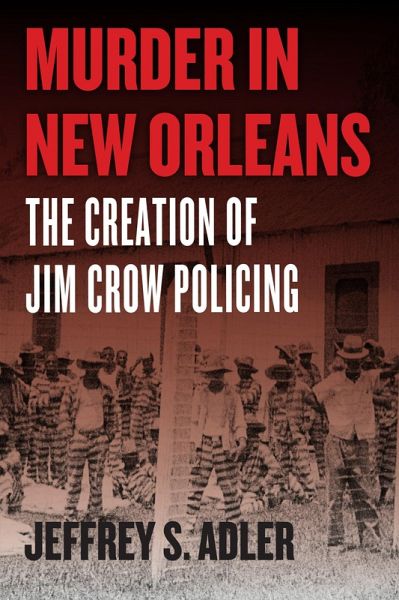
New Orleans in the 1920s and 1930s was a deadly place. In 1925, the city's homicide rate was six times that of New York City and twelve times that of Boston. Jeffrey S. Adler has explored every homicide recorded in New Orleans between 1925 and 1940-over two thousand in all-scouring police and autopsy reports, old interviews, and crumbling newspapers. More than simply quantifying these cases, Adler places them in larger contexts-legal, political, cultural, and demographic-and emerges with a tale of racism, urban violence, and vicious policing that has startling relevance for today.
Murder in New Orleans shows that whites were convicted of homicide at far higher rates than blacks leading up to the mid-1920s. But by the end of the following decade, this pattern had reversed completely, despite an overall drop in municipal crime rates. The injustice of this sharp rise in arrests was compounded by increasingly brutal treatment of black subjects by the New Orleans police department. Adler explores other counterintuitive trends in violence, particularly how murder soared during the flush times of the Roaring Twenties, how it plummeted during the Great Depression, and how the vicious response to African American crime occurred even as such violence plunged in frequency-revealing that the city's cycle of racial policing and punishment was connected less to actual patterns of wrongdoing than to the national enshrinement of Jim Crow. Rather than some hyperviolent outlier, this Louisiana city was a harbinger of the endemic racism at the center of today's criminal justice state. Murder in New Orleans lays bare how decades-old crimes, and the racially motivated cruelty of the official response, have baleful resonance in the age of Black Lives Matter.
Dieser Download kann aus rechtlichen Gründen nur mit Rechnungsadresse in A, B, BG, CY, CZ, D, DK, EW, E, FIN, F, GR, HR, H, IRL, I, LT, L, LR, M, NL, PL, P, R, S, SLO, SK ausgeliefert werden.