42,95 €
42,95 €
inkl. MwSt.
Sofort per Download lieferbar

21 °P sammeln
42,95 €
Als Download kaufen
42,95 €
inkl. MwSt.
Sofort per Download lieferbar
21 °P sammeln
Jetzt verschenken
Alle Infos zum eBook verschenken
42,95 €
inkl. MwSt.
Sofort per Download lieferbar
Alle Infos zum eBook verschenken
21 °P sammeln

Andere Kunden interessierten sich auch für
") Muslim Women's Rights (eBook, PDF)42,95 €
Muslim Women's Rights (eBook, PDF)42,95 €") Promoting Women's Rights in Islamic Law in a Non-Muslim State - Israel (eBook, ePUB)68,95 €
Promoting Women's Rights in Islamic Law in a Non-Muslim State - Israel (eBook, ePUB)68,95 €") Islam and Biomedical Research Ethics (eBook, ePUB)41,95 €
Islam and Biomedical Research Ethics (eBook, ePUB)41,95 €") Muslim Family Law in Western Courts (eBook, ePUB)47,95 €
Muslim Family Law in Western Courts (eBook, ePUB)47,95 €") Muslim Endowments, Waqf Law and Judicial Response in India (eBook, ePUB)43,95 €
Muslim Endowments, Waqf Law and Judicial Response in India (eBook, ePUB)43,95 €") Adjudicating Family Law in Muslim Courts (eBook, ePUB)49,95 €
Adjudicating Family Law in Muslim Courts (eBook, ePUB)49,95 €") Rethinking Muslim Personal Law (eBook, ePUB)38,95 €
Rethinking Muslim Personal Law (eBook, ePUB)38,95 €


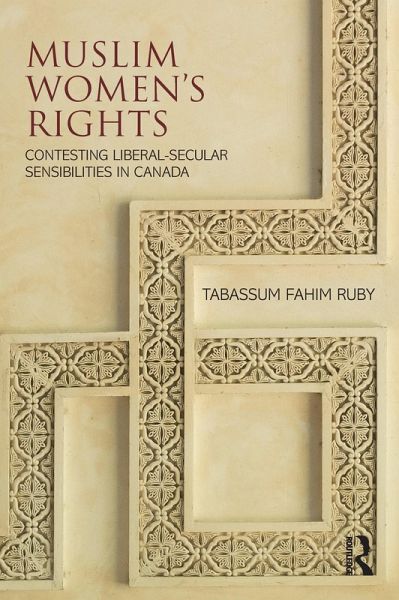
In the post-9/11 environment, the figure of the Muslim woman is at the forefront of global politics. Her representation is often articulated within a rights discourse owing much to liberal-secular sensibilities-notions of freedom, equality, rational thinking, individualism, and modernization. Muslim Women's Rights explores how these liberal-secular sensibilities inform, shape, and foreclose public discussion on questions of Islam and gender.
The book draws on postcolonial, antiracist, and transnational feminist studies in order to analyze public and legal debates surrounding proposed shari'ah tribunals in Canada. It examines the cultural and epistemological suppositions underlying common assumptions about Islamic laws; explores how these assumptions are informed by the Western progress narrative and women's rights debates; and asks what forms of politics these enable and foreclose. The book assesses the influence of secularism on the ontology, epistemology, and ethics afforded to Islam in the West, and begins to trace possibilities by which Islamic family law might be productively addressed on its own terms.
Muslim Women's Rights is a significant contribution to the fields of both Islam and gender and the critical study of secularism.
The book draws on postcolonial, antiracist, and transnational feminist studies in order to analyze public and legal debates surrounding proposed shari'ah tribunals in Canada. It examines the cultural and epistemological suppositions underlying common assumptions about Islamic laws; explores how these assumptions are informed by the Western progress narrative and women's rights debates; and asks what forms of politics these enable and foreclose. The book assesses the influence of secularism on the ontology, epistemology, and ethics afforded to Islam in the West, and begins to trace possibilities by which Islamic family law might be productively addressed on its own terms.
Muslim Women's Rights is a significant contribution to the fields of both Islam and gender and the critical study of secularism.
Dieser Download kann aus rechtlichen Gründen nur mit Rechnungsadresse in A, B, BG, CY, CZ, D, DK, EW, E, FIN, F, GR, HR, H, IRL, I, LT, L, LR, M, NL, PL, P, R, S, SLO, SK ausgeliefert werden.