Sie sind bereits eingeloggt. Klicken Sie auf 2. tolino select Abo, um fortzufahren.
Bitte loggen Sie sich zunächst in Ihr Kundenkonto ein oder registrieren Sie sich bei bücher.de, um das eBook-Abo tolino select nutzen zu können.
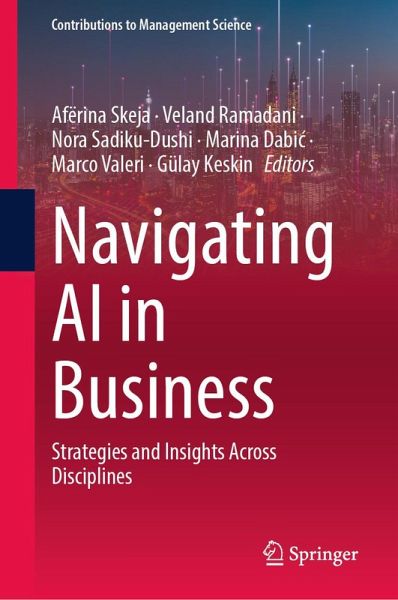
This book examines how AI transforms business administration, creating entrepreneurial opportunities and innovative business models. AI supports sustainable business models by driving social, environmental, and financial value. It accelerates information dissemination, networking, and communication efficiency, benefiting family businesses and large companies alike. The book provides insights into integrating AI in marketing, finance, and HR to enhance efficiency and drive innovation. Featuring unique models, research, and case studies, it addresses practical AI applications, ethical…mehr
This book examines how AI transforms business administration, creating entrepreneurial opportunities and innovative business models. AI supports sustainable business models by driving social, environmental, and financial value. It accelerates information dissemination, networking, and communication efficiency, benefiting family businesses and large companies alike. The book provides insights into integrating AI in marketing, finance, and HR to enhance efficiency and drive innovation. Featuring unique models, research, and case studies, it addresses practical AI applications, ethical considerations, and future trends. This book is essential for professionals and academics leveraging AI at the intersection of technology and business.
Dieser Download kann aus rechtlichen Gründen nur mit Rechnungsadresse in A, B, BG, CY, CZ, D, DK, EW, E, FIN, F, GR, HR, H, IRL, I, LT, L, LR, M, NL, PL, P, R, S, SLO, SK ausgeliefert werden.
Die Herstellerinformationen sind derzeit nicht verfügbar.
Autorenporträt
Afërina Skeja is an Assistant Professor at UBT, Kosovo, with a PhD from Trakya University, Türkiye. Her research spans business management, innovation, digital transformation, and sustainability. She has published widely and serves on the Editorial Board of *Humanities and Social Sciences Communications* and the Advisory Board of the Foreign Trade Department at Çanakkale Onsekiz Mart University. Veland Ramadani is a Professor at South-East European University, North Macedonia. He specializes in entrepreneurship, innovation, and sustainability, with over 150 articles and 33 edited books. Recognized among the world’s top 2% researchers by Stanford and Elsevier, he has served on international boards, delivered keynotes globally, and consulted on EU and Middle Eastern projects. Nora Sadiku-Dushi is an Assistant Professor at the University of Prishtina. She holds a PhD in Business Administration and researches entrepreneurship, digital marketing, and sustainability. She has published in top journals, co-authored a book, and mentored SMEs. Nora also serves on editorial boards and provides consultancy in marketing and entrepreneurship. Marina Dabi¿ is a Professor at the Universities of Zagreb, Dubrovnik, and Ljubljana. She researches innovation, entrepreneurship, and international business. A top 2% scientist per Stanford, she is Editor-in-Chief of *Technology in Society* and serves on EU research panels. Her work appears in leading journals like *JIBS*, *TFSC*, and *Technovation*. Marco Valeri is Associate Professor at Niccolò Cusano University, Italy, and Visiting/Adjunct Professor at institutions in the UK, Macedonia, Malaysia, India, France, and Hungary. His expertise includes strategic management, leadership, and hospitality. He serves on editorial boards and has edited numerous handbooks on entrepreneurship and tourism for major publishers. Gülay Keskin is an Assistant Professor and Director at Çanakkale Onsekiz Mart University, Türkiye. She holds a PhD in Business Administration and focuses on marketing, consumer behavior, tourism, and sustainability. Her academic work includes research in digital and entrepreneurial marketing, and she actively contributes to vocational education and leadership.
Inhaltsangabe
Part I: Foundations and Cross-Disciplinary Perspectives.- 1. Introduction to Navigating AI in Business: Strategies and Insights Across Disciplines.- 2. The AI Revolution in Business.- 3. Artificial Intelligence in Strategic Management: Shaping the Future of Business Leadership.- 4. Responsible AI in Organizational Decision-Making: A Conceptual Framework.- 5. Mitigating the Risks of Generative AI in Government through Algorithmic Governance.- Part II: AI in Business Functions and Processes.- 6. AI Applications for Organizational Learning and Development: An Interdisciplinary Approach.- 7. AI in Human Resources Management, Systematic Literature Review.- 8. Next-Gen HR: Leveraging AI for Employee Readiness.- 9. Leveraging AI for Talent Management: From Talent Acquisition to Succession Planning.- 10. Exploring the Influence of Artificial Intelligence on Accounting and Auditing Firm Performance.- 11. Bankruptcy Prediction: Statistical Models to Deep Learning Models.- 12. AI and Competitive Advantage Strategies: Evidence from the Banking Sector.- 13. AI in Marketing and Consumer Behavior.- 14. Generative AI in Consumer Behaviour and Marketing: Applications, Opportunities and Challenges.- 15. Responsible Use of Artificial Intelligence in International Marketing: A Comparative Analysis of Multinational Enterprises.- 16. Usability of Artificial Intelligence in Customer Satisfaction: Evidence from Family-Owned Businesses in Sub-Saharan Africa.- Part III: AI in Industry-Specific Contexts.- 17. Artificial Intelligence in Tourism Marketing.- 18. AI in Healthcare Brand Management: Building Trust and Reputation.- 19. Adoption of Photovoltaic Systems (PV) and Artificial Intelligence (AI) in Rural Economies of Albania.- .- 20. Machinewashing: An Emerging Threat to Digital Reputation in the Artificial Intelligence (AI) Era.- Part IV: Legal, Ethical, and Future Considerations.- 21. Navigating the Intersection of Law and Innovation: The Criminal Legal Framework for Self-Driving Cars in the AI-Driven Automotive Industry.
Part I: Foundations and Cross-Disciplinary Perspectives.- 1. Introduction to Navigating AI in Business: Strategies and Insights Across Disciplines.- 2. The AI Revolution in Business.- 3. Artificial Intelligence in Strategic Management: Shaping the Future of Business Leadership.- 4. Responsible AI in Organizational Decision-Making: A Conceptual Framework.- 5. Mitigating the Risks of Generative AI in Government through Algorithmic Governance.- Part II: AI in Business Functions and Processes.- 6. AI Applications for Organizational Learning and Development: An Interdisciplinary Approach.- 7. AI in Human Resources Management, Systematic Literature Review.- 8. Next-Gen HR: Leveraging AI for Employee Readiness.- 9. Leveraging AI for Talent Management: From Talent Acquisition to Succession Planning.- 10. Exploring the Influence of Artificial Intelligence on Accounting and Auditing Firm Performance.- 11. Bankruptcy Prediction: Statistical Models to Deep Learning Models.- 12. AI and Competitive Advantage Strategies: Evidence from the Banking Sector.- 13. AI in Marketing and Consumer Behavior.- 14. Generative AI in Consumer Behaviour and Marketing: Applications, Opportunities and Challenges.- 15. Responsible Use of Artificial Intelligence in International Marketing: A Comparative Analysis of Multinational Enterprises.- 16. Usability of Artificial Intelligence in Customer Satisfaction: Evidence from Family-Owned Businesses in Sub-Saharan Africa.- Part III: AI in Industry-Specific Contexts.- 17. Artificial Intelligence in Tourism Marketing.- 18. AI in Healthcare Brand Management: Building Trust and Reputation.- 19. Adoption of Photovoltaic Systems (PV) and Artificial Intelligence (AI) in Rural Economies of Albania.- .- 20. Machinewashing: An Emerging Threat to Digital Reputation in the Artificial Intelligence (AI) Era.- Part IV: Legal, Ethical, and Future Considerations.- 21. Navigating the Intersection of Law and Innovation: The Criminal Legal Framework for Self-Driving Cars in the AI-Driven Automotive Industry.
Es gelten unsere Allgemeinen Geschäftsbedingungen: www.buecher.de/agb
Impressum
www.buecher.de ist ein Internetauftritt der buecher.de internetstores GmbH
Geschäftsführung: Monica Sawhney | Roland Kölbl | Günter Hilger
Sitz der Gesellschaft: Batheyer Straße 115 - 117, 58099 Hagen
Postanschrift: Bürgermeister-Wegele-Str. 12, 86167 Augsburg
Amtsgericht Hagen HRB 13257
Steuernummer: 321/5800/1497
USt-IdNr: DE450055826