Sie sind bereits eingeloggt. Klicken Sie auf 2. tolino select Abo, um fortzufahren.
Bitte loggen Sie sich zunächst in Ihr Kundenkonto ein oder registrieren Sie sich bei bücher.de, um das eBook-Abo tolino select nutzen zu können.
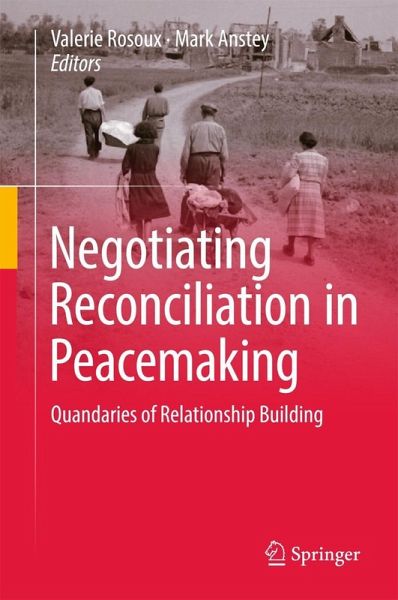
Introduces a new conceptual framework on reconciliation as an integral component of peacemaking processes Builds new bridges between practitioners and international relations scholars using multidisciplinary perspectives Reviews reconciliation as an 'agreed-upon norm' of conflict resolution
Introduces a new conceptual framework on reconciliation as an integral component of peacemaking processes
Builds new bridges between practitioners and international relations scholars using multidisciplinary perspectives
Reviews reconciliation as an 'agreed-upon norm' of conflict resolution
Dieser Download kann aus rechtlichen Gründen nur mit Rechnungsadresse in A, B, BG, CY, CZ, D, DK, EW, E, FIN, F, GR, HR, H, IRL, I, LT, L, LR, M, NL, PL, P, R, S, SLO, SK ausgeliefert werden.
Die Herstellerinformationen sind derzeit nicht verfügbar.
Autorenporträt
Valerie Rosoux has a Licence in Philosophy and a Ph.D. in International Relations. She is a senior research fellow at the Belgian National Fund for Scientific Research (FNRS) and a Senior Visiting Fellow of Clingendael, the Netherlands Institute of International Relations. She teaches International Negotiation, and Conflict Transformation at the University of Louvain (UCL). In 2010-2011, she was a Jennings Randoph Fellow Senior Fellow at the United States Institute of Peace (Washington DC). As a post-doctoral researcher, she worked at the Johns Hopkins University School of Advanced International Studies (SAIS) in 2002, the Center for International Studies and Research (CERI), Institut d'Études Politiques of Paris (2001) and the University Laval, Canada (2000). Her research interests focus on transitional justice, post-war reconciliation and the uses of memory in international relations. Since 2016, she is a member of the Belgian Royal Academy. Mark Anstey (D Phil) is an Emeritus Professor of Nelson Mandela Metropolitan University and a Senior Visiting Fellow of Clingendael, the Netherlands Institute of International Relations. He was a Professor with Michigan State University in Dubai (2008-11), and has taught at the Universities of the Witwatersrand, Cape Town, and Stellenbosch. An active labor and community mediator since 1984, he served on South Africa's peace structures during the political transition period, and was Director of Monitoring (Eastern Cape) for the Independent Electoral Commission in the country's historic 1994 elections. He has particular interest in relationship building interventions in places of work. He is active in post-graduate teaching and is the author of seven books and numerous publications in academic and professional journals. He has given addresses, trained and consulted across a spread of countries in Africa, Europe, the Middle East, as well as the USA.
Inhaltsangabe
Chapter 1. Introduction - Negotiating perilous relations: quandaries of reconciliation (Valerie Rosoux).- Chapter 2. Reconciliation as a Puzzle: Walking Among Definitions (Valerie Rosoux).- Chapter 3. Reconciliation, Morality and Moral Compromise (Rudolf Schüssler).- Chapter 4. Power, Negotiation and Reconciliation (Mark Anstey).- Chapter 5. Time and Reconciliation: Dealing with festering wounds (Valerie Rosoux).- Chapter 6. Gender and Peace Negotiations:Why Gendering Peace Negotiations Multiplies Opportunities for Reconciliation (Élise Féron).- Chapter 7. Reconciliation and Development (Mark Anstey).- Chapter 8. Rwanda: The Limits of a Negotiated Justice (Valérie Rosoux).- Chapter 9. The Refugee Issue in the Israeli-Palestinian Peace Process: The (im)Possibility of Negotiating Accountability (Laetitia Bucaille).- Chapter 10. Russian-Polish Reconciliation and Negotiation (Igor Gretskiy).- Chapter 11. Negotiating and Sharing Power: Burundi's Bumpy Road to Reconciliation without Truth (Stef Vandeginste).- Chapter 11. Security and Reconciliation: Introducing Soft Security 2.0 to Reconciliation Dynamics (Moty Cristal).- Chapter 12. Reconciliation and the Land Question in South Africa: A case for Negotiation? (Gavin Bradshaw).- Chapter 13. "When Shall We Not Forgive?" - The Israeli-German Reparations Agreement: The Interface Between Negotiation and Reconciliation (Aviv Melamud).- Chapter 14. Tensions between Short Term Outcomes and Long Term Peacebuilding in Post-war Sri Lanka (Nick Lewer).- Chapter 15. Negotiating Grassroots Reconciliation in the Context of Social Disintegration in Post-apartheid South Africa (Ruben Richard).- Chapter 16. Lessons for Theory: Reconciliation as a Constant Negotiation (Valérie Rosoux).- Chapter 17. Lessons for Practice (Mark Anstey).
Chapter 1. Introduction - Negotiating perilous relations: quandaries of reconciliation (Valerie Rosoux).- Chapter 2. Reconciliation as a Puzzle: Walking Among Definitions (Valerie Rosoux).- Chapter 3. Reconciliation, Morality and Moral Compromise (Rudolf Schüssler).- Chapter 4. Power, Negotiation and Reconciliation (Mark Anstey).- Chapter 5. Time and Reconciliation: Dealing with festering wounds (Valerie Rosoux).- Chapter 6. Gender and Peace Negotiations:Why Gendering Peace Negotiations Multiplies Opportunities for Reconciliation (Élise Féron).- Chapter 7. Reconciliation and Development (Mark Anstey).- Chapter 8. Rwanda: The Limits of a Negotiated Justice (Valérie Rosoux).- Chapter 9. The Refugee Issue in the Israeli-Palestinian Peace Process: The (im)Possibility of Negotiating Accountability (Laetitia Bucaille).- Chapter 10. Russian-Polish Reconciliation and Negotiation (Igor Gretskiy).- Chapter 11. Negotiating and Sharing Power: Burundi's Bumpy Road to Reconciliation without Truth (Stef Vandeginste).- Chapter 11. Security and Reconciliation: Introducing Soft Security 2.0 to Reconciliation Dynamics (Moty Cristal).- Chapter 12. Reconciliation and the Land Question in South Africa: A case for Negotiation? (Gavin Bradshaw).- Chapter 13. "When Shall We Not Forgive?" - The Israeli-German Reparations Agreement: The Interface Between Negotiation and Reconciliation (Aviv Melamud).- Chapter 14. Tensions between Short Term Outcomes and Long Term Peacebuilding in Post-war Sri Lanka (Nick Lewer).- Chapter 15. Negotiating Grassroots Reconciliation in the Context of Social Disintegration in Post-apartheid South Africa (Ruben Richard).- Chapter 16. Lessons for Theory: Reconciliation as a Constant Negotiation (Valérie Rosoux).- Chapter 17. Lessons for Practice (Mark Anstey).
Es gelten unsere Allgemeinen Geschäftsbedingungen: www.buecher.de/agb
Impressum
www.buecher.de ist ein Internetauftritt der buecher.de internetstores GmbH
Geschäftsführung: Monica Sawhney | Roland Kölbl | Günter Hilger
Sitz der Gesellschaft: Batheyer Straße 115 - 117, 58099 Hagen
Postanschrift: Bürgermeister-Wegele-Str. 12, 86167 Augsburg
Amtsgericht Hagen HRB 13257
Steuernummer: 321/5800/1497
USt-IdNr: DE450055826