40,95 €
inkl. MwSt.
Sofort per Download lieferbar
20 °P sammeln

Andere Kunden interessierten sich auch für
") Just-in-Time Systems (eBook, PDF)112,95 €
Just-in-Time Systems (eBook, PDF)112,95 €") Practical Bilevel Optimization (eBook, PDF)232,95 €
Practical Bilevel Optimization (eBook, PDF)232,95 €") Dynamic Optimization and Differential Games (eBook, PDF)167,95 €
Dynamic Optimization and Differential Games (eBook, PDF)167,95 €") Finite-Dimensional Variational Inequalities and Complementarity Problems (eBook, PDF)72,95 €
Finite-Dimensional Variational Inequalities and Complementarity Problems (eBook, PDF)72,95 €") Applications of Supply Chain Management and E-Commerce Research (eBook, PDF)72,95 €
Applications of Supply Chain Management and E-Commerce Research (eBook, PDF)72,95 €") Quantitative Pareto Analysis by Cone Separation Technique (eBook, PDF)72,95 €
Quantitative Pareto Analysis by Cone Separation Technique (eBook, PDF)72,95 €") Metaheuristic Procedures for Training Neural Networks (eBook, PDF)72,95 €
Metaheuristic Procedures for Training Neural Networks (eBook, PDF)72,95 €




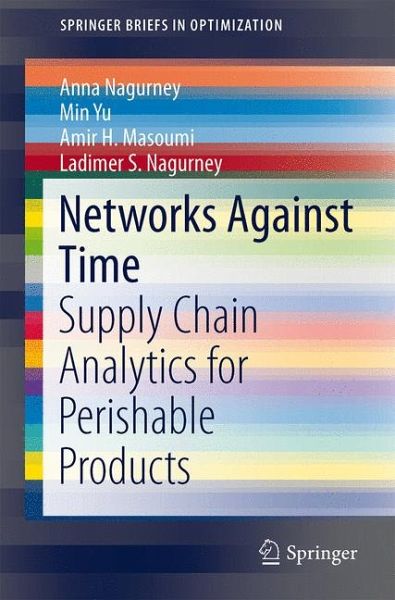
Despite significant achievements, the discipline of supply chain management is still unable to satisfactorily handle many practical real-world challenges. The authors of Networks Against Time claim that a unified supply chain network analytics framework is needed which should be able to handle optimization and competitive behavior while also maintain relevance to many industrial sectors in which perishable products are prominent, from healthcare to food and from fashion apparel to technology. This Brief provides a wide range of critical supply chain problems which are modeled as generalized networks. Guidelines are provided to determine the arc multipliers that capture perish ability of the product whether food, radioisotopes, or even highly perishable blood in healthcare over space and time. Through case studies the authors portray the application of the models and algorithms to real-world sectors which illustrate the power of the framework in practice. The models and algorithms are fully described along with the input and output data in the case studies. This level of transparency is useful pedagogically as well as for future research and for applications in practice. Researchers and practitioners in mathematics, in operations research and management science, operations management, as well as in economics and computer science will find this book useful to gain a broader appreciation of the richness of network supply chain structures, processes, and applications. This book can also be used by advanced undergraduate students and graduate students in the disciplines noted above to familiarize themselves with methodologies and supply chain network models and applications.¿¿
Dieser Download kann aus rechtlichen Gründen nur mit Rechnungsadresse in A, B, BG, CY, CZ, D, DK, EW, E, FIN, F, GR, HR, H, IRL, I, LT, L, LR, M, NL, PL, P, R, S, SLO, SK ausgeliefert werden.
The structure of the book is very straightforward since all the chapters from 2 to 6 start by introducing the focus supply chain then unfold with the formulation of the model, the computational approach for its solution and the case study. The repetitive structure helps the reader to easily understand and connect the various parts of the book. Furthermore, each of these chapters ends with additional notes and links to other works about the supply chain at issue, as well as a rich and updated list of references, so that the content of the chapter can be related to and compared with the current state of the art. The level of mathematical formulation is adequate and all the presented formulas are explained in detail. Also, complete input and output data about case studies are presented.
In my opinion, this book is a valid contribution to the discipline of supply chain management in the time-sensitive product field because it provides a systematic and analytic framework ofanalysis which actually lacks in the existing literature.
-Anna Corinna Cagliano, Production Planning & Control
In my opinion, this book is a valid contribution to the discipline of supply chain management in the time-sensitive product field because it provides a systematic and analytic framework ofanalysis which actually lacks in the existing literature.
-Anna Corinna Cagliano, Production Planning & Control