Sie sind bereits eingeloggt. Klicken Sie auf 2. tolino select Abo, um fortzufahren.
Bitte loggen Sie sich zunächst in Ihr Kundenkonto ein oder registrieren Sie sich bei bücher.de, um das eBook-Abo tolino select nutzen zu können.
Neurodiversity in higher education is gaining essential recognition, yet significant challenges remain. This book offers a comprehensive exploration of strategies and initiatives designed to foster inclusion for neurodivergent students. It is an invaluable resource for higher education academics and nonacademics, illuminating pathways towards accessible learning environments and systemic institutional change. This book delves into the multifaceted aspects of supporting neurodivergent students in higher education. It presents an array of topics, including the application of a bioecological…mehr
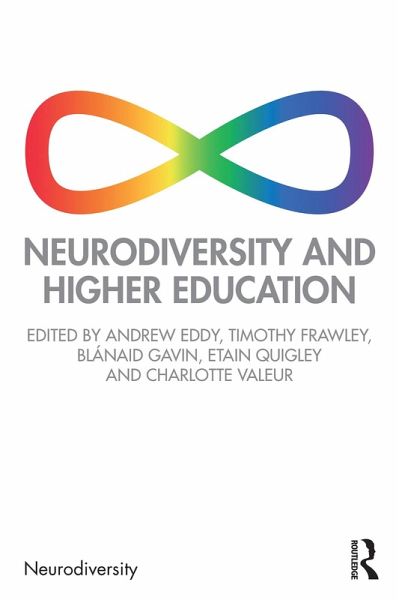
Neurodiversity in higher education is gaining essential recognition, yet significant challenges remain. This book offers a comprehensive exploration of strategies and initiatives designed to foster inclusion for neurodivergent students. It is an invaluable resource for higher education academics and nonacademics, illuminating pathways towards accessible learning environments and systemic institutional change.
This book delves into the multifaceted aspects of supporting neurodivergent students in higher education. It presents an array of topics, including the application of a bioecological theory for inclusive design, assistive technologies that enhance learning experiences and innovative work-integrated learning programmes. Key chapters explore accessible library design, tailored support for dyslexia and ADHD and successful mentorship initiatives. Through case studies and institutional profiles, it showcases practical strategies that promote neuro-inclusion, from flexible learning environments to institutional reforms. The book emphasises the importance of collaborative efforts, systemic approaches and leadership commitment to creating truly supportive educational programmes.
Highlighting both challenges and transformative strategies, this book underscores the necessity of systemic change for neuro-inclusion in higher education. It serves as a critical guide for institutions aiming to build equitable, inclusive environments, offering practical insights and evidence-based recommendations to empower neurodivergent students and staff to enhance their academic and professional success.
Dieser Download kann aus rechtlichen Gründen nur mit Rechnungsadresse in A, B, BG, CY, CZ, D, DK, EW, E, FIN, F, GR, HR, H, IRL, I, LT, L, LR, M, NL, PL, P, R, S, SLO, SK ausgeliefert werden.
Die Herstellerinformationen sind derzeit nicht verfügbar.
Autorenporträt
Andrew Eddy is the Co-founder of the Neurodiversity Hub community of practice, working with universities and employers to facilitate neurodivergent higher education students to become more work-ready and increase their employment opportunities. Andrew is retired but continues his interest in neurodiversity and advocating for more neuro-inclusive workplaces and learning spaces. Timmy Frawley, DGov; MEd, BNS, RPN, RNT, is Associate Professor in Mental Health Nursing at UCD. A registered psychiatric nurse and educator, he has held leadership roles in curriculum development, governance and research. His work focuses on neurodiversity, nursing governance and service user involvement. He is committed to education, inclusion and issues concerning professional regulation. Blánaid Gavin, PhD, is a child and adolescent psychiatrist who has worked clinically with children and teenagers for over 20 years. She is particularly interested in expanding understanding in relation to child and adolescent mental health. To this end, she has been involved in teaching and research focused on optimising outcomes for young people. She specialises in the area of ADHD. Etain Quigley, PhD, is Lecturer in Law at Maynooth University, specialising in neurodiversity, mental health, youth justice and criminology. She has held Irish Research Council awards, worked on FP7 and H2020 projects and serves on Mental Health Tribunals. She is also a co- founding editor of Neurodiversity (Sage). Charlotte Valeur is an investment banker and seasoned FTSE Chair, Non-Executive Director and governance expert. She is a professor, author and public speaker in corporate governance, leadership, equality and diversity. Charlotte is Autistic and ADHD, and the founder and CEO of the global Institute of Neurodiversity (ION).
Inhaltsangabe
Biographies Introduction Book Layout PART I - FUNDAMENTAL TOPICS RELATING TO NEURODIVERSITY AND HIGHER EDUCATION Chapter 1: Designing for Neurodiversity in Higher Education: a Bioecological Approach Lorna Hamilton Chapter 2: ADHD in Higher Education: Key Issues and Future Directions Jane Sedgwick-Müller Chapter 3: Dyslexia in Higher Education: the Australian Story Shae Wissell, Judith Hudson, Steve Edwards and Claire Davill Chapter 4: Creating Inclusive Learning Environments: the Role of Library Design in Supporting Neurodivergent Students in Higher Education Sonja Duric, Emil Jonescu, Winnie Dunn, Jessica Green, Talia Uylaki and Jessika Hames Chapter 5: Assistive Technology, Neurodiversity and Higher Education Aoife McNicholl, Trevor Boland andAbbie Robinson Chapter 6: Neurodiversity Inclusion in Work Integrated Learning: Neurodiversity Placements Program Beth Radulski, Cheryl Dissanayake and Katie Wright Chapter 7: Toward Neurodiversity-Friendly Higher Education: Lessons from a Campus-Wide Initiative and the Case for Collaborative Evidence-Based Practice Blánaid Gavin, Timmy Frawley and Sandra Connell Epilogue PART II - PROGRAM PROFILES - SECTION FOREWORD AND PROFILES OF NINE HIGHER EDUCATION PROGRAMS Foreword: Student Support Programs: Common Ground, Unique Approaches and Lived Experience Sandra Thom-Jones Profile 1: Royal College of Art, UK: An Example of SpLD Support at a UK Post-Graduate Art and Design University Qona Rankin Profile 2: USC Upstate, USA-Beyond Accommodations: Enabling Learners, Faculty, and Staff, Embracing Neurodiversity for All Renu Pariyadath Profile 3: University of Delaware, USA: Spectrum Scholars Wes Garton, Adrienne Cornish Lucas and Jennifer Grelak Profile 4: University of Calgary, Canada-Supporting Success in Post-Secondary Settings for Neurodivergent Students: the UCAN Peer Mentorship Program Carly McMorris, Mercedes Bagshawe, Nicole Eddy and Megan Ames Profile 5: Universiti Kebangsaan Malaysia-Elevating Career Support for Students Displaying a Number of Autistic Traits Mohd Syazwan Zainal Profile 6: Curtin University, Western Australia-Specialist Mentoring Program Jasmine McDonald and Sylvanna Mirichlis Profile 7: Curtin University, Western Australia-AASQA Program Ben Milbourn, Tele Tan, Elinda Ai Lim Lee, Susan Hall, Lucy Simons and Sonya Girdler Profile 8: University of Tennessee at Chattanooga, USA-Mosaic Program Amy Rutherford, Mary-Elizabeth Goodman and Anne Hill Profile 9: Landmark College, USA-Programming for Fostering Career Connections Among Neurodivergent College Students Jan Coplan, Adam R. Lalor, Marlee Bickford-Bushey and Rebecca W. Matte Index
Es gelten unsere Allgemeinen Geschäftsbedingungen: www.buecher.de/agb
Impressum
www.buecher.de ist ein Internetauftritt der buecher.de internetstores GmbH
Geschäftsführung: Monica Sawhney | Roland Kölbl | Günter Hilger
Sitz der Gesellschaft: Batheyer Straße 115 - 117, 58099 Hagen
Postanschrift: Bürgermeister-Wegele-Str. 12, 86167 Augsburg
Amtsgericht Hagen HRB 13257
Steuernummer: 321/5800/1497
USt-IdNr: DE450055826