Sie sind bereits eingeloggt. Klicken Sie auf 2. tolino select Abo, um fortzufahren.
Bitte loggen Sie sich zunächst in Ihr Kundenkonto ein oder registrieren Sie sich bei bücher.de, um das eBook-Abo tolino select nutzen zu können.
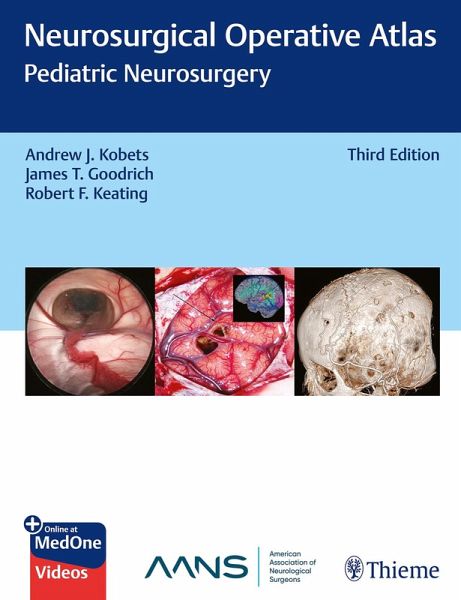
A masterful pediatric neurosurgical resource that enhances the surgeon's ability to improve outcomes for the smallest and most complex patients around the world Neurosurgical Operative Atlas: Pediatric Neurosurgery, Third Edition edited by Andrew J. Kobets, the late James T. Goodrich, and Robert F. Keating showcases the latest neurosurgical techniques for a full spectrum of pediatric neurosurgical diagnoses. The original concept of this atlas was envisioned by world-renowned pediatric neurosurgeon Dr. James Goodrich, reflecting his unwavering dedication to surgical education, cutting…mehr
A masterful pediatric neurosurgical resource that enhances the surgeon's ability to improve outcomes for the smallest and most complex patients around the world
Neurosurgical Operative Atlas: Pediatric Neurosurgery, Third Edition edited by Andrew J. Kobets, the late James T. Goodrich, and Robert F. Keating showcases the latest neurosurgical techniques for a full spectrum of pediatric neurosurgical diagnoses. The original concept of this atlas was envisioned by world-renowned pediatric neurosurgeon Dr. James Goodrich, reflecting his unwavering dedication to surgical education, cutting edge approaches, and improving patient outcomes. The third edition honors his extraordinary contributions, enduring commitment to excellence, and relentless pursuit of surgical innovations to advance pediatric neurosurgical care.
The book is systemically organized into 12 subspecialty sections, thereby encompassing the full scope of pediatric neurosurgery. Throughout 84 chapters, pediatric neurosurgeons from across the world share their expertise, while paying tribute to Dr. Goodrich's indelible contributions to the field. Each chapter begins with a concise overview of the clinical topic, followed by insightful discussion of patient selection, preoperative planning, surgical techniques, complications, and postoperative guidelines.
Key Highlights
Features reader-friendly content from an impressive group of esteemed pediatric neurosurgeons and specialists
Builds on the prior edition, with 38 additional chapters covering an expanded number of pathologies and surgical techniques
High-quality illustrations, short videos, succinct descriptions, and expert insights detail operative intricacies, pearls, and pitfalls
With comprehensive coverage of complex surgical procedures and techniques, this atlas is an indispensable resource for practitioners and trainees seeking to enhance their neurosurgical skills and knowledge.
Dieser Download kann aus rechtlichen Gründen nur mit Rechnungsadresse in A, D ausgeliefert werden.
Die Herstellerinformationen sind derzeit nicht verfügbar.
Inhaltsangabe
Part I: Cranial 1. Fibrous Dysplasia Involving the Craniofacial Skeleton 2. Depressed Skull Fractures in Infants 3. Growing Skull Fractures in the Young Child 4. Surgical Techniques for Evacuation of SDH/EDH 5. Decompressive Craniectomy in Children 6. Management of Skull Defects from TBI 7. Surgical Treatments of CSF Leaks 8. Anterior Cranial Fossa Encephaloceles and Endoscopic Approaches 9. Neurosurgical Treatment of Occipital and Posterior Fossa Encephaloceles 10. Surgical Management of Posterior Fossa Cysts and Dandy-Walker Malformation 11. Surgical Management of Supratentorial, Sylvian Fissure, and Midline Arachnoid Cysts 12. Operative Techniques for Managing Cranial Dermal Sinus Tracts Part II: Hydrocephalus 13. Surgical Techniques for Placement of VP Shunts 14. Placement of Ventriculoatrial Shunts 15. Surgical Technique for Placement of a Lumboperitoneal Shunt 16. The Ventriculosinus Shunt 17. Endoscopic Third Ventriculocisternostomy (ETV) Techniques 18. Surgical Management of Hydrocephalus in Very Low Birth Weight Infants 19. Surgical Options for the Treatment of "Slit Ventricle Syndrome" Part III: Craniosynostosis 20. Endoscopic Repair of Craniosynostosis/Plagiocephaly (Unilateral Coronal) 21. Minimally Invasive Endoscopic Strip Craniectomy for Sagittal Craniosynostosis 22. Endoscopic Synostectomy of Multisutural Synostosis 23. Pi Craniectomy for the Treatment of Sagittal Synostosis 24. Sagittal Synostosis 25. Deformational Plagiocephaly and Brachycephaly 26. Management of Complex Craniosynostosis 27. Use of Distractors in Posterior Cranial Vault Remodeling for Craniosynostosis 28. Orbital Hypertelorism and Orbital Dystopia 29. Monobloc Advancement in the Very Young Child 30. Surgical Management of Pansynostosis (Craniosynostosis) Part IV: Spine 31. Surgical Techniques for Intramedullary Spinal Cord Tumors 32. Surgical Treatment of Intramedullary Tumors 33. Extramedullary Spinal Cord Tumors 34. Surgical Treatment of Cervical Medullary Tumors Part V: Congenital 35. Closure of the Myelomeningocele 36. Intrauterine Repair of Myelomeningocele 37. Lumbosacral Meningoceles and Meningocele Manque 38. Surgical Management of Lipomyelomeningoceles 39. Operative Techniques for Managing Spinal Dermal Sinus Tracts 40. Diastematomyelia 41. Split Cord Malformations 42. Surgical Management of the Hypertrophic/Fatty Filum Terminale (Filar-Type Lipoma) 43. Syringomyelia and Shunt Placement Part VI: Brain Tumor: Supratentorial 44. Supratentorial Surgical Approaches for Brain Tumors in Infants 45. Surgical Approaches for Suprasellar Tumors 46. Surgical Management of Cranial Vault Tumors 47. Endoscopic Techniques for Brain Tumors and Hydrocephalus Management 48. Optic Pathway Gliomas 49. Pituitary Tumors (Craniopharyngioma/Adenomas): Operative Approaches 50. Transsphenoidal Approaches to the Pituitary 51. Cortical Mapping for Surgery in Eloquent Brain Areas 52. Surgical Management of Chiasmatic and Hypothalamic Tumors 53. Transoral Surgery for Craniovertebral Junction Abnormalities 54. Keyhole Approaches to Tumors 55. Skull Base Approaches to Tumors 56. Frameless Guidance Techniques for Brain Tumor Resection 57. Keyhole Approaches to Tumors of the Skull Base Part VII: Brain Lesions: Infratentorial 58. Stereotactic Biopsies of Diffuse Intrinsic Pontine Gliomas 59. Surgical Approaches to the Brainstem 60. Midline Posterior Fossa and Cerebellopontine Angle Tumors in Children 61. Surgical Approaches to Pineal Region Tumors 62. Posterior Rigid Fixation for Unstable CVJ Anomalies 63. Neurosurgical Techniques for Chiari Malformation Type I Bone-only Decompression 64. Surgical Management of Chiari Type I Malformation with Duraplasty/Fourth Ventricle Stent Part VIII: Infection 65. Neurosurgical Management of Empyema 66. Neurosurgical Management of Parasitic Infections 67. Operative Management of Intracranial Tuberculomas 68. Brain Abscesses 69. Infected Ventriculoperitoneal Shunts Part IX: Vascular 70. Moyamoya Syndrome with Pial Synangiosis (EDAS) 71. Treatment of Moyamoya Angiopathy with Multiple Burr Holes 72. Surgical Techniques in AVM Surgery—General Principles 73. Surgical Management of Intracranial Vascular Lesions: Cavernomas, Sturge-Weber Syndrome Part X: Functional 74. Baclofen Pumps 75. Selective Dorsal Rhizotomy for Lower Limb Spasticity Part XI: Peripheral Nerve 76. Brachial Plexus Exploration and Reconstruction 77. Approach and Surgical Management of Brachial Plexus Palsy 78. Surgical Management of Peripheral Neurofibromas 79. Common Peripheral Nerve Procedures: Carpal Tunnel, Cubital Tunnel, Peroneal Nerve Decompression and Nerve Grafting Part XII: Epilepsy 80. Temporal Lobectomy 81. Corpus Callosotomy 82. Cortical Mapping for Surgery in Eloquent Brain Areas 83. Hemispherectomy 84. Vagal Nerve Stimulation for Epilepsy Management
Es gelten unsere Allgemeinen Geschäftsbedingungen: www.buecher.de/agb
Impressum
www.buecher.de ist ein Internetauftritt der buecher.de internetstores GmbH
Geschäftsführung: Monica Sawhney | Roland Kölbl | Günter Hilger
Sitz der Gesellschaft: Batheyer Straße 115 - 117, 58099 Hagen
Postanschrift: Bürgermeister-Wegele-Str. 12, 86167 Augsburg
Amtsgericht Hagen HRB 13257
Steuernummer: 321/5800/1497
USt-IdNr: DE450055826