49,95 €
49,95 €
inkl. MwSt.
Sofort per Download lieferbar

25 °P sammeln
49,95 €
Als Download kaufen
49,95 €
inkl. MwSt.
Sofort per Download lieferbar
25 °P sammeln
Jetzt verschenken
Alle Infos zum eBook verschenken
49,95 €
inkl. MwSt.
Sofort per Download lieferbar
Alle Infos zum eBook verschenken
25 °P sammeln

Andere Kunden interessierten sich auch für
") Neurotechnology and Direct Brain Communication (eBook, ePUB)49,95 €
Neurotechnology and Direct Brain Communication (eBook, ePUB)49,95 €") The Believer's Brain (eBook, PDF)48,95 €
The Believer's Brain (eBook, PDF)48,95 €") Fine Art and Perceptual Neuroscience (eBook, PDF)39,95 €
Fine Art and Perceptual Neuroscience (eBook, PDF)39,95 €") On Seeing Forms (eBook, PDF)45,95 €
On Seeing Forms (eBook, PDF)45,95 €") Automaticity and Control in Language Processing (eBook, PDF)33,95 €
Automaticity and Control in Language Processing (eBook, PDF)33,95 €") Homo Prospectus (eBook, PDF)24,95 €
Homo Prospectus (eBook, PDF)24,95 €") Neuromotor Mechanisms in Human Communication (eBook, PDF)79,95 €
Neuromotor Mechanisms in Human Communication (eBook, PDF)79,95 €




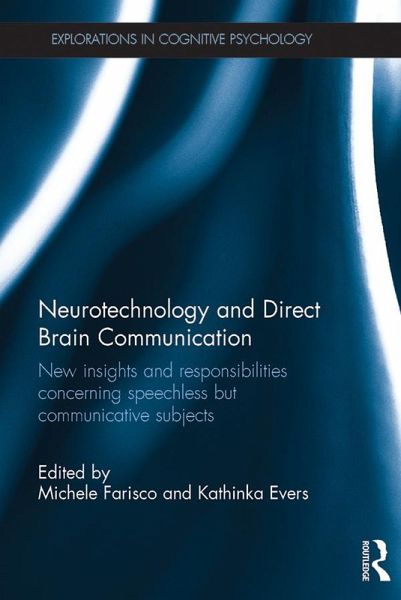
Neurotechnology and Direct Brain Communication focuses on recent neuroscientific investigations of infant brains and of patients with disorders of consciousness (DOC), both of which are at the forefront of contemporary neuroscience. The prospective use of neurotechnology to access mental states in these subjects, including neuroimaging, brain simulation, and brain computer interfaces, offers new opportunities for clinicians and researchers, but has also received specific attention from philosophical, scientific, ethical, and legal points of view. This book offers the first systematic assessment of these issues, investigating the tools neurotechnology offers to care for verbally non-communicative subjects and suggesting a multidisciplinary approach to the ethical and legal implications of ordinary and experimental practices.
The book is divided into three parts: the first and second focus on the scientific and clinical implications of neurological tools for DOC patient and infant care. With reference to these developments, the third and final part presents the case for re-evaluating classical ethical and legal concepts, such as authority, informed consent, and privacy.
Neurotechnology and Direct Brain Communication will appeal to researchers and postgraduate students in the fields of cognitive science, medical ethics, medical technology, and the philosophy of the mind. With implications for patient care, it will also be a useful resource for clinicians, medical centres, and health practitioners.
The book is divided into three parts: the first and second focus on the scientific and clinical implications of neurological tools for DOC patient and infant care. With reference to these developments, the third and final part presents the case for re-evaluating classical ethical and legal concepts, such as authority, informed consent, and privacy.
Neurotechnology and Direct Brain Communication will appeal to researchers and postgraduate students in the fields of cognitive science, medical ethics, medical technology, and the philosophy of the mind. With implications for patient care, it will also be a useful resource for clinicians, medical centres, and health practitioners.
Dieser Download kann aus rechtlichen Gründen nur mit Rechnungsadresse in A, B, BG, CY, CZ, D, DK, EW, E, FIN, F, GR, HR, H, IRL, I, LT, L, LR, M, NL, PL, P, R, S, SLO, SK ausgeliefert werden.