0,00 €
0,00 €
inkl. MwSt.
Sofort per Download lieferbar

0 °P sammeln
0,00 €
Als Download kaufen
0,00 €
inkl. MwSt.
Sofort per Download lieferbar
0 °P sammeln
Jetzt verschenken
Alle Infos zum eBook verschenken
0,00 €
inkl. MwSt.
Sofort per Download lieferbar
Alle Infos zum eBook verschenken
0 °P sammeln

Andere Kunden interessierten sich auch für
") News Framing Effects (eBook, ePUB)0,00 €
News Framing Effects (eBook, ePUB)0,00 €") US Media and Diversity (eBook, PDF)42,95 €
US Media and Diversity (eBook, PDF)42,95 €") Media and Crisis Communication (eBook, PDF)42,95 €
Media and Crisis Communication (eBook, PDF)42,95 €") A Cognitive Psychology of Mass Communication (eBook, PDF)81,95 €
A Cognitive Psychology of Mass Communication (eBook, PDF)81,95 €") Theorizing Mediated Information Distortion (eBook, PDF)39,95 €
Theorizing Mediated Information Distortion (eBook, PDF)39,95 €") Against Meritocracy (eBook, PDF)0,00 €
Against Meritocracy (eBook, PDF)0,00 €") Journalists and Job Loss (eBook, PDF)39,95 €
Journalists and Job Loss (eBook, PDF)39,95 €

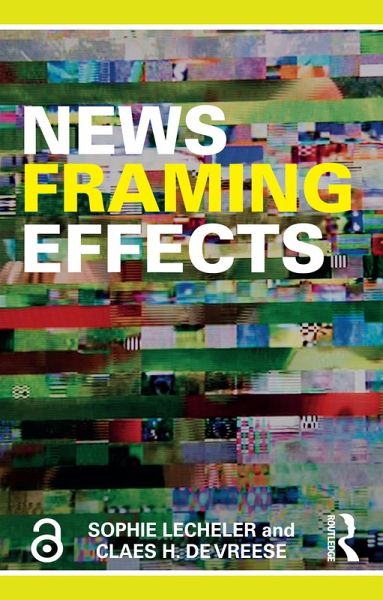
News Framing Effects is a guide to framing effects theory, one of the most prominent theories in media and communication science. Rooted in both psychology and sociology, framing effects theory describes the ability of news media to influence people's attitudes and behaviors by subtle changes to how they report on an issue. The book gives expert commentary on this complex theoretical notion alongside practical instruction on how to apply it to research.
The book's structure mirrors the steps a scholar might take to design a framing study. The first chapter establishes a working definition of news framing effects theory. The following chapters focus on how to identify the independent variable (i.e., the "news frame") and the dependent variable (i.e., the "framing effect"). The book then considers the potential limits or enhancements of the proposed effects (i.e., the "moderators") and how framing effects might emerge (i.e., the "mediators"). Finally, it asks how strong these effects are likely to be. The final chapter considers news framing research in the light of a rapidly and fundamentally changing news and information market, in which technologies, platforms, and changing consumption patterns are forcing assumptions at the core of framing effects theory to be re-evaluated.
The book's structure mirrors the steps a scholar might take to design a framing study. The first chapter establishes a working definition of news framing effects theory. The following chapters focus on how to identify the independent variable (i.e., the "news frame") and the dependent variable (i.e., the "framing effect"). The book then considers the potential limits or enhancements of the proposed effects (i.e., the "moderators") and how framing effects might emerge (i.e., the "mediators"). Finally, it asks how strong these effects are likely to be. The final chapter considers news framing research in the light of a rapidly and fundamentally changing news and information market, in which technologies, platforms, and changing consumption patterns are forcing assumptions at the core of framing effects theory to be re-evaluated.
Dieser Download kann aus rechtlichen Gründen nur mit Rechnungsadresse in A, B, BG, CY, CZ, D, DK, EW, E, FIN, F, GR, HR, H, IRL, I, LT, L, LR, M, NL, PL, P, R, S, SLO, SK ausgeliefert werden.
"Written by two leading experts in news framing and news framing effects, this book is lucidly written, highly informative, and offers a much-needed integrative approach. It should be of great interest not only to students and scholars, but also to practitioners of journalism and political communication."
Jesper Strömbäck, Professor, Department of Journalism, Media and Communication, University of Gothenburg, Sweden
"de Vreese and Lecheler have done students and fellow scholars a great service by creating a succinct, yet comprehensive account of how news frames affect those who receive them. News Framing Effects organizes the major strains of research, addresses debates in the research literature, and offers important new insights."
David Tewksbury, Professor, Department of Communication, University of Illinois at Urbana-Champaign, USA
Jesper Strömbäck, Professor, Department of Journalism, Media and Communication, University of Gothenburg, Sweden
"de Vreese and Lecheler have done students and fellow scholars a great service by creating a succinct, yet comprehensive account of how news frames affect those who receive them. News Framing Effects organizes the major strains of research, addresses debates in the research literature, and offers important new insights."
David Tewksbury, Professor, Department of Communication, University of Illinois at Urbana-Champaign, USA