0,49 €
inkl. MwSt.
Sofort per Download lieferbar
0 °P sammeln

Andere Kunden interessierten sich auch für
 (eBook, ePUB)") Nicomachean Ethics (Summarized Edition) (eBook, ePUB)0,49 €
Nicomachean Ethics (Summarized Edition) (eBook, ePUB)0,49 € (eBook, ePUB)") Groundwork of the Metaphysics of Morals (Summarized Edition) (eBook, ePUB)0,49 €
Groundwork of the Metaphysics of Morals (Summarized Edition) (eBook, ePUB)0,49 € (eBook, ePUB)") The Society of the Spectacle (Summarized Edition) (eBook, ePUB)0,49 €
The Society of the Spectacle (Summarized Edition) (eBook, ePUB)0,49 € (eBook, ePUB)") Ethics (Summarized Edition) (eBook, ePUB)0,49 €
Ethics (Summarized Edition) (eBook, ePUB)0,49 € (eBook, ePUB)") Ethics (Summarized Edition) (eBook, ePUB)0,49 €
Ethics (Summarized Edition) (eBook, ePUB)0,49 € (eBook, ePUB)") Organon - Prior Analytics (Summarized Edition) (eBook, ePUB)0,49 €
Organon - Prior Analytics (Summarized Edition) (eBook, ePUB)0,49 € (eBook, ePUB)") On Benefits (Summarized Edition) (eBook, ePUB)0,49 €
On Benefits (Summarized Edition) (eBook, ePUB)0,49 €
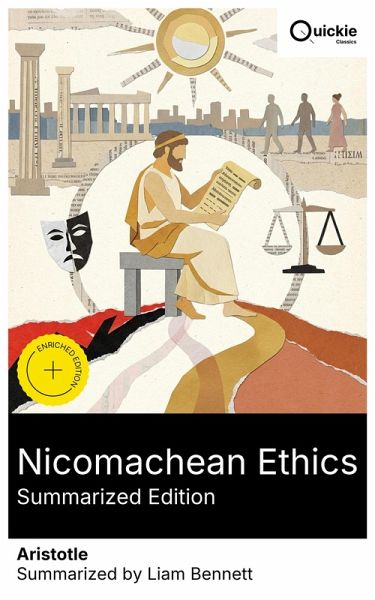
Aristotle's Nicomachean Ethics offers a rigorous map of human flourishing (eudaimonia), arguing that virtue is a practiced mean between extremes, guided by practical wisdom (phronesis). Organized as lecture-books, its style is dialectical and precise, testing reputable opinions (endoxa) against lived experience. Across discussions of character, choice, pleasure, justice (distributive and corrective), weakness of will (akrasia), and the varieties of friendship, Aristotle integrates psychology and politics, culminating in the priority of contemplation and the claim that ethics requires a civic framework. Situated after Plato yet distinctly empirical, it crystallizes Peripatetic moral philosophy. Student of Plato and founder of the Lyceum, Aristotle combined wide-ranging biological research with constitutional studies, an outlook shaped early by his physician father at the Macedonian court and later by tutoring Alexander. The Ethics likely derives from teaching materials for his school, marrying systematic analysis to case-sensitive observation and orienting moral inquiry toward action. This book rewards readers who seek ethical guidance without dogma: students of philosophy, leaders, jurists, and anyone negotiating habit, emotion, and deliberation. Read it for its lucid architecture and its humane insistence that character is formed by practice, choice, and community under the aim of living well. Quickie Classics summarizes timeless works with precision, preserving the author's voice and keeping the prose clear, fast, and readable-distilled, never diluted. Enriched Edition extras: Introduction · Synopsis · Historical Context · Author Biography · Brief Analysis · 4 Reflection Q&As · Editorial Footnotes.
Dieser Download kann aus rechtlichen Gründen nur mit Rechnungsadresse in A, B, BG, CY, CZ, D, DK, EW, E, FIN, F, GR, H, IRL, I, LT, L, LR, M, NL, PL, P, R, S, SLO, SK ausgeliefert werden.