39,95 €
inkl. MwSt.
Sofort per Download lieferbar
20 °P sammeln

Andere Kunden interessierten sich auch für
") Non-Binary Gender Identities (eBook, ePUB)39,95 €
Non-Binary Gender Identities (eBook, ePUB)39,95 €") Queer Memory and Storytelling (eBook, PDF)39,95 €
Queer Memory and Storytelling (eBook, PDF)39,95 €") Gender Diversity and Sport (eBook, PDF)39,95 €
Gender Diversity and Sport (eBook, PDF)39,95 €") Prejudice, Identity and Well-Being (eBook, PDF)48,95 €
Prejudice, Identity and Well-Being (eBook, PDF)48,95 €") Queer Memory and Storytelling (eBook, ePUB)39,95 €
Queer Memory and Storytelling (eBook, ePUB)39,95 €") A Psychodynamic Approach to Female Domination in BDSM Relationships (eBook, PDF)38,95 €
A Psychodynamic Approach to Female Domination in BDSM Relationships (eBook, PDF)38,95 €") Gender Diversity and Sport (eBook, ePUB)39,95 €
Gender Diversity and Sport (eBook, ePUB)39,95 €

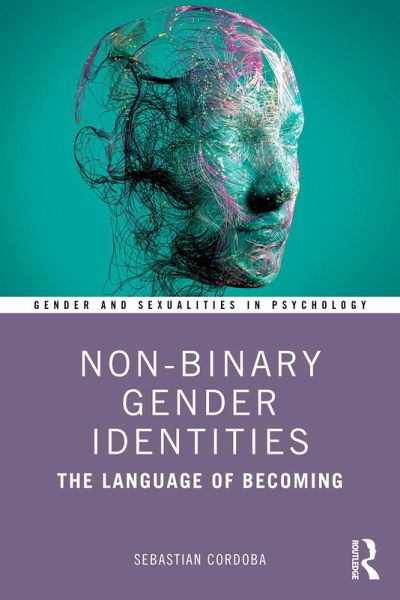
Non-Binary Gender Identities examines how non-binary people discover, adopt, and negotiate language in a variety of social settings, both offline and online. It considers how language, in the form of gender-neutral pronouns, names, and labels, is a central aspect of identity for many and has been the subject of much debate in recent years.
Cordoba captures the psychological, social, and linguistic experiences of non-binary people by illustrating the multiple, complex, and evolving ways in which non-binary people use language to express their gender identities, bodies, authenticity, and navigate social interactions - especially those where their identities are not affirmed. These findings shed light on the gender and linguistic becomings of non-binary people, a pioneering theoretical framework developed in the book, which reflects the dynamic realities of language, subjectivities, and the materiality of the body. Informed by these findings, the text offers recommendations for policy makers and practitioners, designed to facilitate gender-related communication and decrease language-related distress on non-binary people, as well as the general population.
This important book advances our understanding of non-binary gender identities by employing innovative methodologies - including corpus-based research and network visualisation - furthering and developing theory, and yielding original insights. It is essential reading for students and academics in social psychology and gender studies, as well as anyone interested in furthering their understanding of non-binary gender identities.
Cordoba captures the psychological, social, and linguistic experiences of non-binary people by illustrating the multiple, complex, and evolving ways in which non-binary people use language to express their gender identities, bodies, authenticity, and navigate social interactions - especially those where their identities are not affirmed. These findings shed light on the gender and linguistic becomings of non-binary people, a pioneering theoretical framework developed in the book, which reflects the dynamic realities of language, subjectivities, and the materiality of the body. Informed by these findings, the text offers recommendations for policy makers and practitioners, designed to facilitate gender-related communication and decrease language-related distress on non-binary people, as well as the general population.
This important book advances our understanding of non-binary gender identities by employing innovative methodologies - including corpus-based research and network visualisation - furthering and developing theory, and yielding original insights. It is essential reading for students and academics in social psychology and gender studies, as well as anyone interested in furthering their understanding of non-binary gender identities.
Dieser Download kann aus rechtlichen Gründen nur mit Rechnungsadresse in A, B, BG, CY, CZ, D, DK, EW, E, FIN, F, GR, HR, H, IRL, I, LT, L, LR, M, NL, PL, P, R, S, SLO, SK ausgeliefert werden.
'This book is a vital addition to the burgeoning research literature on non-binary experience, and to gender studies more broadly. It presents the first study of its kind to examine the language that non-binary people use to make sense of their experience. Beautifully written, accessible, and engaging, this book invites the reader into exciting and innovative theories and methods, as well as some truly fascinating findings.'
Dr Meg-John Barker, author of Life isn't Binary
'This important text persuasively argues for scholarship to understand how trans and non-binary linguistics centres practices and subjectivities, important to any understanding of gender. They cast new light on gender and the power of words, the ephemeral nature of categories, and their significance to embodiment.'
Zowie Davy, De Montfort University, UK
Dr Meg-John Barker, author of Life isn't Binary
'This important text persuasively argues for scholarship to understand how trans and non-binary linguistics centres practices and subjectivities, important to any understanding of gender. They cast new light on gender and the power of words, the ephemeral nature of categories, and their significance to embodiment.'
Zowie Davy, De Montfort University, UK