42,95 €
42,95 €
inkl. MwSt.
Sofort per Download lieferbar

21 °P sammeln
42,95 €
Als Download kaufen
42,95 €
inkl. MwSt.
Sofort per Download lieferbar
21 °P sammeln
Jetzt verschenken
Alle Infos zum eBook verschenken
42,95 €
inkl. MwSt.
Sofort per Download lieferbar
Alle Infos zum eBook verschenken
21 °P sammeln

Andere Kunden interessierten sich auch für
") Researching Non-state Actors in International Security (eBook, ePUB)0,00 €
Researching Non-state Actors in International Security (eBook, ePUB)0,00 €") Strategic Culture and Violent Non-State Actors (eBook, ePUB)41,95 €
Strategic Culture and Violent Non-State Actors (eBook, ePUB)41,95 €") Routledge Handbook of State Recognition (eBook, ePUB)43,95 €
Routledge Handbook of State Recognition (eBook, ePUB)43,95 €") Chinese Public Diplomacy (eBook, ePUB)51,95 €
Chinese Public Diplomacy (eBook, ePUB)51,95 €") Routledge Handbook of Feminist Peace Research (eBook, ePUB)44,95 €
Routledge Handbook of Feminist Peace Research (eBook, ePUB)44,95 €") The Invasion of Afghanistan and UK-Soviet Relations, 1979-1982 (eBook, ePUB)45,95 €
The Invasion of Afghanistan and UK-Soviet Relations, 1979-1982 (eBook, ePUB)45,95 €") Just War Theory and Non-State Actors (eBook, ePUB)41,95 €
Just War Theory and Non-State Actors (eBook, ePUB)41,95 €


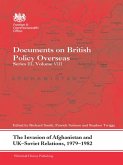

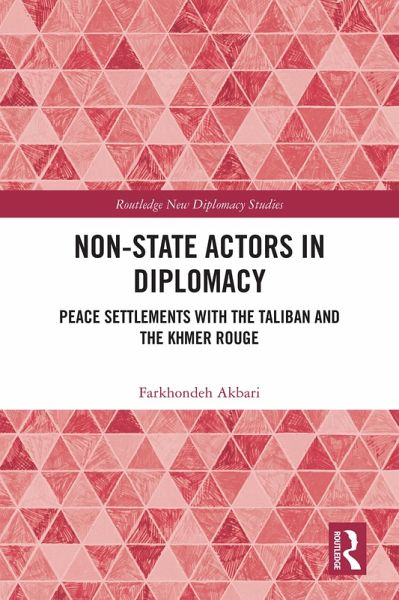
This book examines which characteristics allow a non-state armed actor to be considered an effective diplomatic actor for the purpose of a meaningful peace settlement.
The work demonstrates how such characteristics can potentially contribute to a more successful outcome in peacemaking initiatives with non-state armed actors, and how their absence can become a peril for peace. Addressing a gap in the diplomatic studies literature, the book is concerned with defining, characterising and categorising the effectiveness of diplomatic actors. It argues that the critical characteristics are autonomy, organisational coherence and representativeness, all of which non-state armed actors need to possess to a sufficient degree if they are to engage in meaningful negotiations which could lead to a sustainable peace settlement. The empirical data are drawn from analysis of the diplomatic engagements with the Khmer Rouge that led to 1991 Paris Peace Agreements in relation to the Cambodian conflict and from exploration of the difficulties experienced in attempting to negotiate a peace settlement with the Taliban in Afghanistan. The book's detailed analysis of these two case studies demonstrates the value of the diplomatic actors' framework.
This book will be of much interest to students of diplomacy studies, peace studies, Asian studies and international relations.
The work demonstrates how such characteristics can potentially contribute to a more successful outcome in peacemaking initiatives with non-state armed actors, and how their absence can become a peril for peace. Addressing a gap in the diplomatic studies literature, the book is concerned with defining, characterising and categorising the effectiveness of diplomatic actors. It argues that the critical characteristics are autonomy, organisational coherence and representativeness, all of which non-state armed actors need to possess to a sufficient degree if they are to engage in meaningful negotiations which could lead to a sustainable peace settlement. The empirical data are drawn from analysis of the diplomatic engagements with the Khmer Rouge that led to 1991 Paris Peace Agreements in relation to the Cambodian conflict and from exploration of the difficulties experienced in attempting to negotiate a peace settlement with the Taliban in Afghanistan. The book's detailed analysis of these two case studies demonstrates the value of the diplomatic actors' framework.
This book will be of much interest to students of diplomacy studies, peace studies, Asian studies and international relations.
Dieser Download kann aus rechtlichen Gründen nur mit Rechnungsadresse in A, B, BG, CY, CZ, D, DK, EW, E, FIN, F, GR, HR, H, IRL, I, LT, L, LR, M, NL, PL, P, R, S, SLO, SK ausgeliefert werden.