111,95 €
111,95 €
inkl. MwSt.
Sofort per Download lieferbar

56 °P sammeln
111,95 €
Als Download kaufen
111,95 €
inkl. MwSt.
Sofort per Download lieferbar
56 °P sammeln
Jetzt verschenken
Alle Infos zum eBook verschenken
111,95 €
inkl. MwSt.
Sofort per Download lieferbar
Alle Infos zum eBook verschenken
56 °P sammeln

Andere Kunden interessierten sich auch für
") Notion of Employer in the Era of the Fissured Workplace (eBook, ePUB)111,95 €
Notion of Employer in the Era of the Fissured Workplace (eBook, ePUB)111,95 €") Employer Liability for Workplace Trauma (eBook, PDF)52,95 €
Employer Liability for Workplace Trauma (eBook, PDF)52,95 €") Smoking and the Workplace (eBook, PDF)117,95 €
Smoking and the Workplace (eBook, PDF)117,95 €") Trade Union Rights at the Workplace (eBook, PDF)99,95 €
Trade Union Rights at the Workplace (eBook, PDF)99,95 €") Impact of the Internet and New Technologies on the Workplace (eBook, PDF)120,95 €
Impact of the Internet and New Technologies on the Workplace (eBook, PDF)120,95 €") Sexual Harassment in the Workplace (eBook, PDF)109,95 €
Sexual Harassment in the Workplace (eBook, PDF)109,95 €") The Concept of the Employer (eBook, PDF)16,95 €
The Concept of the Employer (eBook, PDF)16,95 €




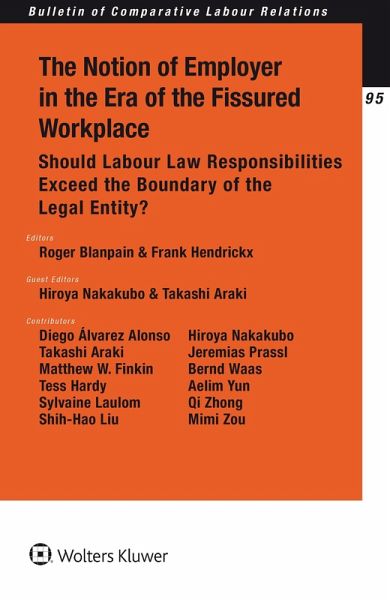
The word ''fissured'' aptly describes the effect on the workplace of the enormous retreat from direct employment on the part of large enterprises that began several decades ago and shows no sign of slowing down. Market-leading companies, even though they continue to wield considerable influence on the fate of actual workers, may thus be relieved of legal responsibility as employers. How extensive is this phenomenon? Do recourses exist in labour law? What ongoing trends can be discerned? This groundbreaking book tackles these questions and more, with thoroughly researched reports from ten of the world's leading market-driven economies - Australia, China, France, Germany, Japan, the Republic of Korea, Spain, Taiwan, the United Kingdom, and the United States.
Recognizing that law should squarely grasp and tackle this new reality, the authors consider such questions as the following:
Each contributor describes, for his or her country, how far the fragmentation and externalization of employment has gone, current legislation protecting workers in a multilayered contractual relationship or indirect employment relationship (e.g., on health and safety, wages, bargaining, dismissal), and emerging developments and trends.
This book ably responds to the question posed by a recent study: Why has work became so bad for so many and what can be done to improve it? Although concerned scholars worldwide will rally to the call, the reports in this volume will also be of great practical value to business persons and labour and employment lawyers everywhere.
Recognizing that law should squarely grasp and tackle this new reality, the authors consider such questions as the following:
- - How far can current labour law go in determining the responsibility of persons who have no direct contractual relationship with the workers?
- - Do other measures such as soft law or reputation mechanisms in the market deal with the undesirable consequences of the ¬fissurization more properly?
- - What managerial motives and socioeconomic backgrounds give rise to such ¬fissurization?
- - What distinct phenomena compose ¬fissuring?
- - Are measures available to protect workers that go beyond the boundary of the legal entity (e.g., initiatives toward piercing the corporate veil)?
Each contributor describes, for his or her country, how far the fragmentation and externalization of employment has gone, current legislation protecting workers in a multilayered contractual relationship or indirect employment relationship (e.g., on health and safety, wages, bargaining, dismissal), and emerging developments and trends.
This book ably responds to the question posed by a recent study: Why has work became so bad for so many and what can be done to improve it? Although concerned scholars worldwide will rally to the call, the reports in this volume will also be of great practical value to business persons and labour and employment lawyers everywhere.
Dieser Download kann aus rechtlichen Gründen nur mit Rechnungsadresse in A, B, BG, CY, CZ, D, DK, EW, E, FIN, F, GR, HR, H, IRL, I, LT, L, LR, M, NL, PL, P, R, S, SLO, SK ausgeliefert werden.