49,95 €
49,95 €
inkl. MwSt.
Sofort per Download lieferbar

25 °P sammeln
49,95 €
Als Download kaufen
49,95 €
inkl. MwSt.
Sofort per Download lieferbar
25 °P sammeln
Jetzt verschenken
Alle Infos zum eBook verschenken
49,95 €
inkl. MwSt.
Sofort per Download lieferbar
Alle Infos zum eBook verschenken
25 °P sammeln

Andere Kunden interessierten sich auch für
") Nouveau-riche Nationalism and Multiculturalism in Korea (eBook, PDF)49,95 €
Nouveau-riche Nationalism and Multiculturalism in Korea (eBook, PDF)49,95 €") The Routledge Companion to Race and Ethnicity (eBook, ePUB)21,95 €
The Routledge Companion to Race and Ethnicity (eBook, ePUB)21,95 €") The Politics of Korean Language Textbooks in the Two Koreas (eBook, ePUB)38,95 €
The Politics of Korean Language Textbooks in the Two Koreas (eBook, ePUB)38,95 €") Social Media and the Cultural Politics of Korean Pop Culture in East Asia (eBook, ePUB)39,95 €
Social Media and the Cultural Politics of Korean Pop Culture in East Asia (eBook, ePUB)39,95 €") Introducing Korean Popular Culture (eBook, ePUB)35,95 €
Introducing Korean Popular Culture (eBook, ePUB)35,95 €") Asian Nationalism in an Age of Globalization (eBook, ePUB)45,95 €
Asian Nationalism in an Age of Globalization (eBook, ePUB)45,95 €") Women, Television and Everyday Life in Korea (eBook, ePUB)55,95 €
Women, Television and Everyday Life in Korea (eBook, ePUB)55,95 €


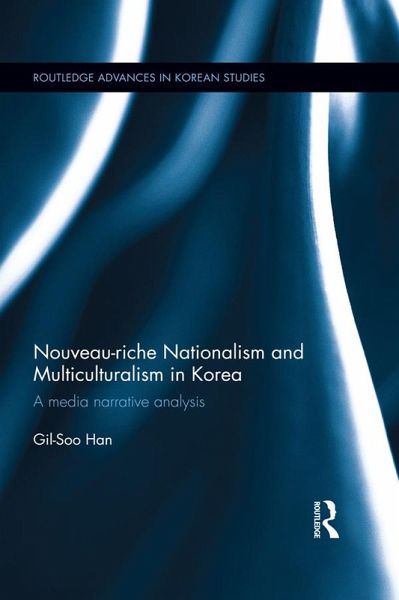
The unprecedented economic success of South Korea since the 1990s has led in turn to a large increase in the number of immigrants and foreign workers in Korean industries. This book describes and explains the experiences of discrimination and racism that foreigners and 'new' Koreans have faced in a multicultural South Korea. It looks at how society has treated the foreigners and what their experiences have been given that common discourse about race in Korea surrounds issues of Korean heterogeneity and pure blood nationalism.
Starting with critiques of Korean scholarship and policy framework on multiculturalism, this book argues for the need to revisit the most fundamental aspect of multiculturalism: the host population's ability to respect new comers rather than discriminate against them. The author employs a critical realist understanding of racism and attempts to identify long-lasting institutional factors which make Korean society less than welcoming 'new' or temporary Koreans. A large number of new reportages are identified and systematically analysed based on the principles of grounded theory method. The findings show that nouveau-riche nationalism and pure-blood nationalism are widely practised when Koreans deal with 'foreigners'. As a newly industrialised and highly successful nation, Korean society is still in transition and treats foreigners according to economic standard of their countries of origin.
As one of the very first books in English about foreigners' experiences of Korean nationalism, multiculturalism and discrimination, it will be of great interest to students and scholars of Sociology, Ethnic studies, Asian studies, Korean studies, Media studies and Cultural studies.
Starting with critiques of Korean scholarship and policy framework on multiculturalism, this book argues for the need to revisit the most fundamental aspect of multiculturalism: the host population's ability to respect new comers rather than discriminate against them. The author employs a critical realist understanding of racism and attempts to identify long-lasting institutional factors which make Korean society less than welcoming 'new' or temporary Koreans. A large number of new reportages are identified and systematically analysed based on the principles of grounded theory method. The findings show that nouveau-riche nationalism and pure-blood nationalism are widely practised when Koreans deal with 'foreigners'. As a newly industrialised and highly successful nation, Korean society is still in transition and treats foreigners according to economic standard of their countries of origin.
As one of the very first books in English about foreigners' experiences of Korean nationalism, multiculturalism and discrimination, it will be of great interest to students and scholars of Sociology, Ethnic studies, Asian studies, Korean studies, Media studies and Cultural studies.
Dieser Download kann aus rechtlichen Gründen nur mit Rechnungsadresse in A, B, BG, CY, CZ, D, DK, EW, E, FIN, F, GR, HR, H, IRL, I, LT, L, LR, M, NL, PL, P, R, S, SLO, SK ausgeliefert werden.