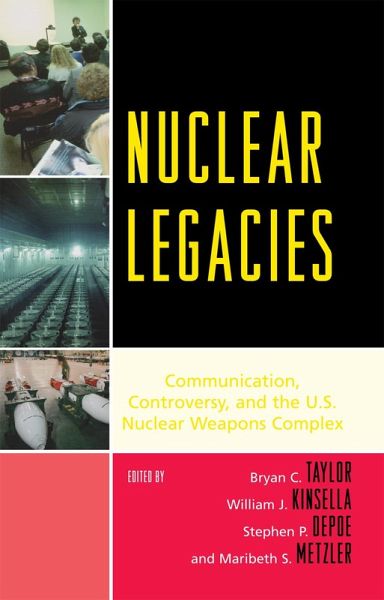
Communication, Controversy, and the U.S. Nuclear Weapons Complex Redaktion: Metzler, Maribeth S.; Depoe, Stephen P.; Kinsella, William J.; Taylor, Bryan C.
Communication, Controversy, and the U.S. Nuclear Weapons Complex Redaktion: Metzler, Maribeth S.; Depoe, Stephen P.; Kinsella, William J.; Taylor, Bryan C.
Sie sind bereits eingeloggt. Klicken Sie auf 2. tolino select Abo, um fortzufahren.
Bitte loggen Sie sich zunächst in Ihr Kundenkonto ein oder registrieren Sie sich bei bücher.de, um das eBook-Abo tolino select nutzen zu können.
Although the Cold War is commonly considered 'over,' the legacies of that conflict continue to unfold throughout the globe. One site of post-Cold War controversy involves the consequences of U.S. nuclear weapons production for worker safety, public health, and the environment. Over the past two decades, citizens, organizations, and governments have passionately debated the nature of these consequences, and how they should be managed. This volume clarifies the role of communication in creating, maintaining, and transforming the relationships between these parties, and in shaping the outcomes of…mehr
Although the Cold War is commonly considered 'over,' the legacies of that conflict continue to unfold throughout the globe. One site of post-Cold War controversy involves the consequences of U.S. nuclear weapons production for worker safety, public health, and the environment. Over the past two decades, citizens, organizations, and governments have passionately debated the nature of these consequences, and how they should be managed. This volume clarifies the role of communication in creating, maintaining, and transforming the relationships between these parties, and in shaping the outcomes of related organizational and political deliberations. Providing various perspectives on nuclear culture and discourse, this anthology serves as a model of interdisciplinary communication scholarship that cuts across the subfields of political, environmental, and organizational communication studies, and rhetoric.
Die Herstellerinformationen sind derzeit nicht verfügbar.
Autorenporträt
Bryan C. Taylor is associate professor of communication at the University of Colorado-Boulder. Stephen P. Depoe is associate professor in the Department of Communication at the University of Cincinnati, where he also directs the Center for Health and Environmental Communication Research. William J. Kinsella is a faculty member in the Department of Communication and the interdisciplinary program in Science, Technology, and Society at North Carolina State University. Maribeth S. Metzler is associate professor and director of the public relations program at the University of Cincinnati.
Inhaltsangabe
Chapter 1 Introduction: Linking Nuclear Legacies and Communication Studies Part 2 The Discourse of Officials and Stakeholders of Nuclear Weapons Production Chapter 3 Convergence and Divergence in the Public Dialogue on Nuclear Weapons Cleanup Chapter 4 Becoming Hanford Downwinders: Producing Community and Challenging Discursive Containment Chapter 5 Regional Communication and Sense of Place Surrounding the Waste Isolation Pilot Plant Part 6 Organizing the Past, Present, and Future of Nuclear Weapons Production Chapter 7 Cold War Triumphant: The Rhetorical Uses of History, Memory, and Heritage Preservation within the Department of Energy's Nuclear Weapons Complex Chapter 8 TRUTH is Generated HERE: Knowledge Loss and the Production of Nuclear Confidence in the Post-Cold War Era Chapter 9 (Forever) At Work in the Fields of the Bomb: Images of Long Term Stewardship in Post-Cold War Nuclear Discourse Part 10 Critical Response Chapter 11 Response: Nuclear Legacies and Opportunities for Politically and Ethically Engaged Communication Scholarship
Chapter 1 Introduction: Linking Nuclear Legacies and Communication Studies Part 2 The Discourse of Officials and Stakeholders of Nuclear Weapons Production Chapter 3 Convergence and Divergence in the Public Dialogue on Nuclear Weapons Cleanup Chapter 4 Becoming Hanford Downwinders: Producing Community and Challenging Discursive Containment Chapter 5 Regional Communication and Sense of Place Surrounding the Waste Isolation Pilot Plant Part 6 Organizing the Past, Present, and Future of Nuclear Weapons Production Chapter 7 Cold War Triumphant: The Rhetorical Uses of History, Memory, and Heritage Preservation within the Department of Energy's Nuclear Weapons Complex Chapter 8 TRUTH is Generated HERE: Knowledge Loss and the Production of Nuclear Confidence in the Post-Cold War Era Chapter 9 (Forever) At Work in the Fields of the Bomb: Images of Long Term Stewardship in Post-Cold War Nuclear Discourse Part 10 Critical Response Chapter 11 Response: Nuclear Legacies and Opportunities for Politically and Ethically Engaged Communication Scholarship
Es gelten unsere Allgemeinen Geschäftsbedingungen: www.buecher.de/agb
Impressum
www.buecher.de ist ein Internetauftritt der buecher.de internetstores GmbH
Geschäftsführung: Monica Sawhney | Roland Kölbl | Günter Hilger
Sitz der Gesellschaft: Batheyer Straße 115 - 117, 58099 Hagen
Postanschrift: Bürgermeister-Wegele-Str. 12, 86167 Augsburg
Amtsgericht Hagen HRB 13257
Steuernummer: 321/5800/1497
USt-IdNr: DE450055826