30,95 €
inkl. MwSt.
Erscheint vor. 19.05.26
15 °P sammeln

Andere Kunden interessierten sich auch für
") The Energy Trilemma in the Baltic Sea Region (eBook, ePUB)42,95 €
The Energy Trilemma in the Baltic Sea Region (eBook, ePUB)42,95 €") Energy Justice in Latin America (eBook, ePUB)41,95 €
Energy Justice in Latin America (eBook, ePUB)41,95 €") Energy Transition in the Baltic Sea Region (eBook, ePUB)0,00 €
Energy Transition in the Baltic Sea Region (eBook, ePUB)0,00 €") The Poverty of Green Philosophy (eBook, ePUB)5,99 €
The Poverty of Green Philosophy (eBook, ePUB)5,99 €") Nuclear Energy (eBook, ePUB)74,95 €
Nuclear Energy (eBook, ePUB)74,95 €") Energy, Environment and Geopolitics in Eurasia (eBook, ePUB)39,95 €
Energy, Environment and Geopolitics in Eurasia (eBook, ePUB)39,95 €") Steam Generators for Nuclear Power Plants (eBook, ePUB)146,95 €
Steam Generators for Nuclear Power Plants (eBook, ePUB)146,95 €


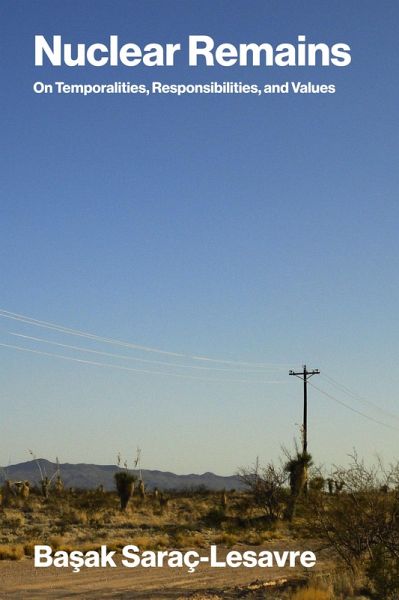
An ethnography of U.S. nuclear waste policy, and how to understand contemporary societies' attempts to establish "good" relations with the future. Contemporary societies are often criticized for their incapacity to account for the long-term. Nuclear Remains asks what happens when a society decides to think long-term-examining the U.S. efforts to hold present and distant futures together. Focusing on the case of the U.S. nuclear waste program, Basak Saraç-Lesavre argues that no temporal orientation is inherently ethical; what matters is how temporal orientations construed as desirable get translated into action. To analyze how concerned actors seek to establish "good" relations between past, present, and future, Saraç-Lesavre introduces the problem of rendez-vous framework-tracing how temporal gaps are identified and resolutions formulated and inscribed in different forms of arrangements. Her multi-sited ethnographic research takes readers from Congressional debates over funding-to reconcile accountability to and immunity from politics-to Carlsbad, New Mexico, where local actors have been trying to keep their community attached to nuclear futures. Over time, these arrangements face tests. They are barely ever considered au rendez-vous when meeting contemporary conditions, yet produce significant effects: material, economic, political, and moral relations, and ultimately, societies themselves. This framework applies broadly to cases where temporal relations are at stake: climate change adaptation, government of commons, pension schemes, energy transition, and care systems.
Dieser Download kann aus rechtlichen Gründen nur mit Rechnungsadresse in A, B, BG, CY, CZ, D, DK, EW, E, FIN, F, GR, HR, H, IRL, I, LT, L, LR, M, NL, PL, P, R, S, SLO, SK ausgeliefert werden.