Sie sind bereits eingeloggt. Klicken Sie auf 2. tolino select Abo, um fortzufahren.
Bitte loggen Sie sich zunächst in Ihr Kundenkonto ein oder registrieren Sie sich bei bücher.de, um das eBook-Abo tolino select nutzen zu können.
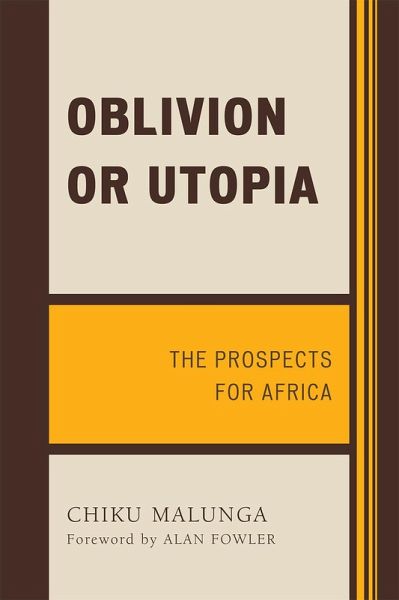
Oblivion or Utopia: the Prospects for Africa explains that most of the problems on the continent stem from the fact that, although the continent may be politically independent, it is not economically independent. Efforts to reverse the continent's continuing underdevelopment have failed to date, including trillions of dollars in aid, because they have not been consciously aimed at enabling Africa to turn its vast natural resources into wealth, which is the only known way of ensuring economic independence. Based on a comprehensive exploration of impediments to reach the goal of economic…mehr
Oblivion or Utopia: the Prospects for Africa explains that most of the problems on the continent stem from the fact that, although the continent may be politically independent, it is not economically independent. Efforts to reverse the continent's continuing underdevelopment have failed to date, including trillions of dollars in aid, because they have not been consciously aimed at enabling Africa to turn its vast natural resources into wealth, which is the only known way of ensuring economic independence. Based on a comprehensive exploration of impediments to reach the goal of economic independence required for self definition, the book proposes a five step strategy which can enable the continent to turn its natural resources into wealth by: 1.Raising awareness and consciousness that Africa is not economically independent yet 2.Creating visions of aspiration 3.Organizing for wealth creation 4.Cultivating a business culture 5.Patronizing own businesses A revolutionary implementation of the five steps, the author argues, would make utopia triumph over oblivion on the continent of Africa.
Die Herstellerinformationen sind derzeit nicht verfügbar.
Autorenporträt
Chiku Malunga is an author and a consultant with many years of experience in organization development and development practice work among African, European and American non-profits, NGOs and civil society organizations. He holds a doctorate degree in development studies from the University of South Africa. He is currently the director of Capacity Development Consultants (CADECO), an organization that promotes African- centered organizational improvement models. Malunga's interest is in contextualizing European and American concepts of organizational/institutional development and development practice for more relevance in the developing regions of the world, and using Africa's indigenous wisdom to enrich the organizational and development theories and practice in the developed regions of the world. Malunga carries out this bridging mission through writing, consultancy and speaking engagements. His other books include: Understanding Organizational Sustainability through African Proverbs, Making Strategic Plans Work: Insights from African Indigenous Wisdom and Understanding Organizational Leadership through Ubuntu.
Inhaltsangabe
Chapter 1 Foreword Chapter 2 Acknowledgements Chapter 3 Chapter 1: Introduction Chapter 4 Chapter 2: The Nature of the Struggle Chapter 5 Chapter 3: Africa's Economy Chapter 6 Chapter 4: African Politics and Economic Development Chapter 7 Chapter 5: Civil Society and Economic Development Chapter 8 Chapter 6: African Culture and Economic Development Chapter 9 Chapter 7: What can Africa learn from South Korea's Economic Miracle? Chapter 10 Chapter 8: Positioning Africa in the World Chapter 11 Chapter 9: What would an Economically Liberated Africa Look Like? Chapter 12 Chapter 10: The Five Step Strategy for Africa's Economic Independence Chapter 13 Bibliography Chapter 14 Appendix: A Summary of the Discussion of the Future of Africa Chapter 15 Index Chapter 16 About the Author
Es gelten unsere Allgemeinen Geschäftsbedingungen: www.buecher.de/agb
Impressum
www.buecher.de ist ein Internetauftritt der buecher.de internetstores GmbH
Geschäftsführung: Monica Sawhney | Roland Kölbl | Günter Hilger
Sitz der Gesellschaft: Batheyer Straße 115 - 117, 58099 Hagen
Postanschrift: Bürgermeister-Wegele-Str. 12, 86167 Augsburg
Amtsgericht Hagen HRB 13257
Steuernummer: 321/5800/1497
USt-IdNr: DE450055826