0,49 €
inkl. MwSt.
Sofort per Download lieferbar
0 °P sammeln

Andere Kunden interessierten sich auch für
 (eBook, ePUB)") A Tale of Two Cities (Summarized Edition) (eBook, ePUB)0,49 €
A Tale of Two Cities (Summarized Edition) (eBook, ePUB)0,49 € (eBook, ePUB)") Great Expectations (Summarized Edition) (eBook, ePUB)0,49 €
Great Expectations (Summarized Edition) (eBook, ePUB)0,49 € (eBook, ePUB)") Our Mutual Friend (Summarized Edition) (eBook, ePUB)0,49 €
Our Mutual Friend (Summarized Edition) (eBook, ePUB)0,49 € (eBook, ePUB)") Notes from Underground (Summarized Edition) (eBook, ePUB)0,49 €
Notes from Underground (Summarized Edition) (eBook, ePUB)0,49 € (eBook, ePUB)") Celtic Legends & Myths (Summarized Edition) (eBook, ePUB)0,49 €
Celtic Legends & Myths (Summarized Edition) (eBook, ePUB)0,49 € (eBook, ePUB)") Gone to Earth (Summarized Edition) (eBook, ePUB)0,49 €
Gone to Earth (Summarized Edition) (eBook, ePUB)0,49 € (eBook, ePUB)") Emma (Summarized Edition) (eBook, ePUB)0,49 €
Emma (Summarized Edition) (eBook, ePUB)0,49 €
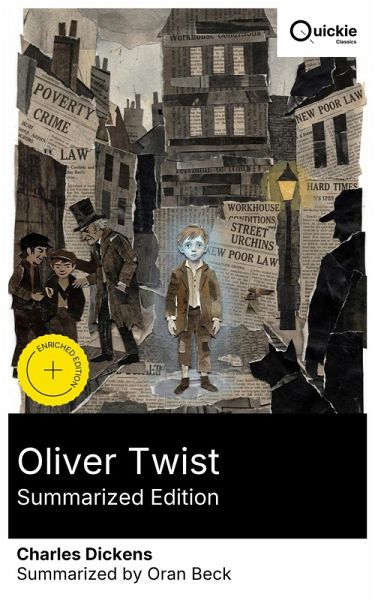
Oliver Twist maps the passage of an orphan from parish workhouse to London's criminal underworld, exposing the hypocrisies of the New Poor Law and the commodification of childhood. In a blend of picaresque movement, melodramatic suspense, and Gothic chiaroscuro, Dickens employs an omniscient, satiric narrator whose indignation is leavened by irony and pathos. Vivid set pieces-workhouse cruelty, Fagin's den, Sikes's brutality, Nancy's moral courage-construct a topography of urban vice and reluctant virtue, situating the novel within early Victorian social-problem fiction and the contentious Newgate novel debates. Born from Dickens's own encounters with poverty, journalism, and theatricality, the narrative draws on his childhood trauma of factory labor and his father's imprisonment for debt, as well as his reporter's tours through police courts and slums. Serialized composition in Bentley's Miscellany shaped its cliffhangers and crowd-pleasing turns, while the author's reformist impulse compelled a scathing depiction of institutional callousness, anti-Semitic caricature complicated by later revisions, and a probing interest in how language, law, and space discipline the poor. Readers of Victorian literature, social history, and urban studies will find Oliver Twist indispensable: a gripping narrative and a moral document that continues to illuminate poverty, criminality, and compassion. Quickie Classics summarizes timeless works with precision, preserving the author's voice and keeping the prose clear, fast, and readable-distilled, never diluted. Enriched Edition extras: Introduction · Synopsis · Historical Context · Author Biography · Brief Analysis · 4 Reflection Q&As · Editorial Footnotes.
Dieser Download kann aus rechtlichen Gründen nur mit Rechnungsadresse in A, B, BG, CY, CZ, D, DK, EW, E, FIN, F, GR, H, IRL, I, LT, L, LR, M, NL, PL, P, R, S, SLO, SK ausgeliefert werden.