0,49 €
inkl. MwSt.
Sofort per Download lieferbar
0 °P sammeln

Andere Kunden interessierten sich auch für
 (eBook, ePUB)") On Benefits (De Beneficiis) (eBook, ePUB)1,99 €
On Benefits (De Beneficiis) (eBook, ePUB)1,99 € (eBook, ePUB)") Logic: Deductive and Inductive (Summarized Edition) (eBook, ePUB)0,49 €
Logic: Deductive and Inductive (Summarized Edition) (eBook, ePUB)0,49 € (eBook, ePUB)") Leviathan (Summarized Edition) (eBook, ePUB)0,49 €
Leviathan (Summarized Edition) (eBook, ePUB)0,49 € (eBook, ePUB)") Ethics (Summarized Edition) (eBook, ePUB)0,49 €
Ethics (Summarized Edition) (eBook, ePUB)0,49 € (eBook, ePUB)") Second Treatise of Government (Summarized Edition) (eBook, ePUB)0,49 €
Second Treatise of Government (Summarized Edition) (eBook, ePUB)0,49 € (eBook, ePUB)") The Essays of Arthur Schopenhauer; Counsels and Maxims (Summarized Edition) (eBook, ePUB)0,49 €
The Essays of Arthur Schopenhauer; Counsels and Maxims (Summarized Edition) (eBook, ePUB)0,49 € (eBook, ePUB)") Ethics (Summarized Edition) (eBook, ePUB)0,49 €
Ethics (Summarized Edition) (eBook, ePUB)0,49 €





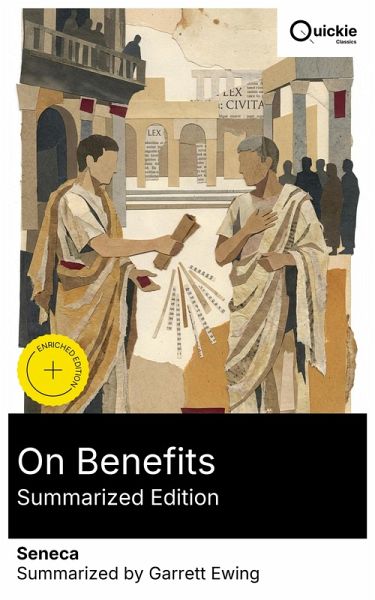
On Benefits (De Beneficiis) probes the ethics of giving, receiving, and reciprocating within Rome's patronage culture. In seven books to Aebutius Liberalis, Seneca defines a benefit as the giver's intention (animus), not the thing, and weighs timing, proportion, and decorum. He distinguishes gratitude from repayment, rebukes ostentation and calculation, and analyzes ingratitude as a civic toxin. Composed in tight, aphoristic prose enlivened by historical exempla and probing distinctions, the treatise marries Stoic moral theory to the practical social economy of the early Principate. Lucius Annaeus Seneca-philosopher, dramatist, and statesman-wrote amid Nero's court after exile and a return to immense influence. Schooled by Stoics like Attalus, he reflected on power, liberality, and obligation in works including On Mercy; De Beneficiis extends that counsel to the gift economy sustaining amicitia and imperial rule. Scholars of classical ethics, historians of Roman society, and readers interested in leadership or philanthropy will find this a lucid, bracing guide. It models generosity governed by character rather than cost, and invites reflection on how gifts forge-and poison-community. Quickie Classics summarizes timeless works with precision, preserving the author's voice and keeping the prose clear, fast, and readable-distilled, never diluted. Enriched Edition extras: Introduction · Synopsis · Historical Context · Author Biography · Brief Analysis · 4 Reflection Q&As · Editorial Footnotes.
Dieser Download kann aus rechtlichen Gründen nur mit Rechnungsadresse in A, B, BG, CY, CZ, D, DK, EW, E, FIN, F, GR, H, IRL, I, LT, L, LR, M, NL, PL, P, R, S, SLO, SK ausgeliefert werden.