Sie sind bereits eingeloggt. Klicken Sie auf 2. tolino select Abo, um fortzufahren.
Bitte loggen Sie sich zunächst in Ihr Kundenkonto ein oder registrieren Sie sich bei bücher.de, um das eBook-Abo tolino select nutzen zu können.
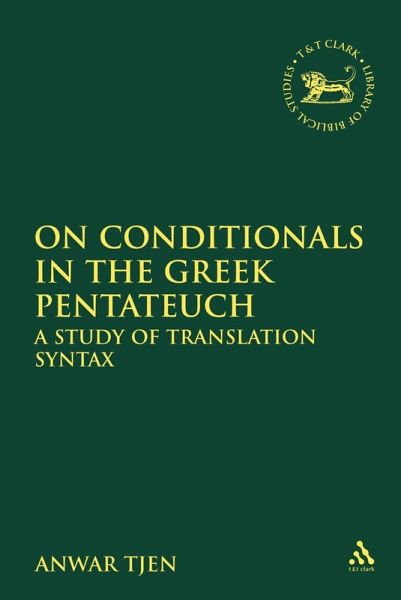
The book examines conditionals in the Greek Pentateuch from the point of view of the study of translation syntax. It takes seriously into account the double character of Septuagintal Greek, both as a translation from Hebrew and as vernacular Greek. Methodologically, the underlying Hebrew is taken as the point of departure in close comparison with the resultant translation, with the purpose of examining major features in the translators? handling of this complex construction. These include the rendering of verbal and non-verbal forms in the protasis and apodosis, the question of sense-division…mehr
The book examines conditionals in the Greek Pentateuch from the point of view of the study of translation syntax. It takes seriously into account the double character of Septuagintal Greek, both as a translation from Hebrew and as vernacular Greek. Methodologically, the underlying Hebrew is taken as the point of departure in close comparison with the resultant translation, with the purpose of examining major features in the translators? handling of this complex construction. These include the rendering of verbal and non-verbal forms in the protasis and apodosis, the question of sense-division between the two constituent clauses, the influence of genre or discourse type and interference from the underlying form or structure. Detailed analyses of the resultant translation displays features that are natural Greek, on the one hand, and features that betray the character of "translation-language", on the other hand, owing to interference from the source text. The latter manifests itself most conspicuously in renderings that are ungrammatical or unnatural, and, in a more subtle way, through equivalents which are grammatically acceptable but occur with a strikingly high frequency in the Septuagint as compared with original Greek compositions contemporary with the Septuagint.
Die Herstellerinformationen sind derzeit nicht verfügbar.
Autorenporträt
Dr. Anwar Tjen is an ordained Lutheran minister of Christian Protestant Church in Indonesia (GKPI) and is Translation Consultant of the Indonesia Bible Society, currently in charge of the following major revisions: Indonesian Standard Version, Toba Batak Bible and Javanese Old Testament.
Inhaltsangabe
Acknowledgements Abbreviations INTRODUCTION 1. Studying LXX conditionals: methodology and scope 2. Overview of previous studies on LXX conditionals 3. A note on the critical texts 4. Organization of this study CHAPTER 1 - HEBREW CONDITIONALS: AN OVERVIEW 1. Relative order of protasis-apodosis 2. Marking of conditionality 3. Unmarked conditionals 4. Ellipsis in conditional constructions 5. Verb forms and taxonomy of conditionals: temporal reference, degree of certainty, modality CHAPTER 2 - GREEK CONDITIONALS: AN OVERVIEW 1. Relative order of protasis-apodosis 2. Marking of conditionality 3. Formal features of Greek conditional constructions 4. Major change in Koine: the decline of the optative 5. Classification and interpretation of Greek conditionals CHAPTER 3 - IDENTIFICATION AND INTERPRETATION OF HEBREW CONSTRUCTIONS AS CONDITIONALS IN THE LXX 1. Introductory markers in overtly marked conditionals 2. Constructions introduced by £' and yk 3. Constructions introduced by other markers 4. Unmarked constructions rendered as conditionals 5. Some cases involving orthographic or textual differences 6. Summary CHAPTER 4 - COLLOCATIONAL FEATURES IN THE LXX RENDERING OF HEBREW CONDITIONAL SYNTAGMS: YIQTOL-weQATAL 1. Distribution of the renderings 2. The prevalent equivalent: ??n + subjunctive 3. E¿ + indicative 4. Non-finite equivalents 5. Cases containing pluses or minuses in the LXX 6. WeQATALs interpreted as paratactic conditionals 7. WeQATAL and peculiar cases of sense-division 8. Summary CHAPTER 5 - COLLOCATIONAL FEATURES IN THE LXX RENDERING OF CONDITIONAL SYNTAGMS: QATAL, wayYIQTOL, QOTEL AND OTHER FORMS 1. Conditional syntagms with QATAL
Es gelten unsere Allgemeinen Geschäftsbedingungen: www.buecher.de/agb
Impressum
www.buecher.de ist ein Internetauftritt der buecher.de internetstores GmbH
Geschäftsführung: Monica Sawhney | Roland Kölbl | Günter Hilger
Sitz der Gesellschaft: Batheyer Straße 115 - 117, 58099 Hagen
Postanschrift: Bürgermeister-Wegele-Str. 12, 86167 Augsburg
Amtsgericht Hagen HRB 13257
Steuernummer: 321/5800/1497
USt-IdNr: DE450055826