Optimization of Electric-Vehicle Charging (eBook, PDF)
Scheduling and Planning Problems
Alle Infos zum eBook verschenken
Optimization of Electric-Vehicle Charging (eBook, PDF)
Scheduling and Planning Problems
- Format: PDF
- Merkliste
- Auf die Merkliste
- Bewerten Bewerten
- Teilen
- Produkt teilen
- Produkterinnerung
- Produkterinnerung

Hier können Sie sich einloggen

Bitte loggen Sie sich zunächst in Ihr Kundenkonto ein oder registrieren Sie sich bei bücher.de, um das eBook-Abo tolino select nutzen zu können.
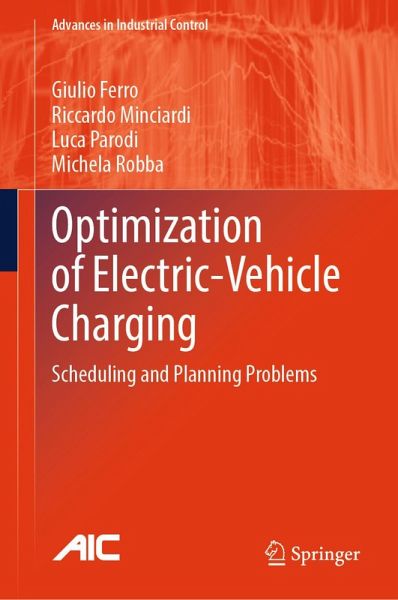
This book provides models and methods for the optimal management of electrical vehicles through an interdisciplinary approach that brings together knowledge from the sectors of transportation, manufacturing and smart grids.
Optimization of Electric-Vehicle Charging explores several optimization models for the scheduling of electric vehicles in a smart grid. Both discrete-time and discrete-event approaches are considered to minimize tardiness, charging and production costs, on the basis of information like release time, due date, deadline, energy request, and availability of energy…mehr
- Geräte: PC
- ohne Kopierschutz
- eBook Hilfe
- Größe: 11.61MB
Shifeng WangRoad Terrain Classification Technology for Autonomous Vehicle (eBook, PDF)72,95 €
Alexander Arnfinn OlsenPosition and Nearshore Mooring (eBook, PDF)112,95 €
Advanced Microsystems for Automotive Applications 2018 (eBook, PDF)112,95 €
Proceedings of the 25th Pan-American Conference of Naval Engineering-COPINAVAL (eBook, PDF)112,95 €
Advanced Microsystems for Automotive Applications 2017 (eBook, PDF)112,95 €
The Roles of Accelerated Pavement Testing in Pavement Sustainability (eBook, PDF)312,95 €
Jiangong ZhuAlternating Current (AC) Heating for Lithium-Ion Batteries in Electric Vehicles (eBook, PDF)128,95 €-
-
-
Optimization of Electric-Vehicle Charging explores several optimization models for the scheduling of electric vehicles in a smart grid. Both discrete-time and discrete-event approaches are considered to minimize tardiness, charging and production costs, on the basis of information like release time, due date, deadline, energy request, and availability of energy generated from renewable sources. Transportation demand is assessed, as well as user-equilibrium-based approaches, for the location of charging stations and for the assignment of users to multiple charging stations.
Employing illustrations, tables and examples to elucidate the ideas presented, this book will be of value to researchers and practitioners in the fields of electrical engineering and transportation, as well as to graduate and PhD students.
Dieser Download kann aus rechtlichen Gründen nur mit Rechnungsadresse in A, B, BG, CY, CZ, D, DK, EW, E, FIN, F, GR, HR, H, IRL, I, LT, L, LR, M, NL, PL, P, R, S, SLO, SK ausgeliefert werden.
- Produktdetails
- Verlag: Springer International Publishing
- Seitenzahl: 178
- Erscheinungstermin: 1. Oktober 2024
- Englisch
- ISBN-13: 9783031619175
- Artikelnr.: 71816918
- Verlag: Springer International Publishing
- Seitenzahl: 178
- Erscheinungstermin: 1. Oktober 2024
- Englisch
- ISBN-13: 9783031619175
- Artikelnr.: 71816918
- Herstellerkennzeichnung Die Herstellerinformationen sind derzeit nicht verfügbar.
Riccardo Minciardi is a Fullwas Professor of Modelling and Simulation at the University of Genoa, and until 2021; his current research interests include modelling and control of automated manufacturing systems, transport planning in urban systems, risk management, and sustainable planning and optimal control of energy and environmental systems. He has co-authored more than 250 publications in international journals, books, invited chapters, and conference proceedings.
Michela Robba is an Associate Professor of Systems Engineering at University of Genoa. She received the Degree in Environmental Engineering in 2000, and the PhD in Electronic and Computer Engineering in 2004, from the University of Genova. The research activity is in the field of focused on optimization and control of smart grids, electric vehicles, renewable energy resources, and natural resources management. She is the Italian responsible at EU ESFRI (European Strategy Forum on Research Infrastructures) for the Energy area, and she is a member of the scientific board of the Italian Energy Technological Cluster, and she is the President of Liguria Region Innovation Pole on (Italy) Energy Consortium. She is Senior Editor of the IEEE Transactions on automation science and engineering journal, and Associate Editor for the journals International Journal of Robotics and Research, and Control Engineering Practice. She is the Chair of the IFAC Technical Committee 6.3 Power and Energy, Environment and Sustainable Development. She lectures for the courses "Simulation of energy and environmental systems" and "Models and methods for Energy Engineering" at Savona Campus Polytechnic School, University of Genoa. Systems. She is author of more than 120150 publications in international journals, books and proceedings of international conferences.
Luca Parodi is a Ph.D. Student in Systems Engineering Post-doc Researcher at the Department of Informatics, Bioengineering, Robotics and Systems Engineering (DIBRIS),) of the University of Genoa. He received his B.S. degree in Industrial Engineering (2017) and), his M.Sc. in Energy Engineering (2019) and his Ph.D. in Systems Engineering (2023) at the University of Genoa. His research is mainly focused on EV optimal charging and scheduling, and Demand Response models in microgrids and smart buildingsoptimization of energy systems. He has co-authored more than 20 publications in international journals, books, invited chapters, and conference proceedings.
Optimal Planning and Management of Electric Vehicles: State of the Art and
Challenges.- 3. Optimal Charging in Smart Grids: Discrete Time Optimization
Model for Aperiodic Scheduling.- 4. Optimal Charging in Smart Grids: A
Discrete Event Approach for Scheduling in Single Socket Charging
Stations.- 5. Optimal Charging in Smart Grids: A Discrete Event Approach
for Scheduling in Multi Socket Charging Stations.- 6. Optimal Charging in
Smart Grids: A Discrete Event Approach for Periodic Scheduling.- 7.
Planning for Electric Vehicles: Deterministic and Stochastic User
Equilibrium Approaches for Joint Traffic Assignment and Energy Demand
Assignment.- 8. Planning for Electric Vehicles: A User Equilibrium
Approaches for Joint Traffic Assignment, Energy Demand Assignment and
Sizing of Charging Stations.- 9. Planning for Electric Vehicles: Optimal
Placement of Charging Stations in an Electrical Distribution Grid.- 10.
Conclusions.
Optimal Planning and Management of Electric Vehicles: State of the Art and
Challenges.- 3. Optimal Charging in Smart Grids: Discrete Time Optimization
Model for Aperiodic Scheduling.- 4. Optimal Charging in Smart Grids: A
Discrete Event Approach for Scheduling in Single Socket Charging
Stations.- 5. Optimal Charging in Smart Grids: A Discrete Event Approach
for Scheduling in Multi Socket Charging Stations.- 6. Optimal Charging in
Smart Grids: A Discrete Event Approach for Periodic Scheduling.- 7.
Planning for Electric Vehicles: Deterministic and Stochastic User
Equilibrium Approaches for Joint Traffic Assignment and Energy Demand
Assignment.- 8. Planning for Electric Vehicles: A User Equilibrium
Approaches for Joint Traffic Assignment, Energy Demand Assignment and
Sizing of Charging Stations.- 9. Planning for Electric Vehicles: Optimal
Placement of Charging Stations in an Electrical Distribution Grid.- 10.
Conclusions.