79,95 €
79,95 €
inkl. MwSt.
Erscheint vor. 02.01.26
payback
40 °P sammeln
79,95 €
79,95 €
inkl. MwSt.
Erscheint vor. 02.01.26

Alle Infos zum eBook verschenken
payback
40 °P sammeln
Als Download kaufen
79,95 €
inkl. MwSt.
Erscheint vor. 02.01.26
payback
40 °P sammeln
Jetzt verschenken
79,95 €
inkl. MwSt.
Erscheint vor. 02.01.26

Alle Infos zum eBook verschenken
payback
40 °P sammeln

Sollten wir den Preis dieses Artikels vor dem Erscheinungsdatum senken, werden wir dir den Artikel bei der Auslieferung automatisch zum günstigeren Preis berechnen.
  • Format: ePub

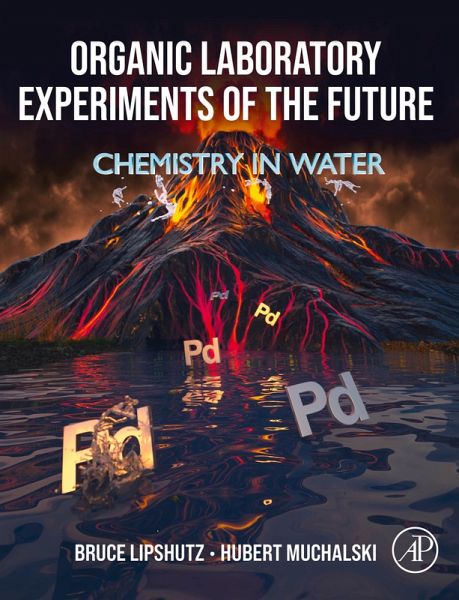
This lab manual offers students the opportunity to learn organic chemistry through a green chemistry lens, resulting in a more sustainable, future-looking course. Lipshutz and Muchalski's Organic Laboratory Experiments of the Future: Doing Chemistry in Water approaches the subject with experiments, diagrams, and illustrations shaped by student feedback and honed through years of research and laboratory experience.Organic Laboratory Experiments of the Future: Doing Chemistry in Water includes material on reactions run in water, including but not limited to: ppm Pd-catalyzed couplings, SNAr…mehr

  • Geräte: eReader
  • ohne Kopierschutz
  • eBook Hilfe
  • Größe: 29.05MB
Produktbeschreibung
This lab manual offers students the opportunity to learn organic chemistry through a green chemistry lens, resulting in a more sustainable, future-looking course. Lipshutz and Muchalski's Organic Laboratory Experiments of the Future: Doing Chemistry in Water approaches the subject with experiments, diagrams, and illustrations shaped by student feedback and honed through years of research and laboratory experience.Organic Laboratory Experiments of the Future: Doing Chemistry in Water includes material on reactions run in water, including but not limited to: ppm Pd-catalyzed couplings, SNAr reactions, nitro group reductions, enzyme-catalyzed reactions, catalytic hydrogenation of olefins, olefin metathesis, reductive aminations, and chemoenzymatic sequences. This lab manual is ideal for courses in organic chemistry, biochemistry, sustainable and green chemistry, and environmentally-responsible lab courses. - Provides practical information and techniques for utilizing green chemistry, and chemistry in water, in particular, in the study of modern organic chemistry. - Includes numerous figures, examples, illustrative problems, and appendices that reinforce laboratory concepts and methods. - Features coverage on experiments that focus on chemocatalysis as well as biocatalysis; reactions that include Nobel Prize-winning organometallic chemistry; multi-step sequences involving chemocatalysis, or chemoenzymatic catalysist

Dieser Download kann aus rechtlichen Gründen nur mit Rechnungsadresse in A, B, BG, CY, CZ, D, DK, EW, E, FIN, F, GR, HR, H, IRL, I, LT, L, LR, M, NL, PL, P, R, S, SLO, SK ausgeliefert werden.

Autorenporträt
Bruce Lipshutz, Distinguished Professor of Chemistry at UC Santa Barbara (UCSB), received his Ph.D. at Yale in 1977, after which he moved as an American Cancer Society Postdoctoral Research Fellow to Harvard University to work with Nobel Laureate E. J. Corey. After two years he relocated to southern California at UCSB, taking an Assistant Professor position, and in 1989 became a full Professor of Chemistry. After over 25 years on the faculty at UCSB, his research group left traditional organic synthesis and began the journey of converting organic chemistry into a sustainable discipline, focused on the "switch to Nature's chosen medium: water. The Lipshutz research group continues to develop new technologies in green chemistry, with the specific goal being to get organic solvents out of organic reactions, as organic solvents are, by far, responsible for most of the organic waste created by the chemical enterprise and derive mainly from the world's finite petroleum reserves. To accomplish this goal, the concept of "designer surfactants has been introduced within the area of aqueous micellar catalysis. The nanoparticles that form in water from these amphiphiles act as nanoreactors, enabling key transition metal-catalyzed cross-couplings, and many other of the most common reactions to be carried out in water under mild conditions. The group has also focused its attention on developing new catalysts for key Pd- and several other transition metal-catalyzed reactions that enable C-C, C-N, and C-H bond formation typically at the parts per million level of the metal. Most recently, these newly developed technologies in chemo-catalysis are being merged with enzymatic processes, commonly referred to "chemoenzymatic catalysis, which enable tandem, 1-pot reactions in water. For these efforts over the past 15 years, several awards both in traditional and green chemistry have been received, most notably the EPA's Presidential Green Chemistry Challenge Award, the American Chemical Society's Green Chemistry Institute's Peter Dunn Award, and the H. C. Brown Award for Creativity in Organic Synthesis.Hubert is a native of Poland where he received his B.S./M.S. in Chemistry at Wroclaw University of Technology in 2006. During these studies, he investigated the diselenide catalyzed hydroperoxide oxidation of naphthalenes. In 2006, he began graduate studies at Vanderbilt with prof. Jeffrey N. Johnston. There Hubert developed a unique a-diazo imide reagent that enabled the development of the Brønsted acid catalyzed syn-glycolate Mannich reaction. He then used the Bronsted acid-promoted azide-alkene synthesis of vic-amino alcohols to develop a two directional synthesis approach to (+)-zwittermicin A. Hubert was a postdoctoral scholar with prof. Ned Porter until 2015 where he investigated kinetic isotope effect of lipid peroxidation. In 2015 he joined the Chemistry Department at Fresno State as Assistant Professor of Chemistry. In 2021 he was promoted to the rank of Associate Professor with tenure.
