14,95 €
14,95 €
inkl. MwSt.
Sofort per Download lieferbar

7 °P sammeln
14,95 €
Als Download kaufen
14,95 €
inkl. MwSt.
Sofort per Download lieferbar
7 °P sammeln
Jetzt verschenken
Alle Infos zum eBook verschenken
14,95 €
inkl. MwSt.
Sofort per Download lieferbar
Alle Infos zum eBook verschenken
7 °P sammeln

Andere Kunden interessierten sich auch für
") To Build a Black Future (eBook, ePUB)12,95 €
To Build a Black Future (eBook, ePUB)12,95 €") Shirley Chisholm in Her Own Words (eBook, ePUB)18,95 €
Shirley Chisholm in Her Own Words (eBook, ePUB)18,95 €") The Instigators (eBook, ePUB)20,42 €
The Instigators (eBook, ePUB)20,42 €") The Making of Black Lives Matter (eBook, ePUB)10,95 €
The Making of Black Lives Matter (eBook, ePUB)10,95 €") If We Are Brave (eBook, ePUB)12,25 €
If We Are Brave (eBook, ePUB)12,25 €") How Capitalism Underdeveloped Black America (eBook, ePUB)10,95 €
How Capitalism Underdeveloped Black America (eBook, ePUB)10,95 €") Race and the Shaping of Twentieth-Century Atlanta (eBook, ePUB)22,95 €
Race and the Shaping of Twentieth-Century Atlanta (eBook, ePUB)22,95 €







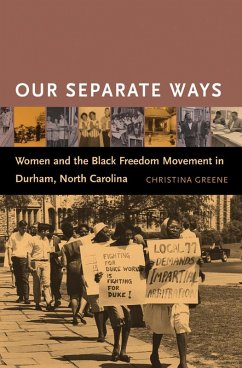
In an in-depth community study of women in the civil rights movement, Christina Greene examines how several generations of black and white women, low-income as well as more affluent, shaped the struggle for black freedom in Durham, North Carolina. In the city long known as “the capital of the black middle class,” Greene finds that, in fact, low-income African American women were the sustaining force for change. Greene demonstrates that women activists frequently were more organized, more militant, and more numerous than their male counterparts. They brought new approaches and strategies to protest, leadership, and racial politics. Arguing that race was not automatically a unifying force, Greene sheds new light on the class and gender fault lines within Durham’s black community. While middle-class black leaders cautiously negotiated with whites in the boardroom, low-income black women were coordinating direct action in hair salons and neighborhood meetings. Greene’s analysis challenges scholars and activists to rethink the contours of grassroots activism in the struggle for racial and economic justice in postwar America. She provides fresh insight into the changing nature of southern white liberalism and interracial alliances, the desegregation of schools and public accommodations, and the battle to end employment discrimination and urban poverty.
Dieser Download kann aus rechtlichen Gründen nur mit Rechnungsadresse in A, D ausgeliefert werden.