21,76 €
21,76 €
inkl. MwSt.
Sofort per Download lieferbar

0 °P sammeln
21,76 €
Als Download kaufen
21,76 €
inkl. MwSt.
Sofort per Download lieferbar
0 °P sammeln
Jetzt verschenken
Alle Infos zum eBook verschenken
21,76 €
inkl. MwSt.
Sofort per Download lieferbar
Alle Infos zum eBook verschenken
0 °P sammeln

Andere Kunden interessierten sich auch für
") Strangers to Ourselves (eBook, ePUB)7,99 €
Strangers to Ourselves (eBook, ePUB)7,99 €") The Psychopath Test (eBook, ePUB)7,99 €
The Psychopath Test (eBook, ePUB)7,99 €") The Complications (eBook, ePUB)15,99 €
The Complications (eBook, ePUB)15,99 €") How Minds Change (eBook, ePUB)12,85 €
How Minds Change (eBook, ePUB)12,85 €") What Happened to You? (eBook, ePUB)11,95 €
What Happened to You? (eBook, ePUB)11,95 €") You Will Get Through This Night (eBook, ePUB)12,99 €
You Will Get Through This Night (eBook, ePUB)12,99 €") The Truth Detective (eBook, ePUB)6,99 €
The Truth Detective (eBook, ePUB)6,99 €


'A TRULY IMPORTANT BOOK' JOHN HUMPHRYS
'FASCINATING... SHOCKING' SPECTATOR
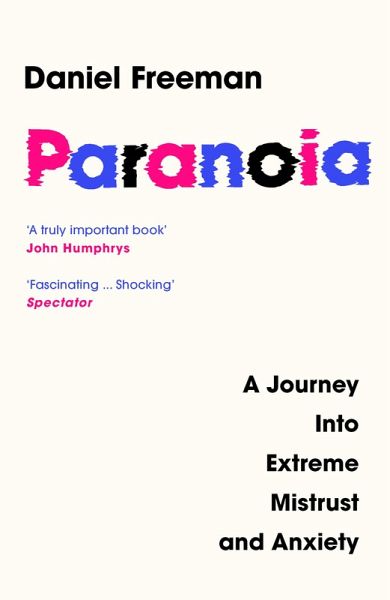
What is paranoia? What makes us mistrustful? How can this be overcome?
Daniel Freeman, Professor of Psychology at Oxford, has spent thirty years at the vanguard of paranoia research and treatment. This remarkable and moving book tells the story of that journey.
For decades, conventional wisdom held that paranoia was only experienced by people with severe mental health problems and little could be done to rectify its disastrous effects. Paranoia gives us a front row seat as Freeman turns the traditional view on its head.
He develops life-changing treatments for clinical paranoia - often using state-of-the-art technology like virtual reality. He reveals that suspicion is rife in society, with paranoia widespread, conspiracy theories rampant and emotion all too often trumping evidence. He discovers the causes of mistrust, including the role of genes, trauma, lack of sleep, worry, low self-confidence, cannabis use and hearing voices, and delves into the murky world of Covid-19 conspiracy theories. Lighting up the narrative throughout are the rarely heard voices of people whose lives have been almost wrecked by paranoia - and then in many cases transformed by Freeman's groundbreaking treatments.
This is also a practical book. Freeman shows how we can measure our own levels of mistrust. He explains how we can remedy things if those levels are higher than we'd like, because although mistrust can seem engrained, things can change for the better. Ultimately, it can be overcome. Compelling and compassionate, this is a gripping tale from the front line of suspicion - an impassioned plea for the urgent rebuilding of trust between us all.
'FASCINATING... SHOCKING' SPECTATOR
What is paranoia? What makes us mistrustful? How can this be overcome?
Daniel Freeman, Professor of Psychology at Oxford, has spent thirty years at the vanguard of paranoia research and treatment. This remarkable and moving book tells the story of that journey.
For decades, conventional wisdom held that paranoia was only experienced by people with severe mental health problems and little could be done to rectify its disastrous effects. Paranoia gives us a front row seat as Freeman turns the traditional view on its head.
He develops life-changing treatments for clinical paranoia - often using state-of-the-art technology like virtual reality. He reveals that suspicion is rife in society, with paranoia widespread, conspiracy theories rampant and emotion all too often trumping evidence. He discovers the causes of mistrust, including the role of genes, trauma, lack of sleep, worry, low self-confidence, cannabis use and hearing voices, and delves into the murky world of Covid-19 conspiracy theories. Lighting up the narrative throughout are the rarely heard voices of people whose lives have been almost wrecked by paranoia - and then in many cases transformed by Freeman's groundbreaking treatments.
This is also a practical book. Freeman shows how we can measure our own levels of mistrust. He explains how we can remedy things if those levels are higher than we'd like, because although mistrust can seem engrained, things can change for the better. Ultimately, it can be overcome. Compelling and compassionate, this is a gripping tale from the front line of suspicion - an impassioned plea for the urgent rebuilding of trust between us all.
Dieser Download kann aus rechtlichen Gründen nur mit Rechnungsadresse in A, B, BG, CY, CZ, D, DK, EW, E, FIN, F, GR, HR, H, IRL, I, LT, L, LR, M, NL, PL, P, R, S, SLO, SK ausgeliefert werden.
This volume represents a major step forward in advancing the understanding of delusions. - From the foreword by Aaron T. Beck
'The penultimate chapter presents and overview of Freeman and Garety's updated model of delusion formation and maintenance. The model is an attempt to integrate all their work on emotions and cognitive biases, but also uses Maher's idea that delusions are explanations of experience. ... The richness of the model may be helpful to therapists planning interventions in that the model suggests many areas that could be the focus of work.
The majority of chapters draw on material in already published articles, yet the authors manage to bring these together by re-writing and adding material, so producing a coherent whole. Whether one agrees or disagrees with specific aspects of Freeman and Garety's model, this book is a very important contribution, is presented with exemplary clarity, and is work that researchers and practitioners will need to know.' - John Rhodes, Consultant Clinical Psychologist, Haringey Adult Mental Health, in Behavioural & Cognitive Psychotherapy, Vol. 34 Autumn 2006.
'The penultimate chapter presents and overview of Freeman and Garety's updated model of delusion formation and maintenance. The model is an attempt to integrate all their work on emotions and cognitive biases, but also uses Maher's idea that delusions are explanations of experience. ... The richness of the model may be helpful to therapists planning interventions in that the model suggests many areas that could be the focus of work.
The majority of chapters draw on material in already published articles, yet the authors manage to bring these together by re-writing and adding material, so producing a coherent whole. Whether one agrees or disagrees with specific aspects of Freeman and Garety's model, this book is a very important contribution, is presented with exemplary clarity, and is work that researchers and practitioners will need to know.' - John Rhodes, Consultant Clinical Psychologist, Haringey Adult Mental Health, in Behavioural & Cognitive Psychotherapy, Vol. 34 Autumn 2006.