121,95 €
inkl. MwSt.
Sofort per Download lieferbar
61 °P sammeln

Andere Kunden interessierten sich auch für
") Nordic Private Collections of Chinese Objects (eBook, PDF)39,95 €
Nordic Private Collections of Chinese Objects (eBook, PDF)39,95 €") Landscape Painting in Revolutionary France (eBook, PDF)42,95 €
Landscape Painting in Revolutionary France (eBook, PDF)42,95 €") Henri Bertin and the Representation of China in Eighteenth-Century France (eBook, PDF)42,95 €
Henri Bertin and the Representation of China in Eighteenth-Century France (eBook, PDF)42,95 €") James McNeill Whistler and France (eBook, PDF)42,95 €
James McNeill Whistler and France (eBook, PDF)42,95 €") The Société des Trois in the Nineteenth Century (eBook, PDF)42,95 €
The Société des Trois in the Nineteenth Century (eBook, PDF)42,95 €") René Magritte and the Art of Thinking (eBook, PDF)42,95 €
René Magritte and the Art of Thinking (eBook, PDF)42,95 €") Postcolonising the Medieval Image (eBook, PDF)46,95 €
Postcolonising the Medieval Image (eBook, PDF)46,95 €







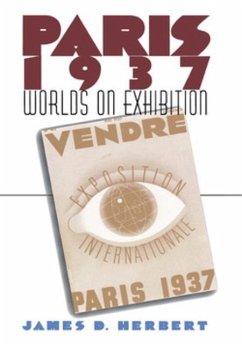
This elegant and theoretically informed book, illustrated with forty-five photographs, explores the cultural significance of six exhibitions or new museum installations, all opening in Paris between mid-1937 and early 1938: the commercially oriented world's fair titled L'Exposition Internationale des Art et Techniques; the historical Musée des Monuments Français; the ethnographic Musée de l'Homme; two massive art retrospectives, one sponsored by the state of France and the other by the municipality of Paris; and L'Exposition Internationale du Surréalisme.
James D. Herbert capitalizes on the proximity of these disparate exhibits to show how they competed with and yet also complemented one another in visually rendering the full scope of human accomplishment through time and across the globe. In this task, Herbert argues, they both succeeded and failed in interesting and productive ways. He asserts that the exhibitions projected and, in a sense, created (created precisely through the act of projection) the real world that they ostensibly only represented.
In fact, Herbert argues, the exhibitions developed a particular sense of French national identity-one that, in managing to be at the same moment both inwardly focused and beneficently expansive, would present a vivid contrast to the growing German nationalism of the Third Reich. His epilogue takes a final look at these issues from the perspective of Jean Cocteau's 1950 film Orphée. A ground-breaking work in cultural history, Paris 1937, with its insightful examination of objects from a variety of fields, is a pioneering text in the field of visual studies.
James D. Herbert capitalizes on the proximity of these disparate exhibits to show how they competed with and yet also complemented one another in visually rendering the full scope of human accomplishment through time and across the globe. In this task, Herbert argues, they both succeeded and failed in interesting and productive ways. He asserts that the exhibitions projected and, in a sense, created (created precisely through the act of projection) the real world that they ostensibly only represented.
In fact, Herbert argues, the exhibitions developed a particular sense of French national identity-one that, in managing to be at the same moment both inwardly focused and beneficently expansive, would present a vivid contrast to the growing German nationalism of the Third Reich. His epilogue takes a final look at these issues from the perspective of Jean Cocteau's 1950 film Orphée. A ground-breaking work in cultural history, Paris 1937, with its insightful examination of objects from a variety of fields, is a pioneering text in the field of visual studies.
Dieser Download kann aus rechtlichen Gründen nur mit Rechnungsadresse in A, D ausgeliefert werden.