Sie sind bereits eingeloggt. Klicken Sie auf 2. tolino select Abo, um fortzufahren.
Bitte loggen Sie sich zunächst in Ihr Kundenkonto ein oder registrieren Sie sich bei bücher.de, um das eBook-Abo tolino select nutzen zu können.
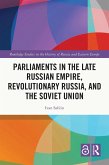
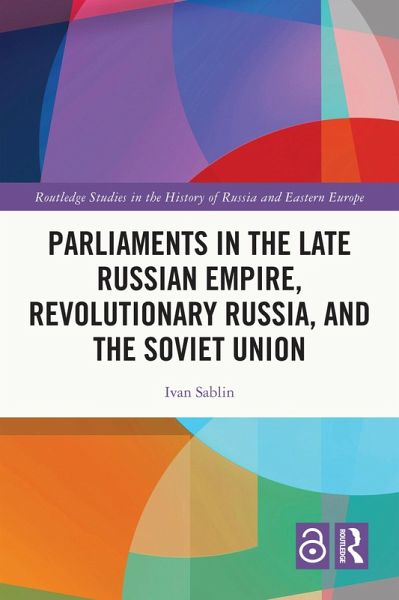
This book examines the meanings that were attached to the terms "parliament" and "parliamentarism" in the different historical and discursive contexts of the late Russian Empire, revolutionary and Soviet Russia, and the Soviet Union. It discusses those institutions referred to as parliaments by contemporaries, gives special attention to their functions, and traces the broader debates on parliamentarism within Russia and the Soviet Union, in Russian émigré circles, and among foreign observers. It highlights that only the late imperial and perestroika assemblies can be considered legislative…mehr
This book examines the meanings that were attached to the terms "parliament" and "parliamentarism" in the different historical and discursive contexts of the late Russian Empire, revolutionary and Soviet Russia, and the Soviet Union. It discusses those institutions referred to as parliaments by contemporaries, gives special attention to their functions, and traces the broader debates on parliamentarism within Russia and the Soviet Union, in Russian émigré circles, and among foreign observers. It highlights that only the late imperial and perestroika assemblies can be considered legislative institutions that expressed dissensus but argues that other assemblies, often referred to as "rubber-stamp" parliaments due to their lack of legislative competence and influence over other authorities, should not be dismissed. The Supreme Soviet, for instance, provided an integrative function binding society and elites in a top-down manner, while its deputies engaged in information acquisition and state micromanagement through interactions with their constituents. It also played an important role in interparliamentary relations and, as one of the first institutions of nominal parliamentarism in an autocratic single-party regime, of which there were many in the twentieth century, served as a model for numerous state socialist regimes. By addressing the role of parliaments in reassembling imperial spaces through political representation and the functions of nominal legislative institutions, the book explores the contribution of Russian and Soviet assemblies to global political modernity.
Dieser Download kann aus rechtlichen Gründen nur mit Rechnungsadresse in A, B, BG, CY, CZ, D, DK, EW, E, FIN, F, GR, HR, H, IRL, I, LT, L, LR, M, NL, PL, P, R, S, SLO, SK ausgeliefert werden.
Die Herstellerinformationen sind derzeit nicht verfügbar.
Autorenporträt
Ivan Sablin is a research project coordinator in the Department of History at Heidelberg University, Germany, and research fellow at the Institute of Contemporary History, Ljubljana, Slovenia.
Inhaltsangabe
List of Figures
Abbreviations
Note on the Text
Acknowledgements
Introduction
Chapter 1: Representation of the people: The making of the State Duma, 1905-1907
Chapter 2: Legislative chambers: The State Duma and the State Council, 1907-1917
Chapter 3: A parliamentary revolution: Postimperial assemblies, 1917-1918
Chapter 4: An antiparliamentary revolution: The RSFSR Congress of Soviets and the Central Executive Committee, 1918-1922
Chapter 5: An alternative to parliament: The USSR Congress of Soviets and the Central Executive Committee, 1923-1934
Chapter 6: A socialist parliament: The making of the Supreme Soviet and its functions, 1935-1954
Chapter 7: The supreme body of state power: The Supreme Soviet normalized and contested, 1955-1985
Chapter 8: Soviet parliamentarism: The Supreme Soviet and the Congress of People's Deputies, 1985-1991
Conclusion
Index
List of Figures Abbreviations Note on the Text Acknowledgements Introduction Chapter 1: Representation of the people: The making of the State Duma, 1905-1907 Chapter 2: Legislative chambers: The State Duma and the State Council, 1907-1917 Chapter 3: A parliamentary revolution: Postimperial assemblies, 1917-1918 Chapter 4: An antiparliamentary revolution: The RSFSR Congress of Soviets and the Central Executive Committee, 1918-1922 Chapter 5: An alternative to parliament: The USSR Congress of Soviets and the Central Executive Committee, 1923-1934 Chapter 6: A socialist parliament: The making of the Supreme Soviet and its functions, 1935-1954 Chapter 7: The supreme body of state power: The Supreme Soviet normalized and contested, 1955-1985 Chapter 8: Soviet parliamentarism: The Supreme Soviet and the Congress of People's Deputies, 1985-1991 Conclusion Index
Chapter 1: Representation of the people: The making of the State Duma, 1905-1907
Chapter 2: Legislative chambers: The State Duma and the State Council, 1907-1917
Chapter 3: A parliamentary revolution: Postimperial assemblies, 1917-1918
Chapter 4: An antiparliamentary revolution: The RSFSR Congress of Soviets and the Central Executive Committee, 1918-1922
Chapter 5: An alternative to parliament: The USSR Congress of Soviets and the Central Executive Committee, 1923-1934
Chapter 6: A socialist parliament: The making of the Supreme Soviet and its functions, 1935-1954
Chapter 7: The supreme body of state power: The Supreme Soviet normalized and contested, 1955-1985
Chapter 8: Soviet parliamentarism: The Supreme Soviet and the Congress of People's Deputies, 1985-1991
Conclusion
Index
List of Figures Abbreviations Note on the Text Acknowledgements Introduction Chapter 1: Representation of the people: The making of the State Duma, 1905-1907 Chapter 2: Legislative chambers: The State Duma and the State Council, 1907-1917 Chapter 3: A parliamentary revolution: Postimperial assemblies, 1917-1918 Chapter 4: An antiparliamentary revolution: The RSFSR Congress of Soviets and the Central Executive Committee, 1918-1922 Chapter 5: An alternative to parliament: The USSR Congress of Soviets and the Central Executive Committee, 1923-1934 Chapter 6: A socialist parliament: The making of the Supreme Soviet and its functions, 1935-1954 Chapter 7: The supreme body of state power: The Supreme Soviet normalized and contested, 1955-1985 Chapter 8: Soviet parliamentarism: The Supreme Soviet and the Congress of People's Deputies, 1985-1991 Conclusion Index
Es gelten unsere Allgemeinen Geschäftsbedingungen: www.buecher.de/agb
Impressum
www.buecher.de ist ein Internetauftritt der buecher.de internetstores GmbH
Geschäftsführung: Monica Sawhney | Roland Kölbl | Günter Hilger
Sitz der Gesellschaft: Batheyer Straße 115 - 117, 58099 Hagen
Postanschrift: Bürgermeister-Wegele-Str. 12, 86167 Augsburg
Amtsgericht Hagen HRB 13257
Steuernummer: 321/5800/1497
USt-IdNr: DE450055826