0,00 €
inkl. MwSt.
Sofort per Download lieferbar
0 °P sammeln

Andere Kunden interessierten sich auch für
") Pathways for Irregular Forces in Southeast Asia (eBook, PDF)0,00 €
Pathways for Irregular Forces in Southeast Asia (eBook, PDF)0,00 €") Civil-Military Relations in Indonesia (eBook, ePUB)44,95 €
Civil-Military Relations in Indonesia (eBook, ePUB)44,95 €") Military Modernisation in Southeast Asia after the Cold War (eBook, ePUB)42,95 €
Military Modernisation in Southeast Asia after the Cold War (eBook, ePUB)42,95 €") Marginalisation and Human Rights in Southeast Asia (eBook, ePUB)41,95 €
Marginalisation and Human Rights in Southeast Asia (eBook, ePUB)41,95 €") Competing Desires (eBook, ePUB)42,95 €
Competing Desires (eBook, ePUB)42,95 €") Patterns of Im/mobility, Conflict and Identity (eBook, ePUB)44,95 €
Patterns of Im/mobility, Conflict and Identity (eBook, ePUB)44,95 €") Deliberative Democracy in Asia (eBook, ePUB)40,95 €
Deliberative Democracy in Asia (eBook, ePUB)40,95 €
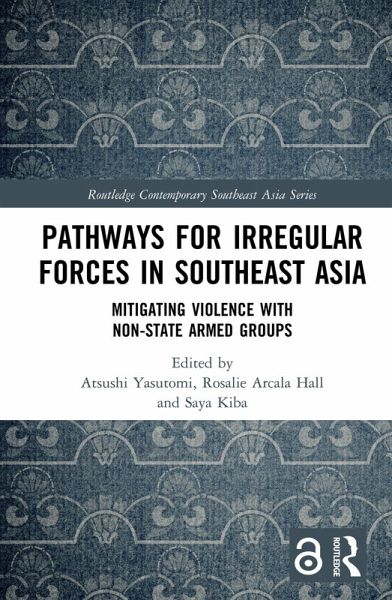
An exploration of the roles that pro- and anti-government militias, private armed groups, vigilantes, and gangs play in local communities in the new democracies of Southeast Asia.
Scholars have typically characterized irregular forces as spoilers and infiltrators in post-conflict peacebuilding processes. The contributors to this book challenge this conventional understanding of irregular forces in Southeast Asia, demonstrating that they often attract solid support from civilians and can be major contributors to the building of local security - a process by which local residents, in the absence of an effective police force, develop, partner or are at least included in the management of community crimes and other violence. They analyze irregular forces' dealings with political actors at the community level, explaining why and how forces are incorporated in and collaborate with legitimate institutions without using violence against them. Offering a new approach to dealing with irregular forces in Southeast Asia, contributors explore new theoretical frameworks that are better suited for evaluating irregular forces' relationship to different security providers and the political environments in the region. Specifically, they examine case studies from Indonesia, Timor-Leste, the Philippines, and Thailand.
A valuable resource for researchers, students and practitioners in the areas of conflict resolution, peacebuilding, and security governance, especially those with a focus on Southeast Asia. This book will also be of great interest to scholars of the sociology and anthropology of the region.
Scholars have typically characterized irregular forces as spoilers and infiltrators in post-conflict peacebuilding processes. The contributors to this book challenge this conventional understanding of irregular forces in Southeast Asia, demonstrating that they often attract solid support from civilians and can be major contributors to the building of local security - a process by which local residents, in the absence of an effective police force, develop, partner or are at least included in the management of community crimes and other violence. They analyze irregular forces' dealings with political actors at the community level, explaining why and how forces are incorporated in and collaborate with legitimate institutions without using violence against them. Offering a new approach to dealing with irregular forces in Southeast Asia, contributors explore new theoretical frameworks that are better suited for evaluating irregular forces' relationship to different security providers and the political environments in the region. Specifically, they examine case studies from Indonesia, Timor-Leste, the Philippines, and Thailand.
A valuable resource for researchers, students and practitioners in the areas of conflict resolution, peacebuilding, and security governance, especially those with a focus on Southeast Asia. This book will also be of great interest to scholars of the sociology and anthropology of the region.
Dieser Download kann aus rechtlichen Gründen nur mit Rechnungsadresse in A, B, BG, CY, CZ, D, DK, EW, E, FIN, F, GR, HR, H, IRL, I, LT, L, LR, M, NL, PL, P, R, S, SLO, SK ausgeliefert werden.
"This fascinating collection focuses on irregular forces - militias, private armed groups, youth gangs and martial arts groups - in Southeast Asian cases that include the Philippines, Thailand, Timor-Leste, and Indonesia. Rather than examining these forces from the perspective of states, the individual essays as the volume as a whole suggest looking at them as phenomena rooted into local circumstances, as entities that are not simply informal or illegal entities but have communal roles. The essays are thus devoted to their organizational structure and dynamics to show how they adapt to changing social and political conditions and proceed along evolutionary paths; towards less use of armed force and intimidation, weakening and dissolution or transformation into other social and political forms. Of especial significance are five general essays that frame the case studies by offering general comparative and theoretical directions as well as suggestions for reform. This book will be indispensable for any scholar interested in irregular forces both in the region and outside it."---Eyal Ben-Ari, Kinneret Academic College, Center for Security, Society and Peace
"This is an important book that goes beyond the binary of state and anti-state forces to consider the political, economic, and sociological details of irregular armed groups. Overgeneralization and a military lens have impaired our understanding of armed groups. Western military forays into anthropology in the service of counter-insurgency "human terrain analysis" have been unhelpful.
Yasutomi et al have pioneered a much more promising approach toward respectful and inclusive peace processes, disarmament, and reform of security sector governance.
The micro-sociological approach by Yasutomi et al demonstrates that armed irregular forces can play positive roles in peace processes, despite typically being portrayed as spoilers. These roles are linked to the governance and security needs of differentiated communities.
In addition to rebel groups, South East Asia sees irregular forces engaged by governments, veterans' groups, martial arts groups, and ritual arts groups. Clan, family, and criminal networks add to the complexity of managing human needs for security, reliable governance, and trust in local decision-making.
Yasutomi and colleagues identify three pathways for demobilization and SSR: continued violence, dissolution, and adaptation to new circumstances. All three offer interesting possibilities for demobilization, security sector governance and reform.
Readable, well-documented, building on fieldwork and deep first-hand knowledge, this book has implications far beyond South East Asia with its fundamental insights about irregular forces and their connections to society."---David Last, CD, PhD, Associate Professor, Department of Political Science, Royal Military College of Canada
"This is an important book that goes beyond the binary of state and anti-state forces to consider the political, economic, and sociological details of irregular armed groups. Overgeneralization and a military lens have impaired our understanding of armed groups. Western military forays into anthropology in the service of counter-insurgency "human terrain analysis" have been unhelpful.
Yasutomi et al have pioneered a much more promising approach toward respectful and inclusive peace processes, disarmament, and reform of security sector governance.
The micro-sociological approach by Yasutomi et al demonstrates that armed irregular forces can play positive roles in peace processes, despite typically being portrayed as spoilers. These roles are linked to the governance and security needs of differentiated communities.
In addition to rebel groups, South East Asia sees irregular forces engaged by governments, veterans' groups, martial arts groups, and ritual arts groups. Clan, family, and criminal networks add to the complexity of managing human needs for security, reliable governance, and trust in local decision-making.
Yasutomi and colleagues identify three pathways for demobilization and SSR: continued violence, dissolution, and adaptation to new circumstances. All three offer interesting possibilities for demobilization, security sector governance and reform.
Readable, well-documented, building on fieldwork and deep first-hand knowledge, this book has implications far beyond South East Asia with its fundamental insights about irregular forces and their connections to society."---David Last, CD, PhD, Associate Professor, Department of Political Science, Royal Military College of Canada