15,95 €
inkl. MwSt.
Sofort per Download lieferbar
8 °P sammeln

Andere Kunden interessierten sich auch für
") The Apocryphal Gospels (eBook, PDF)22,95 €
The Apocryphal Gospels (eBook, PDF)22,95 €") Israel's Past (eBook, PDF)80,95 €
Israel's Past (eBook, PDF)80,95 €") Luke the Historian of Israel's Legacy, Theologian of Israel's 'Christ' (eBook, PDF)125,95 €
Luke the Historian of Israel's Legacy, Theologian of Israel's 'Christ' (eBook, PDF)125,95 €") Israel's Hope of Immortality (eBook, PDF)6,99 €
Israel's Hope of Immortality (eBook, PDF)6,99 €") Biblical Figures in Israel's Colonial Political Theology (eBook, PDF)96,95 €
Biblical Figures in Israel's Colonial Political Theology (eBook, PDF)96,95 €") Israel's Prophetic Heritage (eBook, PDF)16,95 €
Israel's Prophetic Heritage (eBook, PDF)16,95 €") The Pauline Effect (eBook, PDF)97,95 €
The Pauline Effect (eBook, PDF)97,95 €
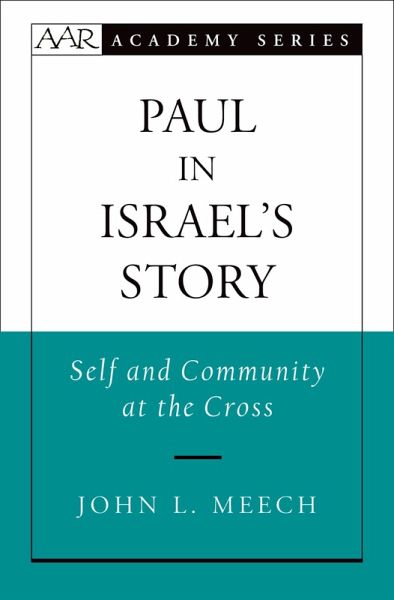
It is commonplace that postmodern thought has problematized the concept of the self. This poses a particularly sharp problem for Christian theologians, for whom the idea of the person as a Christian self must be central. In this book John Meech addresses this problem by means of a theological hermeneutics that brings together cutting edge scholarship in biblical interpretation and constructive theology. The book comprises three major parts. In the first, Meech reflects on St. Paul's construal of Christian identity in light of what has become known as the "new paradigm" in Pauline studies. This movement, identified with N.T. Wright, James Dunn, and Terence Donaldson, stresses the communal aspects of Paul's thought and his narrative understanding of the self. In the second part, Meech offers a pivotal analysis of Rudolf Bultmann's phenomenology of the self and its impact on his demythologizing interpretation of Paul's writings. In the third part, Meech engages Paul Ricoeur's late work, Oneself as Another, as a guide to the postmodern problem of selfhood and as a heuristic resource for interpreting Paul's writings. He does not restrict himself to a textual treatment of Ricoeur's work on selfhood and narrative, nor does he stop at an abstract reflection on its significance for theology. Instead he explores in considerable detail the contributions and implications of Ricoeur's later writings for biblical hermeneutics and theology. Investigating the unthematized hints about community presupposed in Ricoeur's work, Meech reconfigures his ontology of the self as an ontology of the self in community. Finally, he correlates Paul's communal understanding of the "I" with this ontology, articulating a self that is constituted in community but not reduced to a mere locus of community. He argues that the community posited in his study can be understood as the community of the living and dead in Christ.
Dieser Download kann aus rechtlichen Gründen nur mit Rechnungsadresse in A, B, BG, CY, CZ, D, DK, EW, E, FIN, F, GR, HR, H, IRL, I, LT, L, LR, M, NL, PL, P, R, S, SLO, SK ausgeliefert werden.
John Meech's Paul in Israel's Story is an impressive achievement. The deft skill with which Meech integrates biblical criticism, philosophical commentary, and theological insight is innovative and invigorating. Through this interdisciplinary dialogue Meech pioneers new interpretations of Paul's categories of selfhood, the body, Israel, and community. In particular, he demonstrates how the construction of the self's narrative identity through mystical union with Christ is productively elucidated by Ricoeur's philosophy of the intersubjective self - the self as another. Beautifully written, carefully researched, and highly recommended. Mark I. Wallace author of Finding God in the Singing River: Christianity, Nature, Spirit