Sie sind bereits eingeloggt. Klicken Sie auf 2. tolino select Abo, um fortzufahren.
Bitte loggen Sie sich zunächst in Ihr Kundenkonto ein oder registrieren Sie sich bei bücher.de, um das eBook-Abo tolino select nutzen zu können.
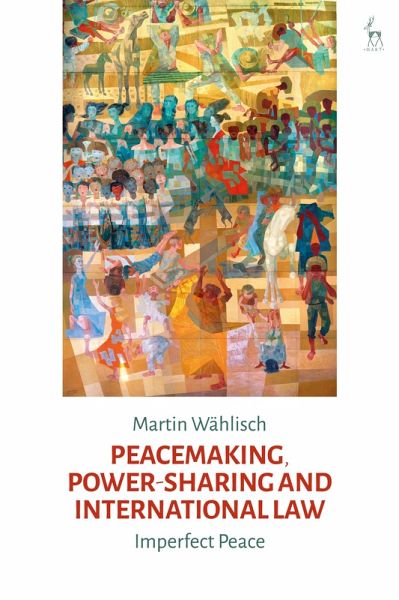
This monograph provides a contemporary analysis of the frictions between peacemaking and international human rights law based on the cases of postconflict power-sharing in Lebanon and Bosnia-Herzegovina. In this context it evaluates the long-standing debate in the United Nations and human rights bodies about the 'imperfect peace'. Written from a practitioner-scholarly viewpoint and drawing from new authentic sources, the book describes the mechanisms used in peace agreements and post-conflict constitutions for managing ethnic or religious diversity, explains their legal limits under…mehr
This monograph provides a contemporary analysis of the frictions between peacemaking and international human rights law based on the cases of postconflict power-sharing in Lebanon and Bosnia-Herzegovina. In this context it evaluates the long-standing debate in the United Nations and human rights bodies about the 'imperfect peace'. Written from a practitioner-scholarly viewpoint and drawing from new authentic sources, the book describes the mechanisms used in peace agreements and post-conflict constitutions for managing ethnic or religious diversity, explains their legal limits under international human rights law, and provides a conceptual framework for analysing the nexus between law and peacemaking. The book argues that the relationship between the content of peace agreements and post-conflict constitutions, their negotiation process and the element of time, needs to be untangled to better understand the legal limits of statebuilding in the aftermath of armed conflict. It is a key resource for scholars in human rights law and peace and conflict studies, advisers in peace processes, constitution-makers, and peace mediators.
Die Herstellerinformationen sind derzeit nicht verfügbar.
Autorenporträt
Martin Wählisch works for the United Nations on peace processes, national dialogues and conflict prevention, and is an Affiliated Lecturer at the Center for Peace Mediation and the Institute for Conflict Management at the European University Viadrina. He holds a PhD in International Law and an MA in Mediation.
Martin Wählisch works as a policy adviser for the United Nations. He currently serves in the Department for Political Affairs of the UN Secretariat in New York. He has been with the Office of the Special Coordinator for Lebanon, the United Nations Development Program (UNDP), and the Berghof Foundation. He holds a PhD in international law from the Humboldt University of Berlin, Faculty of Law, and a post-graduate degree in Mediation (MA) from the European University Viadrina. He has been a fellow of the American University in Kosovo, the Issam Fares Institute for Public Policy and International Affairs at the American University of Beirut, the Lauterpacht Centre for International Law at the University of Cambridge, the Institute for Global Law, Justice, and Policy at New York Law School, and the Harriman Institute at Columbia University.
Inhaltsangabe
1. Introduction I. State Transitions, Power-Sharing and International Law II. Closing the Gap III. Methodology and Scope 2. Power-Sharing in Theory and Practice: Concepts, Mechanisms and Legal Challenges I. Ethnic and Religious Diversity as a Challenge for International Law II. Democracy Theory and the Perspective of Conflict Resolution III. Mechanisms IV. The Legal Debate V. Conclusion: The Necessity and Challenges of Bridging Interdisciplinary Perspectives 3. Power-Sharing on Trial: Sejdic and Finci v Bosnia and Herzegovina I. Bosnia and Herzegovina between Transition and Transformation II. Relevant Decisions of Bosnia and Herzegovina's Constitutional Court (1997-2009) III. ECtHR Definition of Ethnic-Racial Discrimination in Sejdic and Finci IV. Justifying Human Rights Restrictions V. Post-trial Developments and Constitutional Reform Process VI. Conclusion 4. Through the Lens of Human Rights Committees: Lebanese Political Confessionalism and Transitional Mechanism I. State Stability, Sectarian Traditions and Socio-Political Change II. Reports Submitted by Lebanon to the Committee on the Elimination of Racial Discrimination III. Debate in the Committee on the Elimination of Racial Discrimination IV. Analysis: Confessionalism and Non-Discrimination V. Transitional Power-Sharing, Unity Governments, Proportions of High-Level Posts and the Right to Participation VI. Proportionality and Time Limitations VII. Conclusion 5. On the Law of Peace: Parameters, Challenges and Limits I. The Quest for Absolute Limitations in Peacemaking II. Peremptory Norms and Peacemaking III. A Conceptual Model for Reflections about the Law of Peace Debate IV. Open Questions and Future Research Agenda V. Concluding Remarks
1. Introduction I. State Transitions, Power-Sharing and International Law II. Closing the Gap III. Methodology and Scope 2. Power-Sharing in Theory and Practice: Concepts, Mechanisms and Legal Challenges I. Ethnic and Religious Diversity as a Challenge for International Law II. Democracy Theory and the Perspective of Conflict Resolution III. Mechanisms IV. The Legal Debate V. Conclusion: The Necessity and Challenges of Bridging Interdisciplinary Perspectives 3. Power-Sharing on Trial: Sejdic and Finci v Bosnia and Herzegovina I. Bosnia and Herzegovina between Transition and Transformation II. Relevant Decisions of Bosnia and Herzegovina's Constitutional Court (1997-2009) III. ECtHR Definition of Ethnic-Racial Discrimination in Sejdic and Finci IV. Justifying Human Rights Restrictions V. Post-trial Developments and Constitutional Reform Process VI. Conclusion 4. Through the Lens of Human Rights Committees: Lebanese Political Confessionalism and Transitional Mechanism I. State Stability, Sectarian Traditions and Socio-Political Change II. Reports Submitted by Lebanon to the Committee on the Elimination of Racial Discrimination III. Debate in the Committee on the Elimination of Racial Discrimination IV. Analysis: Confessionalism and Non-Discrimination V. Transitional Power-Sharing, Unity Governments, Proportions of High-Level Posts and the Right to Participation VI. Proportionality and Time Limitations VII. Conclusion 5. On the Law of Peace: Parameters, Challenges and Limits I. The Quest for Absolute Limitations in Peacemaking II. Peremptory Norms and Peacemaking III. A Conceptual Model for Reflections about the Law of Peace Debate IV. Open Questions and Future Research Agenda V. Concluding Remarks
Es gelten unsere Allgemeinen Geschäftsbedingungen: www.buecher.de/agb
Impressum
www.buecher.de ist ein Internetauftritt der buecher.de internetstores GmbH
Geschäftsführung: Monica Sawhney | Roland Kölbl | Günter Hilger
Sitz der Gesellschaft: Batheyer Straße 115 - 117, 58099 Hagen
Postanschrift: Bürgermeister-Wegele-Str. 12, 86167 Augsburg
Amtsgericht Hagen HRB 13257
Steuernummer: 321/5800/1497
USt-IdNr: DE450055826