132,95 €
132,95 €
inkl. MwSt.
Sofort per Download lieferbar

66 °P sammeln
132,95 €
Als Download kaufen
132,95 €
inkl. MwSt.
Sofort per Download lieferbar
66 °P sammeln
Jetzt verschenken
Alle Infos zum eBook verschenken
132,95 €
inkl. MwSt.
Sofort per Download lieferbar
Alle Infos zum eBook verschenken
66 °P sammeln

Andere Kunden interessierten sich auch für
") PEM Water Electrolysis (eBook, ePUB)122,95 €
PEM Water Electrolysis (eBook, ePUB)122,95 €") Fuel Cells Technology and Electrode Materials for a Sustainable Future (eBook, ePUB)135,95 €
Fuel Cells Technology and Electrode Materials for a Sustainable Future (eBook, ePUB)135,95 €") Modeling and Numerical Simulation of Proton Exchange Membrane Fuel Cells (eBook, ePUB)122,95 €
Modeling and Numerical Simulation of Proton Exchange Membrane Fuel Cells (eBook, ePUB)122,95 €") Solar Chimney Power Plants (eBook, ePUB)122,95 €
Solar Chimney Power Plants (eBook, ePUB)122,95 €") Ammonia as an Alternative Fuel and Power-to-X Enabler (eBook, ePUB)130,95 €
Ammonia as an Alternative Fuel and Power-to-X Enabler (eBook, ePUB)130,95 €") Photovoltaic Module Cooling Techniques (eBook, ePUB)122,95 €
Photovoltaic Module Cooling Techniques (eBook, ePUB)122,95 €") Power to Fuel (eBook, ePUB)105,95 €
Power to Fuel (eBook, ePUB)105,95 €



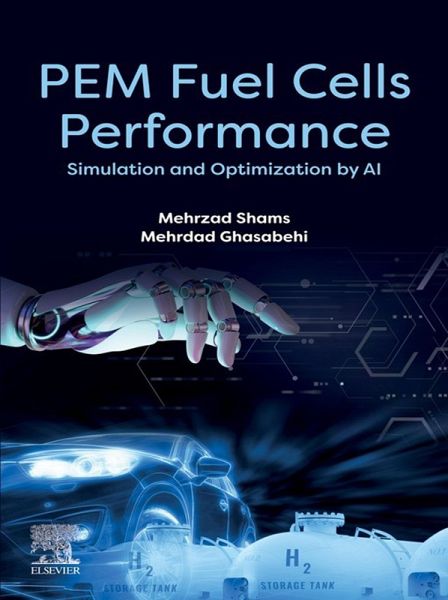
PEM Fuel Cell Performance: Simulation and Optimization by AI introduces innovative methods to enhance the efficiency of PEM fuel cells through computational techniques such as multi-objective optimization, computational fluid dynamics, artificial intelligence, and exergy analysis. This book offers practical solutions, illustrated with examples, case studies, and numerical simulations, aimed at improving the design and optimization of PEM fuel cells and their components. Readers will explore the challenges and potentials of PEM fuel cells across various industries, including transport, power generation, and hydrogen production. The book thoroughly discusses the design, development, testing, and operation of PEM fuel cell systems and components.It also provides foundational knowledge for students, practical examples for researchers, and comprehensive guidance for engineers and practitioners, focusing on aspects like electrodes, gas diffusion layers, flow fields, thermal management, and operating conditions. - Explains how to improve PEM fuel cell performance, from the fundamental principles to advanced modeling and optimization techniques - Introduces simulation approaches, optimization techniques, and data-driven surrogate models based on AI algorithms - Provides examples, case studies, and numerical simulations that illustrate the solutions to specific problems and the applications of novel techniques - Explores optimization strategies specifically related to hybrid energy systems, discusses trade-offs, and shares practical examples
Dieser Download kann aus rechtlichen Gründen nur mit Rechnungsadresse in A, B, BG, CY, CZ, D, DK, EW, E, FIN, F, GR, HR, H, IRL, I, LT, L, LR, M, NL, PL, P, R, S, SLO, SK ausgeliefert werden.