Ena Ray Banerjee
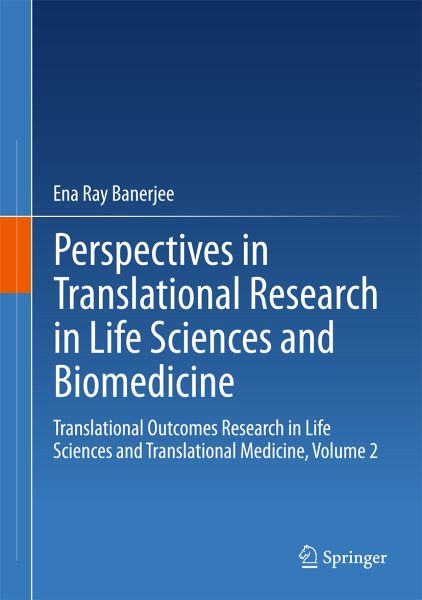
Perspectives in Translational Research in Life Sciences and Biomedicine (eBook, PDF)
Translational Outcomes Research in Life Sciences and Translational Medicine, Volume 2
72,95 €
72,95 €
inkl. MwSt.
Sofort per Download lieferbar

36 °P sammeln
72,95 €
Als Download kaufen
72,95 €
inkl. MwSt.
Sofort per Download lieferbar
36 °P sammeln
Jetzt verschenken
Alle Infos zum eBook verschenken
72,95 €
inkl. MwSt.
Sofort per Download lieferbar
Alle Infos zum eBook verschenken
36 °P sammeln

Ena Ray Banerjee
Perspectives in Translational Research in Life Sciences and Biomedicine (eBook, PDF)
Translational Outcomes Research in Life Sciences and Translational Medicine, Volume 2
- Format: PDF
- Merkliste
- Auf die Merkliste
- Bewerten Bewerten
- Teilen
- Produkt teilen
- Produkterinnerung
- Produkterinnerung

Bitte loggen Sie sich zunächst in Ihr Kundenkonto ein oder registrieren Sie sich bei
bücher.de, um das eBook-Abo tolino select nutzen zu können.
Hier können Sie sich einloggen
Sie sind bereits eingeloggt. Klicken Sie auf 2. tolino select Abo, um fortzufahren.

Bitte loggen Sie sich zunächst in Ihr Kundenkonto ein oder registrieren Sie sich bei bücher.de, um das eBook-Abo tolino select nutzen zu können.
Provides actual laboratory data helping readers to plan experiments Offers step-by-step and lucid directions in the "Materials & Methods" section
Discusses the use of models in drug discovery in an exhaustive manner
Elaborates the concepts of tissue differentiation with valuable and novel insights
- Geräte: PC
- ohne Kopierschutz
- eBook Hilfe
- Größe: 5.08MB
Andere Kunden interessierten sich auch für
Ena Ray BanerjeePerspectives in Translational Research in Life Sciences and Biomedicine (eBook, PDF)112,95 €
Advances in Animal Biotechnology and its Applications (eBook, PDF)128,95 €
Models, Molecules and Mechanisms in Biogerontology (eBook, PDF)160,95 €
RNA Activation (eBook, PDF)120,95 €
Non-coding RNAs in the Vasculature (eBook, PDF)72,95 €
Introduction to Biomolecular Structure and Biophysics (eBook, PDF)112,95 €
Epigenetics in Cardiac Disease (eBook, PDF)112,95 €-
-
-
Provides actual laboratory data helping readers to plan experiments Offers step-by-step and lucid directions in the "Materials & Methods" section
Discusses the use of models in drug discovery in an exhaustive manner
Elaborates the concepts of tissue differentiation with valuable and novel insights
Discusses the use of models in drug discovery in an exhaustive manner
Elaborates the concepts of tissue differentiation with valuable and novel insights
Dieser Download kann aus rechtlichen Gründen nur mit Rechnungsadresse in A, B, BG, CY, CZ, D, DK, EW, E, FIN, F, GR, HR, H, IRL, I, LT, L, LR, M, NL, PL, P, R, S, SLO, SK ausgeliefert werden.
Produktdetails
- Produktdetails
- Verlag: Springer Nature Singapore
- Seitenzahl: 132
- Erscheinungstermin: 17. Oktober 2017
- Englisch
- ISBN-13: 9789811058707
- Artikelnr.: 53059675
- Verlag: Springer Nature Singapore
- Seitenzahl: 132
- Erscheinungstermin: 17. Oktober 2017
- Englisch
- ISBN-13: 9789811058707
- Artikelnr.: 53059675
- Herstellerkennzeichnung Die Herstellerinformationen sind derzeit nicht verfügbar.
Dr. Ena Ray Banerjee is an Associate Professor of Zoology at the University of Calcutta, India, where she heads the department's Immunobiology and Regenerative Research Unit. Her interests are manifold but centered around translational outcomes research in the life sciences by exploring various facets of drug discovery. She has also formed a Consortium of experts from various disciplines to explore biodiversity through bioprospecting and converting them into bioresources currency but in an economically viable and ecologically and environmentally sustainable model.
An alumnus of the premiere educational institutions Lady Brabourne College and Gokhale Memorial Girls' school, Dr. Banerjee has trained in immunobiology, immune modulation in inflammation and cytokine mediated inflammation at the Indian Institute of Chemical Biology and at the University of Washington School of Medicine, Seattle, USA. She led an asthma drug discovery project at Advinus Therapeutics, a TATA Enterprise. Her experience of working in academia and industry in India and the US prepared her for a unique role - that of translational research in the life sciences. Her large team of researchers at the Dept. of Zoology, University of Calcutta works on developing technology-intensive processes and products, developing animal models of diseases for screening novel drug entities, models of developmental biology, or bioresources from local biodiversity. The group engages in drug discovery using novel drugs (small molecules), herbal extracts (functional food), probiotics (neutraceuticals), novel antibody-mediated (camelid antibody) and cells (tissue engineering of stem cells of embryonic origin, adult tissue origin and umbilical cord-derived) in inflammatory disease models (tissue-specific inflammation in the lung and systemic inflammation) and degenerative disease models. She has published widely in premiere scientific journals and has spearheaded the rejuvenation of a world-class heritage museum because she believes that to do bioprospecting and molecular drug discovery, knowing and respecting our biodiversity is key. Through her efforts, this archived faunal repository is positioned to become a center of excellence for technology-based capacity building and an important educational interpretive center.
Chapter 1. Translational Research in Life Sciences.- Chapter 2. Preclinical disease models as a platform for drug discovery.- Chapter 3. Novel antibodies as a replacement for antibiotics.- Chapter 4. Functional Food and Nutraceuticals.- Chapter 5. Bio-Green-Technology as a multi-disciplinary interface amongst the Life Sciences.