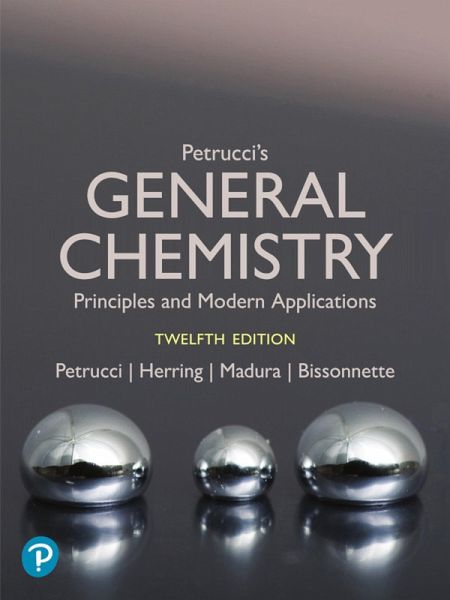
Petrucci's General Chemistry: Principles and Modern Applications -- eBook (eBook, PDF)
Alle Infos zum eBook verschenken
Petrucci's General Chemistry: Principles and Modern Applications -- eBook (eBook, PDF)
- Format: PDF
- Merkliste
- Auf die Merkliste
- Bewerten Bewerten
- Teilen
- Produkt teilen
- Produkterinnerung
- Produkterinnerung

Hier können Sie sich einloggen

Bitte loggen Sie sich zunächst in Ihr Kundenkonto ein oder registrieren Sie sich bei bücher.de, um das eBook-Abo tolino select nutzen zu können.
The most trusted general chemistry text is back in a thoroughly revised 12th edition.
General Chemistry: Principles and Modern Applications has remained one of the most trusted chemistry books in the market for decades. This text is recognized for its superior problems, lucid writing, precision of argument, and meticulous treatment of the subject. The 12th edition offers enhanced hallmark features, new innovations, and revised discussions that respond to key market needs for the detailed and modern treatment of chemistry, embracing the power of visual learning and conquering the challenges of effective problem solving and assessment.…mehr
- Geräte: PC
- ohne Kopierschutz
- eBook Hilfe
- Größe: 160.11MB
Karen C. TimberlakeChemistry: An Introduction to General, Organic, and Biological Chemistry, Global Edition (eBook, PDF)42,95 €
Frank BresciaFundamentals of Chemistry: A Modern Introduction (1966) (eBook, PDF)40,95 €
Nivaldo J. TroPrinciples of Chemistry: A Molecular Approach, Global Edition (eBook, PDF)35,95 €
Nivaldo J. TroChemistry: A Molecular Approach, Global Edition (eBook, PDF)35,95 €
Theodore E. BrownChemistry: The Central Science in SI Units, Expanded Edition, Global Edition (eBook, PDF)35,95 €
Sam StuartOrganosilicon Chemistry: 2 (eBook, PDF)40,95 €
Theodore E. BrownChemistry: The Central Science in SI Units, Global Edition (eBook, PDF)35,95 €-
-
-
General Chemistry: Principles and Modern Applications has remained one of the most trusted chemistry books in the market for decades. This text is recognized for its superior problems, lucid writing, precision of argument, and meticulous treatment of the subject. The 12th edition offers enhanced hallmark features, new innovations, and revised discussions that respond to key market needs for the detailed and modern treatment of chemistry, embracing the power of visual learning and conquering the challenges of effective problem solving and assessment.
Dieser Download kann aus rechtlichen Gründen nur mit Rechnungsadresse in A, B, BG, CY, CZ, D, DK, EW, E, FIN, F, GR, HR, H, IRL, I, LT, L, LR, M, NL, PL, P, R, S, SLO, SK ausgeliefert werden.
- Produktdetails
- Verlag: Pearson HigherEducation
- Altersempfehlung: ab 18 Jahre
- Erscheinungstermin: 20. Juli 2023
- Englisch
- ISBN-13: 9781292457864
- Artikelnr.: 68482574
- Verlag: Pearson HigherEducation
- Altersempfehlung: ab 18 Jahre
- Erscheinungstermin: 20. Juli 2023
- Englisch
- ISBN-13: 9781292457864
- Artikelnr.: 68482574
- Herstellerkennzeichnung Die Herstellerinformationen sind derzeit nicht verfügbar.
Geoff Herring received both his B.Sc. and his Ph.D. in Physical Chemistry from the University of London. He was a Professor Emeritus at the Department of Chemistry of the University of British Columbia, Vancouver. Dr. Herring had research interests in biophysical chemistry and published over 100 papers in physical chemistry and chemical physics. He also pursued studies in the use of information technology and interactive engagement methods in teaching general chemistry with a view to improve student comprehension and learning. Dr. Herring taught chemistry from undergraduate to graduate levels for over 30 years and was the recipient of the Killam Prize for Excellence in Teaching twice.
Jeffry D. Madura was a Professor and the Lambert F. Minucci Endowed Chair in Computational Sciences and Engineering at the Department of Chemistry and Biochemistry of Duquesne University located in Pittsburgh, PA. He earned a B.A. from Thiel College in 1980 and a Ph.D. in Physical Chemistry from Purdue University in 1985 under the direction of Professor William L. Jorgensen. The Ph.D. was followed by a postdoctoral fellowship in computational biophysics with Professor J. Andrew McCammon at the University of Houston. Dr. Madura's research interests were in computational chemistry and biophysics. He published more than 100 peer-reviewed papers in physical chemistry and chemical physics. Dr. Madura taught chemistry to undergraduate and graduate students for over 24 years and was the recipient of a Dreyfus Teacher-Scholar Award. He also received the 2014 American Chemical Society Pittsburgh Section Award and the Bayer School of Natural and Environmental Sciences and the Duquesne University Presidential Award for Excellence in Scholarship in 2007. Dr. Madura was an ACS Fellow and a Fellow of the Royal Society of Chemistry. He also worked with high school students and teachers as part of the ACS Science Coaches program.
Carey Bissonnette was Continuing Lecturer at the Department of Chemistry of the University of Waterloo, Ontario. He received his B.Sc. from the University of Waterloo in 1989 and his Ph.D. in 1993 from the University of Cambridge in England. His research interests were in the development of methods for modeling dynamical processes of polyatomic molecules in the gas phase. He won several awards for excellence in teaching, including the University of Waterloo's Distinguished Teacher Award in 2005. Dr. Bissonnette made extensive use of technology in both the classroom and the laboratory to create an interactive environment for his students to learn and explore. For several years, he was actively engaged in undergraduate curriculum development, high-school liaison activities, and the coordination of the university's high-school chemistry contests written each year by students around the world.
2. Atoms and the Atomic Theory
3. Chemical Compounds
4. Chemical Reactions
5. Introduction to Reactions in Aqueous Solutions
6. Gases
7. Thermochemistry
8. Electrons in Atoms
9. The Periodic Table and Some Atomic Properties
10. Chemical Bonding I: Basic Concepts
11. Chemical Bonding II: Valence Bond and Molecular Orbital Theories
12. Intermolecular Forces: Liquids and Solids
13. Spontaneous Change: Entropy and Gibbs Energy
14. Solutions and Their Physical Properties
15. Chemical Kinetics
16. Principles of Chemical Equilibrium
17. Acids and Bases
18. Additional Aspects of AcidBase Equilibria
19. Solubility and Complex-Ion Equilibria
20. Electrochemistry
21. Chemistry of the Main-Group Elements I: Groups 1, 2, 13, and 14
22. Chemistry of the Main-Group Elements II: Groups 18, 17, 16, 15, and
Hydrogen
23. The Transition Elements
24. Complex Ions and Coordination Compounds
25. Nuclear Chemistry
26. Structure of Organic Compounds
27. Reactions of Organic Compounds
28. Chemistry of the Living State (online)
2. Atoms and the Atomic Theory
3. Chemical Compounds
4. Chemical Reactions
5. Introduction to Reactions in Aqueous Solutions
6. Gases
7. Thermochemistry
8. Electrons in Atoms
9. The Periodic Table and Some Atomic Properties
10. Chemical Bonding I: Basic Concepts
11. Chemical Bonding II: Valence Bond and Molecular Orbital Theories
12. Intermolecular Forces: Liquids and Solids
13. Spontaneous Change: Entropy and Gibbs Energy
14. Solutions and Their Physical Properties
15. Chemical Kinetics
16. Principles of Chemical Equilibrium
17. Acids and Bases
18. Additional Aspects of AcidBase Equilibria
19. Solubility and Complex-Ion Equilibria
20. Electrochemistry
21. Chemistry of the Main-Group Elements I: Groups 1, 2, 13, and 14
22. Chemistry of the Main-Group Elements II: Groups 18, 17, 16, 15, and
Hydrogen
23. The Transition Elements
24. Complex Ions and Coordination Compounds
25. Nuclear Chemistry
26. Structure of Organic Compounds
27. Reactions of Organic Compounds
28. Chemistry of the Living State (online)