51,95 €
51,95 €
inkl. MwSt.
Sofort per Download lieferbar

26 °P sammeln
51,95 €
Als Download kaufen
51,95 €
inkl. MwSt.
Sofort per Download lieferbar
26 °P sammeln
Jetzt verschenken
Alle Infos zum eBook verschenken
51,95 €
inkl. MwSt.
Sofort per Download lieferbar
Alle Infos zum eBook verschenken
26 °P sammeln

Andere Kunden interessierten sich auch für
") God and the Multiverse (eBook, ePUB)49,95 €
God and the Multiverse (eBook, ePUB)49,95 €") Theism and Explanation (eBook, ePUB)56,95 €
Theism and Explanation (eBook, ePUB)56,95 €") Galileo and the Conflict between Religion and Science (eBook, ePUB)46,95 €
Galileo and the Conflict between Religion and Science (eBook, ePUB)46,95 €") Is Faith in God Reasonable? (eBook, ePUB)44,95 €
Is Faith in God Reasonable? (eBook, ePUB)44,95 €") Cosmological Fine-Tuning Arguments (eBook, ePUB)42,95 €
Cosmological Fine-Tuning Arguments (eBook, ePUB)42,95 €") Kierkegaard and Mysticism (eBook, ePUB)42,95 €
Kierkegaard and Mysticism (eBook, ePUB)42,95 €") The Attributes of God in Islamic Thought (eBook, ePUB)42,95 €
The Attributes of God in Islamic Thought (eBook, ePUB)42,95 €

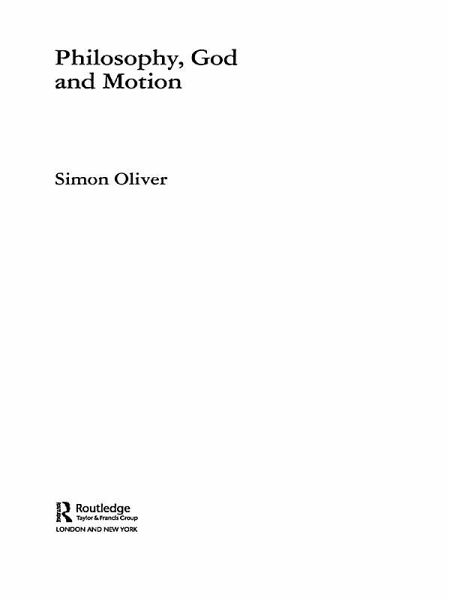
In the post-Newtonian world motion is assumed to be a simple category which relates to the locomotion of bodies in space, and is usually associated only with physics. This book shows this to be a relatively recent understanding of motion and that prior to the scientific revolution motion was a broader and more mysterious category, applying to moral as well as physical movements.
Simon Oliver presents fresh interpretations of key figures in the history of western thought including Plato, Aristotle, Aquinas and Newton, examining the thinkers' handling of the concept of motion. Through close readings of seminal texts in ancient and medieval cosmology and early modern natural philosophy, the books moves from antique to modern times investigating how motion has been of great significance within theology, philosophy and science. Particularly important is the relation between motion and God, following Aristotle traditional doctrines of God have understood the divine as the 'unmoved mover' while post-Holocaust theologians have suggested that in order to be compassionate God must undergo the motion of suffering. The text argues that there may be an authentically theological, as well as a natural scientific understanding of motion.
This volume will prove a major contribution to theology, the history of Christian thought and to the growing field of science and religion.
Simon Oliver presents fresh interpretations of key figures in the history of western thought including Plato, Aristotle, Aquinas and Newton, examining the thinkers' handling of the concept of motion. Through close readings of seminal texts in ancient and medieval cosmology and early modern natural philosophy, the books moves from antique to modern times investigating how motion has been of great significance within theology, philosophy and science. Particularly important is the relation between motion and God, following Aristotle traditional doctrines of God have understood the divine as the 'unmoved mover' while post-Holocaust theologians have suggested that in order to be compassionate God must undergo the motion of suffering. The text argues that there may be an authentically theological, as well as a natural scientific understanding of motion.
This volume will prove a major contribution to theology, the history of Christian thought and to the growing field of science and religion.
Dieser Download kann aus rechtlichen Gründen nur mit Rechnungsadresse in A, B, BG, CY, CZ, D, DK, EW, E, FIN, F, GR, HR, H, IRL, I, LT, L, LR, M, NL, PL, P, R, S, SLO, SK ausgeliefert werden.