Sie sind bereits eingeloggt. Klicken Sie auf 2. tolino select Abo, um fortzufahren.
Bitte loggen Sie sich zunächst in Ihr Kundenkonto ein oder registrieren Sie sich bei bücher.de, um das eBook-Abo tolino select nutzen zu können.
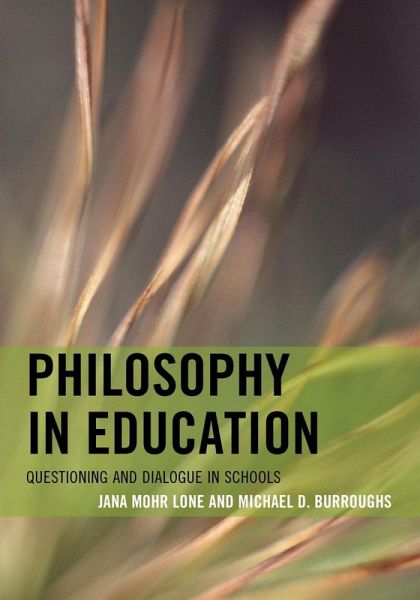
Philosophy in Education: Questioning and Dialog in K-12 Classrooms is a textbook in the fields of pre-college philosophy and philosophy of education, intended for philosophers and philosophy students, K-12 classroom teachers, administrators and educators, policymakers, and pre-college practitioners of all kinds. The book offers a wealth of practical resources for use in elementary, middle school, and high school classrooms, as well as consideration of many of the broader educational, social, and political topics in the field, including the educational value of pre-college philosophy, the…mehr
Philosophy in Education: Questioning and Dialog in K-12 Classrooms is a textbook in the fields of pre-college philosophy and philosophy of education, intended for philosophers and philosophy students, K-12 classroom teachers, administrators and educators, policymakers, and pre-college practitioners of all kinds. The book offers a wealth of practical resources for use in elementary, middle school, and high school classrooms, as well as consideration of many of the broader educational, social, and political topics in the field, including the educational value of pre-college philosophy, the philosophies of education that inform this philosophical practice, and the relevance of pre-college philosophy for pressing issues in contemporary education (such as education reform, child development, and prejudice and privilege in classrooms). The book includes sections on: the expansion of philosophy beyond higher education to pre-college populations; the importance of wondering, questioning and reflection in K-12 education; the ways that philosophy is uniquely suited to help students cultivate critical reasoning and independent thinking capacities; how to develop classroom communities of philosophical inquiry and their potentially transformative impact on students; the cultivation of philosophical sensitivity and positive identity formation in childhood; strategies for recognizing and diminishing the impact of social inequalities in classrooms; and the relationship between introducing philosophy in schools and education reform.
Die Herstellerinformationen sind derzeit nicht verfügbar.
Autorenporträt
Jana Mohr Lone is director of the Center for Philosophy for Children and affiliate associate professor of philosophy at the University of Washington, and author of The Philosophical Child, co-author of Philosophy in Education: Questioning and Dialogue in Schools,and co-editor of Philosophy and Education: Introducing Philosophy to Young People.
Inhaltsangabe
Preface Section IWhy introduce philosophy to young people? Chapter 1 - Philosophy Beyond the University Chapter 2 - Wonder, Questioning and Reflection Section IIMaking Space for Questioning and Dialogue Chapter 3 - Learner-Centered Education and the Dialogical Model Chapter 4 - Philosophical Sensitivity Chapter 5 - The Community of Philosophical Inquiry Section IIIIn the Classroom Chapter 6 - Philosophy in Elementary School A Question Board Creating Our Own Philosophical Story The Three Questions by Jon Muth Stuart Little chapter 12 by E.B. White Big Questions and How We Answer Them Why? by Lindsay Camp and Tony Ross Keep the Question Going What's Your Reason? Good News, Bad News Horton Hears A Who by Dr. Seuss Harry Potter and the Sorcerer's Stone chapter 12 by J.K. Rowling Silent discussion: The Hole by Øyvind Torseter Let's Do Nothing by Tony Fucile The Big Orange Splot by Daniel Manus Pinkwater An Angel for Solomon Singer by Cynthia Rylant A Shelter in Our Car by Monica Gunning Four Feet, Two Sandals by Karen Lynn Williams and Khadra Mohammed Amazing Grace by Mary Hoffman Paperbag Princess by Robert Munsch The Other Side by Jacqueline Woodson Freedom Summer by Deborah Wiles Bird by Zetta Elliott The Conductor by Laetitia Devernay What is Music? Silence and Sound The Art Lesson by Tomie de Paola What is art? The Coat by Julie Hunt and Ron Brooks Chapter 7 - Philosophy in Middle School Freedom Fair or Equal? Justice and Fairness in Schools Stereotyping Following the Leader On Friendship Human Nature and the Ring of Gyges Drawing a Good Life Shallow Pond and Charity Philosophical Inquiry and Teaching The Book Thief by Marcus Zusak LEGOs of Theseus Social Media and Free Will Convince Your Teacher/Principal Logic Charades Chapter 8 - Philosophy in High School Arguments and Philosophical Reasoning Drop the Ball What Do We Find Beautiful? Affirmative Action in University Admissions (1) Affirmative Action in University Admissions (2) I Lost My Cool Social Contract Theory: Creating a Cooperative Learning Environment Applied Ethics - Genetic Enhancement Justice and Utopia The Case of Kitty Genovese: Moral Responsibility and the Bystander Effect The Words We Live By The Ethics of "Stop Snitching" Socratic Seminar In-Class Ethics Bowl Section IVIdentity, Social Inequality and Philosophical Practice Chapter 9 - Philosophical Recognition and Identity: Recognizing the Child Chapter 10 - Children's Philosophical Encounters: Taking Seriously the Role of Privilege in Classrooms Chapter 11 - Philosophy and Transforming K-12 Education Appendix Bibliography About the Authors
Es gelten unsere Allgemeinen Geschäftsbedingungen: www.buecher.de/agb
Impressum
www.buecher.de ist ein Internetauftritt der buecher.de internetstores GmbH
Geschäftsführung: Monica Sawhney | Roland Kölbl | Günter Hilger
Sitz der Gesellschaft: Batheyer Straße 115 - 117, 58099 Hagen
Postanschrift: Bürgermeister-Wegele-Str. 12, 86167 Augsburg
Amtsgericht Hagen HRB 13257
Steuernummer: 321/5800/1497
USt-IdNr: DE450055826