104,95 €
104,95 €
inkl. MwSt.
Sofort per Download lieferbar

52 °P sammeln
104,95 €
Als Download kaufen
104,95 €
inkl. MwSt.
Sofort per Download lieferbar
52 °P sammeln
Jetzt verschenken
Alle Infos zum eBook verschenken
104,95 €
inkl. MwSt.
Sofort per Download lieferbar
Alle Infos zum eBook verschenken
52 °P sammeln

Andere Kunden interessierten sich auch für
") Resource Scarcity in Austere Environments (eBook, PDF)88,95 €
Resource Scarcity in Austere Environments (eBook, PDF)88,95 €") Ethics of Medical Innovation, Experimentation, and Enhancement in Military and Humanitarian Contexts (eBook, PDF)88,95 €
Ethics of Medical Innovation, Experimentation, and Enhancement in Military and Humanitarian Contexts (eBook, PDF)88,95 €") Theories of the Self and Autonomy in Medical Ethics (eBook, PDF)88,95 €
Theories of the Self and Autonomy in Medical Ethics (eBook, PDF)88,95 €") The Ethics of Reproductive Genetics (eBook, PDF)88,95 €
The Ethics of Reproductive Genetics (eBook, PDF)88,95 €") Health Care in Contexts of Risk, Uncertainty, and Hybridity (eBook, PDF)104,95 €
Health Care in Contexts of Risk, Uncertainty, and Hybridity (eBook, PDF)104,95 €") The Medical Act: Conscientious Practice in a World of Dissention and Disagreement (eBook, PDF)72,95 €
The Medical Act: Conscientious Practice in a World of Dissention and Disagreement (eBook, PDF)72,95 € (eBook, PDF)") Ethos, Bioethics, and Sexual Ethics in Work and Reception of the Anatomist Niels Stensen (1638-1686) (eBook, PDF)40,95 €
Ethos, Bioethics, and Sexual Ethics in Work and Reception of the Anatomist Niels Stensen (1638-1686) (eBook, PDF)40,95 €







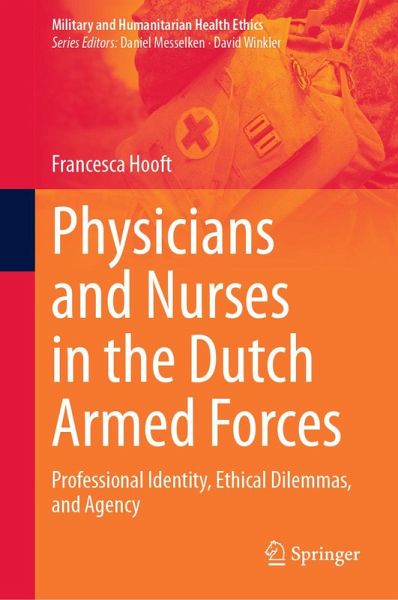
This book analyzes the challenges and ethical dilemmas military physicians and nurses experienced while deployed on military operations-and how they dealt with them. It traces the developments during the deployment of medical personnel within the Dutch armed forces between 1990 and 2010. Throughout this time, medical personnel were confronted with anything from a scarcity of supplies to military hierarchy, factors that potentially threatened their medical standards as well as their professional autonomy. They had to navigate between differing expectations, priorities, and moral codes of the medical and the military profession.
This book makes an original and indispensable contribution to academic debates on medical personnel in the armed forces and dual loyalty, ethical decision-making processes, moral competence, and the salience of (professional) identity in the role of perception, decision-making and coping, both during and after deployment. The target audience for this book is primarily academics working in the social sciences, humanities, medicine, and ethics. Military and medical practitioners, policymakers, NGOs, and educational institutions may use the book's findings for policy and educational purposes.
This book makes an original and indispensable contribution to academic debates on medical personnel in the armed forces and dual loyalty, ethical decision-making processes, moral competence, and the salience of (professional) identity in the role of perception, decision-making and coping, both during and after deployment. The target audience for this book is primarily academics working in the social sciences, humanities, medicine, and ethics. Military and medical practitioners, policymakers, NGOs, and educational institutions may use the book's findings for policy and educational purposes.
Dieser Download kann aus rechtlichen Gründen nur mit Rechnungsadresse in A, B, BG, CY, CZ, D, DK, EW, E, FIN, F, GR, HR, H, IRL, I, LT, L, LR, M, NL, PL, P, R, S, SLO, SK ausgeliefert werden.
Physicians and Nurses in the Dutch Armed Forces certainly is a fascinating and important book ... . One of the great accomplishments of Hooft s book is that she makes perfectly clear that it does matter in which organization a doctor or nurse wants to help. Cultures differ, obligations differ . Hooft makes it clear that doctors and nurses must ask themselves searchingly who they are and what they are, before engaging in medical care in times of war. (Leo van Bergen, Medicine, Con ict and Survival, April 2, 2025)