72,95 €
72,95 €
inkl. MwSt.
Sofort per Download lieferbar

36 °P sammeln
72,95 €
Als Download kaufen
72,95 €
inkl. MwSt.
Sofort per Download lieferbar
36 °P sammeln
Jetzt verschenken
Alle Infos zum eBook verschenken
72,95 €
inkl. MwSt.
Sofort per Download lieferbar
Alle Infos zum eBook verschenken
36 °P sammeln

Andere Kunden interessierten sich auch für
") Interplanetary Dust (eBook, PDF)112,95 €
Interplanetary Dust (eBook, PDF)112,95 €") The Sun, Solar Analogs and the Climate (eBook, PDF)72,95 €
The Sun, Solar Analogs and the Climate (eBook, PDF)72,95 €") Planetary Atmospheric Electricity (eBook, PDF)160,95 €
Planetary Atmospheric Electricity (eBook, PDF)160,95 €") Turning Dust to Gold (eBook, PDF)44,95 €
Turning Dust to Gold (eBook, PDF)44,95 €") Assessment and Mitigation of Asteroid Impact Hazards (eBook, PDF)112,95 €
Assessment and Mitigation of Asteroid Impact Hazards (eBook, PDF)112,95 €") The Heliosphere in the Local Interstellar Medium (eBook, PDF)112,95 €
The Heliosphere in the Local Interstellar Medium (eBook, PDF)112,95 €") Fine Structure of Solar Radio Bursts (eBook, PDF)112,95 €
Fine Structure of Solar Radio Bursts (eBook, PDF)112,95 €







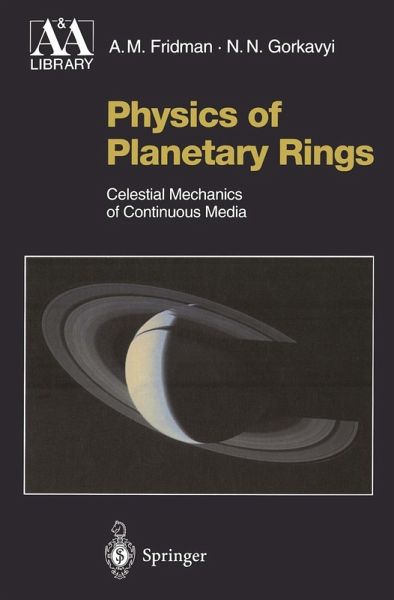
Physics of Planetary Rings describes striking structures of the planetary rings of Saturn, Uranus, Jupiter, and Neptune: Narrow ringlets, spiral waves, and a chain of clumps. The author has contributed essential ideas to the full understanding of planetary rings via the stability analysis of dynamical systems. The combination of a high-quality description, the set of interesting illustrations, as well as the fascinating and natural presentation will make this book of considerable interest to astronomers, physicists, and mathematicians as well as students. There is no competing text for this book so far.
Dieser Download kann aus rechtlichen Gründen nur mit Rechnungsadresse in A, B, BG, CY, CZ, D, DK, EW, E, FIN, F, GR, HR, H, IRL, I, LT, L, LR, M, NL, PL, P, R, S, SLO, SK ausgeliefert werden.