0,49 €
inkl. MwSt.
Sofort per Download lieferbar
0 °P sammeln

Andere Kunden interessierten sich auch für
") Pierre; or The Ambiguities (eBook, ePUB)1,99 €
Pierre; or The Ambiguities (eBook, ePUB)1,99 €") Pierre; or The Ambiguities (eBook, ePUB)0,49 €
Pierre; or The Ambiguities (eBook, ePUB)0,49 €") Pierre; or The Ambiguities (eBook, ePUB)1,82 €
Pierre; or The Ambiguities (eBook, ePUB)1,82 €") Pierre; or The Ambiguities (eBook, ePUB)0,99 €
Pierre; or The Ambiguities (eBook, ePUB)0,99 €") Pierre; or, The Ambiguities (eBook, ePUB)7,99 €
Pierre; or, The Ambiguities (eBook, ePUB)7,99 € (eBook, ePUB)") The Devil's Elixirs (Summarized Edition) (eBook, ePUB)0,49 €
The Devil's Elixirs (Summarized Edition) (eBook, ePUB)0,49 € (eBook, ePUB)") The Village (Summarized Edition) (eBook, ePUB)0,49 €
The Village (Summarized Edition) (eBook, ePUB)0,49 €




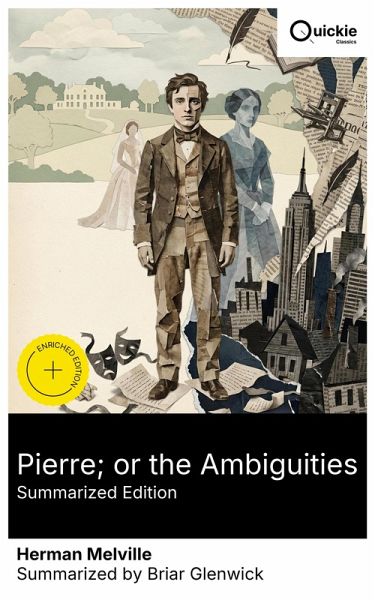
Pierre; or, The Ambiguities probes duty, desire, and authorship through Pierre Glendinning, a country heir who, after meeting the enigmatic Isabel, abandons Lucy and Saddle Meadows for New York, joins a precarious bohemian enclave, and descends into ruin. Melville fuses Gothic romance, sentimental domestic fiction, philosophical allegory, and caustic satire of publishing. Baroque, Shakespearean cadences, an intrusive narrator, and metanarrative chapters yield a self-reflexive experiment that, within the 1850s American romance, converses with Hawthorne and anticipates modernist uncertainty. Composed after the commercial failure of Moby-Dick, the novel reflects Melville's debts, his impatience with genteel didacticism, and his immersion in Shakespeare, Milton, and philosophy. Friendship with Hawthorne sharpened his sense of inherited sin and moral ambiguity; disillusion with the New York literary marketplace animated the ferocious portraits of editors and reviewers, while scandal over incestuous hints helped doom the book's early reception. Demanding yet electrifying, Pierre rewards readers ready to test the limits of the American novel. Essential for students of the American Renaissance and narrative theory, it offers audacity, psychological depth, and the rare exhilaration of a work that makes interpretation itself the drama. Quickie Classics summarizes timeless works with precision, preserving the author's voice and keeping the prose clear, fast, and readable-distilled, never diluted. Enriched Edition extras: Introduction · Synopsis · Historical Context · Author Biography · Brief Analysis · 4 Reflection Q&As · Editorial Footnotes.
Dieser Download kann aus rechtlichen Gründen nur mit Rechnungsadresse in A, B, BG, CY, CZ, D, DK, EW, E, FIN, F, GR, H, IRL, I, LT, L, LR, M, NL, PL, P, R, S, SLO, SK ausgeliefert werden.
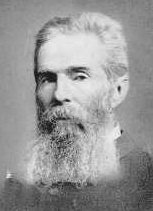
Herman Melville (1819-1891) was an American novelist, short story writer, and poet, best known for his novel ""Moby-Dick."" Here is a detailed overview of his life and literary career, with a focus on his work ""Omoo: A Narrative of Adventures in the South Seas."". Melville was born into a well-to-do family, but his father's financial troubles and death left the family in difficult circumstances. His formal education was sporadic, but he was an avid reader and self-educated in literature and writing. Melville's time at sea profoundly influenced his writing. He worked on several ships, including a whaler, which provided material for his sea narratives. Melville's first two books, ""Typee"" (1846) and ""Omoo"" (1847), were well-received, offering romanticized accounts of his adventures in the South Seas. A narrative of his experiences in the Marquesas Islands. A sequel to ""Typee,"" ""Omoo"" recounts his subsequent adventures in the South Seas, focusing on his time on Tahiti and the surrounding islands. Melville's work was largely forgotten by the time of his death but was rediscovered in the early 20th century. ""Moby-Dick"" and his other works gained recognition for their complexity and depth. Today, Melville is considered one of the greatest American writers, with his work studied for its themes of humanity, nature, and the metaphysical. Herman Melville's life and career were marked by early adventures and literary success, followed by a period of neglect and posthumous recognition. His contributions to American literature, particularly through works like ""Typee,"" ""Omoo,"" and ""Moby-Dick,"" have left a lasting impact.