121,95 €
inkl. MwSt.
Sofort per Download lieferbar
61 °P sammeln

Andere Kunden interessierten sich auch für
") The Exoplanets Revolution (eBook, PDF)63,95 €
The Exoplanets Revolution (eBook, PDF)63,95 €") The Impact of HST on European Astronomy (eBook, PDF)160,95 €
The Impact of HST on European Astronomy (eBook, PDF)160,95 €") New Concepts in Imaging: Optical and Statistical Models (eBook, PDF)0,00 €
New Concepts in Imaging: Optical and Statistical Models (eBook, PDF)0,00 €") Planetary Systems (eBook, PDF)120,95 €
Planetary Systems (eBook, PDF)120,95 €") Infrared Space Interferometry: Astrophysics & the Study of Earth-Like Planets (eBook, PDF)40,95 €
Infrared Space Interferometry: Astrophysics & the Study of Earth-Like Planets (eBook, PDF)40,95 €") The Twin Sister Planets Venus and Earth (eBook, PDF)72,95 €
The Twin Sister Planets Venus and Earth (eBook, PDF)72,95 €") Planets and Their Atmospheres (eBook, PDF)40,95 €
Planets and Their Atmospheres (eBook, PDF)40,95 €



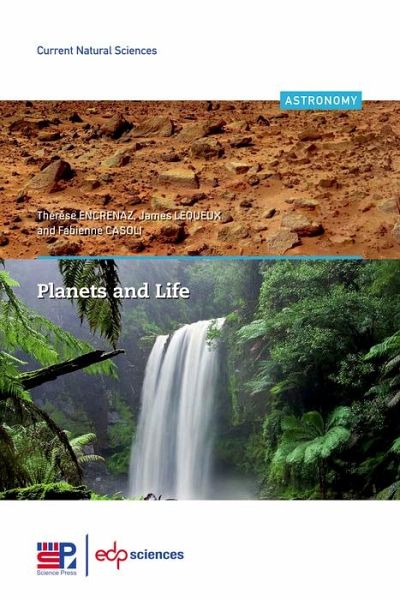
The Earth is the only planet in the Solar System where liquid water is present on the surface, a condition that seems necessary for the development of life. Its sisters Venus and Mars are extremely different. Why did these three planets, born under fairly comparable conditions, evolve to the conditions we observe today? Understanding the physical or chemical factors that are at the origin of such divergent evolutions is a first step in an approach to the problem of the origin of life on Earth.
Dieser Download kann aus rechtlichen Gründen nur mit Rechnungsadresse in A, B, BG, CY, CZ, D, DK, EW, E, FIN, F, GR, HR, H, IRL, I, LT, L, LR, M, NL, PL, P, R, S, SLO, SK ausgeliefert werden.