43,95 €
inkl. MwSt.
Sofort per Download lieferbar
22 °P sammeln

Andere Kunden interessierten sich auch für
") Planning Twentieth Century Capital Cities (eBook, PDF)45,95 €
Planning Twentieth Century Capital Cities (eBook, PDF)45,95 €") Capital Cities in the Aftermath of Empires (eBook, PDF)47,95 €
Capital Cities in the Aftermath of Empires (eBook, PDF)47,95 €") Capital Cities: Varieties and Patterns of Development and Relocation (eBook, PDF)45,95 €
Capital Cities: Varieties and Patterns of Development and Relocation (eBook, PDF)45,95 €") Japanese Machizukuri and Community Engagement (eBook, PDF)41,95 €
Japanese Machizukuri and Community Engagement (eBook, PDF)41,95 €") The Practice Turn in Architecture: Brussels after 1968 (eBook, PDF)49,95 €
The Practice Turn in Architecture: Brussels after 1968 (eBook, PDF)49,95 €") Capital Spaces (eBook, PDF)49,95 €
Capital Spaces (eBook, PDF)49,95 €") Social Capital at the Community Level (eBook, PDF)61,95 €
Social Capital at the Community Level (eBook, PDF)61,95 €






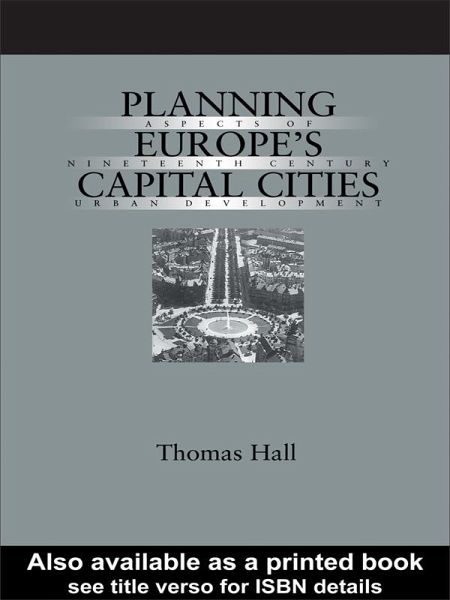
During the nineteenth century many of Europe's capital cities were subject to major expansion and improvement schemes. From Vienna's Ringstrasse to the boulevards of Paris, the townscapes which emerged still shape today's cities and are an inalienable part of European cultural heritage.
In Planning Europe's Capital Cities, Thomas Hall examines the planning process in fifteen of those cities and addresses the following questions: when and why did planning begin, and what problems was it meant to solve? who developed the projects, and how, and who made the decisions? what urban ideas are expressed in the projects? what were the legal consequences of the plans, and how did they actually affect subsequent urban development in the individual cities? what similarities or differences can be identified between the various schemes? how have such schemes affected the development of urban planning in general?
His detailed analysis shows us that the capital city projects of the nineteenth century were central to the evolution of modern planning and of far greater impact and importance than the urban theories and experiments of the Utopians.
In Planning Europe's Capital Cities, Thomas Hall examines the planning process in fifteen of those cities and addresses the following questions: when and why did planning begin, and what problems was it meant to solve? who developed the projects, and how, and who made the decisions? what urban ideas are expressed in the projects? what were the legal consequences of the plans, and how did they actually affect subsequent urban development in the individual cities? what similarities or differences can be identified between the various schemes? how have such schemes affected the development of urban planning in general?
His detailed analysis shows us that the capital city projects of the nineteenth century were central to the evolution of modern planning and of far greater impact and importance than the urban theories and experiments of the Utopians.
Dieser Download kann aus rechtlichen Gründen nur mit Rechnungsadresse in A, B, BG, CY, CZ, D, DK, EW, E, FIN, F, GR, HR, H, IRL, I, LT, L, LR, M, NL, PL, P, R, S, SLO, SK ausgeliefert werden.
'...a labour of love and a major contribution to the burgeoning international literature...it will fill an evident gap in the available scholarship.' - Peter Hall, University College, London
" ...a work of comparative history at its best. There are no false comparisons or wide-ranging generalisations. Instead there is a meticulous review... magnificiently produced, the quality of illustrations is outstandingly good and the author has been given space for text and notes which makes it extremely easy to use. Nothing but praise and thanks to the author for a work which will give so much pleasure and instruction."
'Planning Europe's Capital Cities will also, as mentioned by Peter Hall in the forword, 'throw light on great planners whose reputations have too long laid in their own lands and languages'. It will also inform visitors as to how many features, which now seem quintessential characteristics of the cultural heritage of many European cities, werecreated at the time.' - Claude Chaline, Town Planning Review
Hall's book is a useful resource for understanding the challenges faced by urban planners of large cities in the nineteenth century, and it is valuable as a starting point for scholars wishing to pursue further study of urban planning in nineteenth century Europe. - Erik C. Maiershofer, H-Urban
" ...a work of comparative history at its best. There are no false comparisons or wide-ranging generalisations. Instead there is a meticulous review... magnificiently produced, the quality of illustrations is outstandingly good and the author has been given space for text and notes which makes it extremely easy to use. Nothing but praise and thanks to the author for a work which will give so much pleasure and instruction."
'Planning Europe's Capital Cities will also, as mentioned by Peter Hall in the forword, 'throw light on great planners whose reputations have too long laid in their own lands and languages'. It will also inform visitors as to how many features, which now seem quintessential characteristics of the cultural heritage of many European cities, werecreated at the time.' - Claude Chaline, Town Planning Review
Hall's book is a useful resource for understanding the challenges faced by urban planners of large cities in the nineteenth century, and it is valuable as a starting point for scholars wishing to pursue further study of urban planning in nineteenth century Europe. - Erik C. Maiershofer, H-Urban