232,95 €
232,95 €
inkl. MwSt.
Sofort per Download lieferbar

116 °P sammeln
232,95 €
Als Download kaufen
232,95 €
inkl. MwSt.
Sofort per Download lieferbar
116 °P sammeln
Jetzt verschenken
Alle Infos zum eBook verschenken
232,95 €
inkl. MwSt.
Sofort per Download lieferbar
Alle Infos zum eBook verschenken
116 °P sammeln

Andere Kunden interessierten sich auch für
") Progress in Plant Nutrition: Plenary Lectures of the XIV International Plant Nutrition Colloquium (eBook, PDF)72,95 €
Progress in Plant Nutrition: Plenary Lectures of the XIV International Plant Nutrition Colloquium (eBook, PDF)72,95 €") Plant Nutrition for Sustainable Food Production and Environment (eBook, PDF)232,95 €
Plant Nutrition for Sustainable Food Production and Environment (eBook, PDF)232,95 €") Optimization of Plant Nutrition (eBook, PDF)392,95 €
Optimization of Plant Nutrition (eBook, PDF)392,95 €") Genetic Aspects of Plant Mineral Nutrition (eBook, PDF)40,95 €
Genetic Aspects of Plant Mineral Nutrition (eBook, PDF)40,95 €") Plant Nutrition - Physiology and Applications (eBook, PDF)72,95 €
Plant Nutrition - Physiology and Applications (eBook, PDF)72,95 €") Principles of Plant Nutrition (eBook, PDF)312,95 €
Principles of Plant Nutrition (eBook, PDF)312,95 €") Advances in Plant and Animal Boron Nutrition (eBook, PDF)112,95 €
Advances in Plant and Animal Boron Nutrition (eBook, PDF)112,95 €
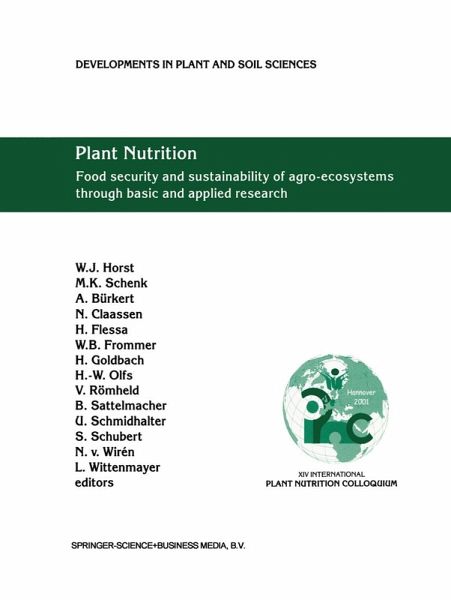
The world's population is expected to reach 8 billion by 2025 and most of this growth in population will occur in developing countries. To feed the world with such a marked increase in population, a great improvement in food production must be achieved particularly in these countries. To meet this challenge, present agricultural productivity must be increased on the cultivated land. However, in many developing countries, particularly in Africa, reduced soil fertility caused by continuous cropping with low nutrient input and the resultant nutrient mining of soils is a major threat both to food production and to ecosystem viability. As a result of declining soil fertility, together with increasing population pressure, expansion of crop production to marginal lands and forested areas contribute to the destruction of natural ecosystems. Food production is not only a quantitative challenge. Improving the nutrient status of plants provides a further valuable means of enhancing food quality and is of extreme benefit to the health of both plants and humans. There are several excellent examples showing that plants with optimum nutrient status are better adapted to biotic and abiotic stress factors. Because of population pressures, many global food systems are not currently providing enough micronutrients to ensure adequate micronutrient intakes in the human diet. This has resulted in an increasing prevalence of micronutrient deficiencies that now afflicts over three billion people worldwide.
Dieser Download kann aus rechtlichen Gründen nur mit Rechnungsadresse in A, B, BG, CY, CZ, D, DK, EW, E, FIN, F, GR, HR, H, IRL, I, LT, L, LR, M, NL, PL, P, R, S, SLO, SK ausgeliefert werden.
`In summary, the book is a valuable reference book on the present state-of-the-art in plant nutrition research and related fields. It is of interest to scientists working in the fields of plant nutrition, soil science and agricultural productivity.'
Journal of Plant Physiology, 159 (2002)
Journal of Plant Physiology, 159 (2002)
`In summary, the book is a valuable reference book on the present state-of-the-art in plant nutrition research and related fields. It is of interest to scientists working in the fields of plant nutrition, soil science and agricultural productivity.'
Journal of Plant Physiology, 159 (2002)
Journal of Plant Physiology, 159 (2002)