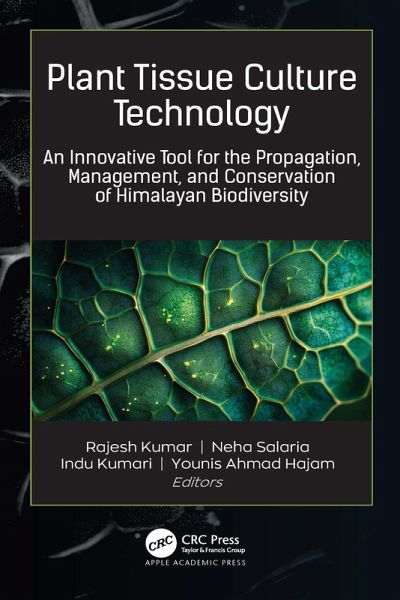
An Innovative Tool for the Propagation, Management, and Conservation of Himalayan Biodiversity Redaktion: Kumar, Rajesh; Hajam, Younis Ahmad; Kumari, Indu; Salaria, Neha
An Innovative Tool for the Propagation, Management, and Conservation of Himalayan Biodiversity Redaktion: Kumar, Rajesh; Hajam, Younis Ahmad; Kumari, Indu; Salaria, Neha
Sie sind bereits eingeloggt. Klicken Sie auf 2. tolino select Abo, um fortzufahren.
Bitte loggen Sie sich zunächst in Ihr Kundenkonto ein oder registrieren Sie sich bei bücher.de, um das eBook-Abo tolino select nutzen zu können.
As home to over 10,000 species of plants, the Himalaya biodiversity hotspot is renowned throughout the world as being a treasure trove of medicinal herbs. These Himalayan medicinal plants, however, are threatened by the rising demand for herbal medicines, as well as by overexploitation. This new volume discusses plant tissue culture or the preservation and conservation of Himalayan endangered plants that are important for medicinal purposes, as well as for maintaining the rich biodiversity of the region.
As home to over 10,000 species of plants, the Himalaya biodiversity hotspot is renowned throughout the world as being a treasure trove of medicinal herbs. These Himalayan medicinal plants, however, are threatened by the rising demand for herbal medicines, as well as by overexploitation. This new volume discusses plant tissue culture or the preservation and conservation of Himalayan endangered plants that are important for medicinal purposes, as well as for maintaining the rich biodiversity of the region.
Dieser Download kann aus rechtlichen Gründen nur mit Rechnungsadresse in A, B, BG, CY, CZ, D, DK, EW, E, FIN, F, GR, HR, H, IRL, I, LT, L, LR, M, NL, PL, P, R, S, SLO, SK ausgeliefert werden.
Die Herstellerinformationen sind derzeit nicht verfügbar.
Autorenporträt
Rajesh Kumar, PhD, is an Assistant Professor of Biosciences at Himachal Pradesh University, Shimla, India. With over 10 years of experience in teaching and research, he is also an expert lecturer at beekeeping training/extension activities. Dr. Kumar has completed two major research projects and two startup projects sponsored by government agencies and has published many research articles, book chapters, abstracts, and conference papers, as well as several books and monographs. He has attended seminars and conferences and delivered invited talks and extension lectures. He is a life member of the Indian Science Congress, National Bee Board, Applied Zoologists Research Association, and Society for Science & Environmental Excellence, as well as a fellow of Himalayan Science and Technology. Neha Salaria, PhD, is an Assistant Professor of Biotechnology in the Department of Life Sciences at Arni University, Himachal Pradesh, India. She has authored research papers and book chapters. A globetrotting scholar, Dr. Salaria has been an active participant in over 40 national and international conferences, seminars, and workshops. She has played a pivotal role in organizing national and international faculty development programs and webinars, contributing to the professional development of her peers. Indu Kumari, PhD, is an Assistant Professor of Zoology at Minerva College of Arts, Sciences and Commerce, Indora, India. She was formerly Assistant Professor in the Department of Life Sciences at Arni University, India. She has been involved in a major research project sanctioned by the Himachal Pradesh Council for Science, Technology & Environment. She has authored research and conference papers, book chapters, and one book. She has participated in and presented her research at national and international conferences, seminars, and workshops and has organized webinars and faculty development programs as well. Younis Ahmad Hajam, PhD, is an Assistant Professor of Life Sciences and Allied Health Sciences at Sant Baba Bhag Singh University, Punjab, India. He is currently handling several research projects. His current research focus is on therapeutic management for diabetes, polycystic ovarian cancer, melatonin physiology, and antioxidants and natural therapies for other metabolic and endocrine disorders. He is the author of many research articles and book chapters, and he has published several books with international publishers. Dr. Hajam has organized, presented, and participated in numerous state, national, and international conferences, seminars, workshops, and symposiums.
Inhaltsangabe
1. Tissue Culture Technology: An Overview. 2. Sustainability of Plant Communities in the Himalayas: Issues and Prospects. 3. In-Vitro Conservation Strategies for Threatened Himalayan Plants. 4. Tissue Culture Technology: An Emerging Viable Technology to Protect Biodiversity in the Face of Biodiversity Loss. 5. Conservation of Threatened Medicinal, Aromatic Plants and Value-Added Plant Species in the Indian Himalayan Region: Role of Tissue Culture. 6. Conservation of Himalayan Economic Plant Resources Using Tissue Culture Techniques With Special Reference to Indian Himalayas. 7. Future Directions in the Conservation of Himalayan Biodiversity Through Tissue Culture. 8. Molecular Methods for Genetic Diversity Evaluation in Tissue Cultured Plants. 9. Plant Tissue Culture Techniques for Medicinal Plants of the Himalayas. 10. Application of Tissue Culture in Conservation Biology: A Narrative Review. 11. Biotechnological Interventions and Propagation Strategies of Endangered Medicinal Plants of the Indian Himalaya: Conservation and Sustainable Utilization. 12. Molecular Techniques for Genetic Diversity Evaluation in Tissue Cultured Plants.
1. Tissue Culture Technology: An Overview. 2. Sustainability of Plant Communities in the Himalayas: Issues and Prospects. 3. In-Vitro Conservation Strategies for Threatened Himalayan Plants. 4. Tissue Culture Technology: An Emerging Viable Technology to Protect Biodiversity in the Face of Biodiversity Loss. 5. Conservation of Threatened Medicinal, Aromatic Plants and Value-Added Plant Species in the Indian Himalayan Region: Role of Tissue Culture. 6. Conservation of Himalayan Economic Plant Resources Using Tissue Culture Techniques With Special Reference to Indian Himalayas. 7. Future Directions in the Conservation of Himalayan Biodiversity Through Tissue Culture. 8. Molecular Methods for Genetic Diversity Evaluation in Tissue Cultured Plants. 9. Plant Tissue Culture Techniques for Medicinal Plants of the Himalayas. 10. Application of Tissue Culture in Conservation Biology: A Narrative Review. 11. Biotechnological Interventions and Propagation Strategies of Endangered Medicinal Plants of the Indian Himalaya: Conservation and Sustainable Utilization. 12. Molecular Techniques for Genetic Diversity Evaluation in Tissue Cultured Plants.
Es gelten unsere Allgemeinen Geschäftsbedingungen: www.buecher.de/agb
Impressum
www.buecher.de ist ein Internetauftritt der buecher.de internetstores GmbH
Geschäftsführung: Monica Sawhney | Roland Kölbl | Günter Hilger
Sitz der Gesellschaft: Batheyer Straße 115 - 117, 58099 Hagen
Postanschrift: Bürgermeister-Wegele-Str. 12, 86167 Augsburg
Amtsgericht Hagen HRB 13257
Steuernummer: 321/5800/1497
USt-IdNr: DE450055826