Sie sind bereits eingeloggt. Klicken Sie auf 2. tolino select Abo, um fortzufahren.
Bitte loggen Sie sich zunächst in Ihr Kundenkonto ein oder registrieren Sie sich bei bücher.de, um das eBook-Abo tolino select nutzen zu können.
Plastic Bottles: Processing, Recycling, Regulations and Alternatives explores the lifecycle of plastic bottles, from creation to disposal, offering a comprehensive and accessible look at bottle packaging. The book is divided into five parts as follows Part 1: The History of Plastic Bottles Traces the development and integration of plastic bottles into daily life. | Covers materials used, labeling, and manufacturing processes in the industry. Part 2: Environmental Impact Examines the limitations of plastic bottles and their environmental consequences. | Discusses challenges in recycling…mehr
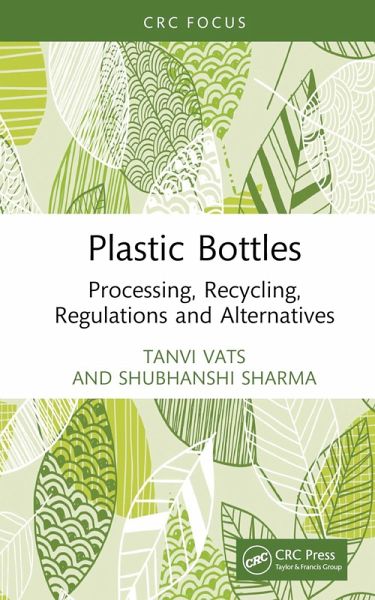
Plastic Bottles: Processing, Recycling, Regulations and Alternatives explores the lifecycle of plastic bottles, from creation to disposal, offering a comprehensive and accessible look at bottle packaging. The book is divided into five parts as follows
Part 1: The History of Plastic Bottles
Traces the development and integration of plastic bottles into daily life.
Covers materials used, labeling, and manufacturing processes in the industry.
Part 2: Environmental Impact
Examines the limitations of plastic bottles and their environmental consequences.
Discusses challenges in recycling and showcases case studies.
Highlights advanced recycling technologies and techniques.
Part 3: Biopolymers as an Alternative
Introduces biopolymers as sustainable alternatives to traditional plastic.
Explores types of biopolymers suitable for bottle production.
Discusses potential benefits and challenges of biopolymer adoption.
Part 4: Regulations and Policies
Focuses on global regulatory frameworks for plastic and biopolymer use.
Covers Extended Producer Responsibility (EPR) and its role in waste management.
Part 5: Future of Bottle Packaging
Looks ahead at developments in sustainable packaging solutions.
Discusses innovations in recycling and emerging research trends.
Target Audience
¿ Accessible to students, academics, and industry professionals from both scientific and non-scientific backgrounds.
¿ Concise and easy-to-read, making it suitable for a wide ranging audience.
This book provides a thorough yet compact overview of the plastic and biopolymer bottle packaging industry, offering valuable insights for both academia and industry.
Dieser Download kann aus rechtlichen Gründen nur mit Rechnungsadresse in A, B, BG, CY, CZ, D, DK, EW, E, FIN, F, GR, HR, H, IRL, I, LT, L, LR, M, NL, PL, P, R, S, SLO, SK ausgeliefert werden.
Die Herstellerinformationen sind derzeit nicht verfügbar.
Autorenporträt
Dr. Tanvi Vats completed her PhD in chemistry jointly from GGS Indraprastha University and National Physical University, New Delhi. She currently serves Gautam Buddha University, Greater Noida as a faculty member where she teaches BTech, BSc and MSc students. Her research interests include nanomaterials and science-related aspects of Intellectual Property Rights. She has attended various national and international conferences and has several research papers, book chapters, encyclopedia articles, and popular science articles to her credit. She has co-authored two books, Microwave assisted Polymerization (published with RSC, Cambridge, UK) and Comprehensive Chemistry: Theory And Practice (published with Viva Books Private Limited, New Delhi). She is a life-time member of the Association of Environmental Analytical Chemistry of India (AEACI), Analytical Chemistry Division Bhabha Atomic Research Centre, Trombay, Mumbai, and the "Academy of Microscope Science & Technology", DMSRDE, Kanpur, India.
Shubhanshi Sharma is an aspiring researcher in the field of polymer packaging. She has completed her MSc in Applied Chemistry from Gautam Buddha University, Greater Noida, India. It was during her Master's thesis on Bioengineering and biopolymers used for tissue engineering and regenerative medicine that she developed an interest in polymer packaging and also an aptitude in the area of science communication. She has a popular science article entitled "Packaging Food: Looking for Durable & Efficient Options" published in Science Reporter. During her leisure hours she finds great enjoyment in delving into books and documentaries that explore the rich tapestry of Indian history. Additionally, she finds solace in mountains and frequently go trekking with friends and family.
Inhaltsangabe
Part 1: Plastic Bottles: A necessary Evil? Chapter 1.1Introduction- The Omnipresent Plastic Bottle Chapter 1.2 Composition: Materials used Chapter 1.3 Labels/ identification codes for different types of plastics Chapter 1.4 Manufacturing Processes Part 2: Plastic Bottles and the Planet Chapter 2.1 Limitation of plastic bottles in packaging Chapter 2.2 Environmental impact of plastic bottles production and disposal Chapter 2.3 Recycling challenges Chapter 2.4 Advancements in recycling challenges Chapter 2.5 Recycling through various case studies Part 3: Biopolymers: An Emerging Alternative Chapter 3.1 Potential application of biopolymers in packaging of bottles Chapter 3.2 Types of biopolymers in bottle packaging Chapter 3.3 Advantages of biopolymers applications in bottle packaging Chapter 3.4 Limitations of biopolymer usage Part 4: Regulatory Framework and Policies Chapter 4.1 Global regulations on plastic bottle production and disposal Chapter 4.2 Efficacy of implementing Extended Producer Responsibility (EPR) Chapter 4.3 Legislations regarding biopolymers as bottle packaging Part 5: Future Scope and Possibilities Chapter 5.1 Sustainable alternatives Chapter 5.2 Issues to be addressed in advanced R&D in plastic bottle recycling technologies
Es gelten unsere Allgemeinen Geschäftsbedingungen: www.buecher.de/agb
Impressum
www.buecher.de ist ein Internetauftritt der buecher.de internetstores GmbH
Geschäftsführung: Monica Sawhney | Roland Kölbl | Günter Hilger
Sitz der Gesellschaft: Batheyer Straße 115 - 117, 58099 Hagen
Postanschrift: Bürgermeister-Wegele-Str. 12, 86167 Augsburg
Amtsgericht Hagen HRB 13257
Steuernummer: 321/5800/1497
USt-IdNr: DE450055826