88,95 €
88,95 €
inkl. MwSt.
Sofort per Download lieferbar

44 °P sammeln
88,95 €
Als Download kaufen
88,95 €
inkl. MwSt.
Sofort per Download lieferbar
44 °P sammeln
Jetzt verschenken
Alle Infos zum eBook verschenken
88,95 €
inkl. MwSt.
Sofort per Download lieferbar
Alle Infos zum eBook verschenken
44 °P sammeln

Andere Kunden interessierten sich auch für
") The Evolutionary Limits of Liberalism (eBook, PDF)56,95 €
The Evolutionary Limits of Liberalism (eBook, PDF)56,95 €") Economic Insights on Higher Education Policy in Ireland (eBook, PDF)88,95 €
Economic Insights on Higher Education Policy in Ireland (eBook, PDF)88,95 €") Shaping the Future of Business Education (eBook, PDF)72,95 €
Shaping the Future of Business Education (eBook, PDF)72,95 €") The Economic Impact of Government Policy on China's Private Higher Education Sector (eBook, PDF)88,95 €
The Economic Impact of Government Policy on China's Private Higher Education Sector (eBook, PDF)88,95 €") Regional Upgrading in Southern Europe (eBook, PDF)104,95 €
Regional Upgrading in Southern Europe (eBook, PDF)104,95 €") The University in the Age of Globalization (eBook, PDF)40,95 €
The University in the Age of Globalization (eBook, PDF)40,95 €") New Perspectives on Internationalization and Competitiveness (eBook, PDF)72,95 €
New Perspectives on Internationalization and Competitiveness (eBook, PDF)72,95 €




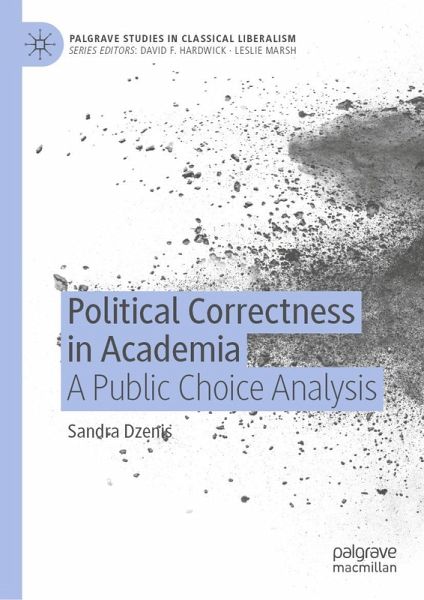
This book explores the phenomenon of political correctness in academia and explains why and how scholars and administrators impact PC's prominence in the academic sphere. To do so, it examines the actions of these agents through the lens of public choice theory, revealing how self-interested strategies drive the policies and norms of the university.
The book examines the ideological dimensions of political correctness and highlights four key spheres of influence - academic research, higher education curricula, affirmative action and speech codes. The book offers a nuanced exploration of how PC and liberalism have common ground. It demonstrates how the liberal values of equality and individual liberty largely underpin PC, whose regulatory function is to protect a liberal value system from illiberal truth claims. Yet the book also shows how interest groups form around the concept of PC in universities and have successfully used systems of rent-seeking and collective action to shape institutional policy and protect their members from ideological and professional competition, which can be seen as a violation of classical liberal principles of fair competition and equal opportunity. This book is a valuable tool for researchers working in political economy and PPE (politics, philosophy and economics), as well as those interested in the political economy of academia and the concept of PC more generally.
The book examines the ideological dimensions of political correctness and highlights four key spheres of influence - academic research, higher education curricula, affirmative action and speech codes. The book offers a nuanced exploration of how PC and liberalism have common ground. It demonstrates how the liberal values of equality and individual liberty largely underpin PC, whose regulatory function is to protect a liberal value system from illiberal truth claims. Yet the book also shows how interest groups form around the concept of PC in universities and have successfully used systems of rent-seeking and collective action to shape institutional policy and protect their members from ideological and professional competition, which can be seen as a violation of classical liberal principles of fair competition and equal opportunity. This book is a valuable tool for researchers working in political economy and PPE (politics, philosophy and economics), as well as those interested in the political economy of academia and the concept of PC more generally.
Dieser Download kann aus rechtlichen Gründen nur mit Rechnungsadresse in A, B, BG, CY, CZ, D, DK, EW, E, FIN, F, GR, HR, H, IRL, I, LT, L, LR, M, NL, PL, P, R, S, SLO, SK ausgeliefert werden.